
Quiet BPD is an informal name for borderline personality disorder (BPD) when the intense emotions, fear of abandonment, and instability are turned inward instead of shown outwardly. Some clinicians call it internalizing BPD. People with quiet borderline personality disorder often seem calm, capable, and easygoing while privately struggling with shame, emptiness, and self-blame. Because the pain is hidden, it is often missed or mistaken for depression or anxiety. It is treatable, and the therapies that help BPD in general can help here too.
If you have ever felt like you were falling apart on the inside while everyone around you assumed you were fine, you are not imagining it. Many people with BPD never have the outbursts or visible crises that most descriptions focus on. For them, the storm happens quietly. The anger is aimed at themselves. The fear of being left is hidden behind people-pleasing. The hurt gets swallowed so no one else has to see it.
This pattern is often called quiet BPD. It is not a separate diagnosis in the DSM-5, the manual clinicians use to diagnose mental health conditions. It describes how BPD can look in someone who has learned to keep their distress out of sight. That is exactly why it gets missed, sometimes for years, and why people who live with it can feel invisible even to the professionals they have asked for help.
This page explains what quiet BPD is, how it differs from the more familiar picture of BPD, and what you can do if this description sounds like you.
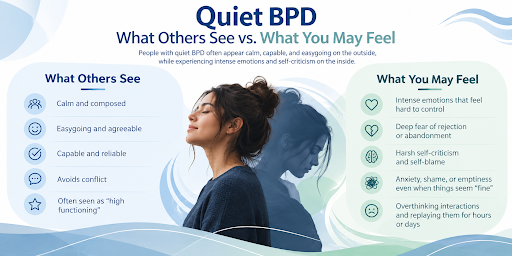
Quiet BPD and classic BPD share the same core: emotions that hit harder and take longer to settle, a deep fear of abandonment, and an unsteady sense of who you are. The difference is direction. In the presentation most people picture, distress is externalized, so it shows up in conflict, visible anger, or impulsive actions others can see. In quiet BPD, the same distress is internalized and turned back on the self.
Experience | Classic (Outward) Presentation | Quiet (Inward) Presentation |
Anger | Expressed at others, sometimes in sudden outbursts | Directed at yourself as harsh self-criticism or self-hatred |
Fear of abandonment | Pleading, protesting, or confronting someone who seems to pull away | Quietly over-accommodating, or withdrawing first so you can’t be left |
Conflict | Arguments that escalate quickly | Avoiding conflict entirely, then replaying it for hours or days |
Emotional swings | Visible to friends, family, and coworkers | Hidden behind a calm or cheerful surface |
How others see you | “Intense” or “dramatic” | “Easygoing,” “sensitive,” or “the reliable one” |
Neither version is milder. Quiet BPD can be just as painful, and the effort of hiding it adds its own exhaustion. Many people also move between the two patterns depending on stress, setting, or who they are with.
Quiet BPD symptoms tend to happen out of view, which can make them hard to name even for the person living with them. Not everyone has every sign, and this list is a guide rather than a diagnosis. Common patterns include:
If you are having thoughts of harming yourself, you deserve support right now. Call or text 988 to reach the Suicide & Crisis Lifeline, or call 911 in an emergency.
High functioning BPD is another informal term that often overlaps with quiet BPD. It describes people who keep up with work, school, and family while privately struggling with BPD symptoms. From the outside, they may look successful and steady. Inside, keeping everything together can take enormous effort, and the cost often shows up later as exhaustion, emptiness, or sudden burnout. Functioning well on paper does not mean you are not suffering, and it does not mean you don’t deserve care.
If you have spent years in and out of therapy without anyone naming what you were feeling, that is not a failure on your part. Quiet BPD is easy to miss for several reasons.
It doesn’t match the stereotype. Most people, including some professionals, picture BPD as loud, angry, and chaotic. Someone who is soft-spoken, cooperative, and eager to please doesn’t fit that image, so the possibility may never come up.
The symptoms look like other conditions. Persistent sadness, emptiness, and self-criticism can look like depression. Constant worry about relationships and fear of rejection can look like social anxiety. Our clinicians also commonly see BPD alongside anxiety, depression, or trauma-related symptoms, and those conditions can take center stage while the underlying pattern stays hidden.
Masking carries into the therapy room. The same habit of appearing fine can make someone seem calm and insightful in sessions. You may minimize how bad things get because you don’t want to be a burden or be seen as too much.
Shame keeps the hardest parts private. Self-harm, intense fear of abandonment, and moments of feeling unreal are difficult to say out loud. Many people with quiet BPD have never told anyone the full story.
None of this means the struggle isn’t real. It means the right questions haven’t been asked yet.
Seeing yourself in a description like this can bring relief, grief, or both. You don’t need to be certain before you take a next step. Here is where to start.
You don’t need a formal diagnosis to reach out. Many people start with a single conversation about what they have been carrying.
Quiet BPD is not a separate diagnosis in the DSM-5. A person with quiet BPD is diagnosed with borderline personality disorder. The term describes an internalized way that BPD can show up, which helps people and clinicians recognize a pattern that is easy to overlook.
Only a qualified mental health professional can diagnose BPD. If you often hide intense emotions, turn anger on yourself, fear being left, and feel empty or unsure of who you are, it is worth asking for an assessment. A screening test can be a helpful first step.
They overlap but aren’t identical. Quiet BPD describes where the distress goes (inward). High functioning BPD describes keeping up with daily responsibilities despite symptoms. Many people fit both descriptions.
Yes. The same evidence-based therapies used for BPD, especially DBT, help people with quiet BPD manage emotions, ease self-criticism, and build steadier relationships. Many people improve significantly with consistent treatment.
You have likely spent a long time making sure no one could see how hard things are. You don’t have to keep doing that alone. At Waterside Behavioral Health, our clinicians work with adults experiencing BPD, including the quieter patterns that are so often missed.
Treatment starts with an assessment so we can understand what you are experiencing and match you with the right level of support. Care is DBT-informed and combines individual therapy with group skills work, offered through our intensive outpatient and partial hospitalization programs. We can also treat anxiety, depression, and trauma-related symptoms that often come alongside BPD.
Learn more about our BPD treatment in Massachusetts, verify your insurance, or call us at (774) 619-7750 for a confidential conversation.