
A BPD test is a set of questions about emotions, relationships, and sense of self. It can’t tell you whether you have borderline personality disorder, but it can help you see whether the patterns in your life are worth talking about with a professional.
If you’re asking “do I have BPD?” or “am I borderline?”, you may be carrying a lot right now. Maybe your emotions hit harder and faster than other people’s seem to. Maybe relationships feel intense and fragile at the same time. Wanting to understand that is not a sign that something is wrong with you. It’s a sign you’re paying attention.
It can help you name patterns. It can’t diagnose you.
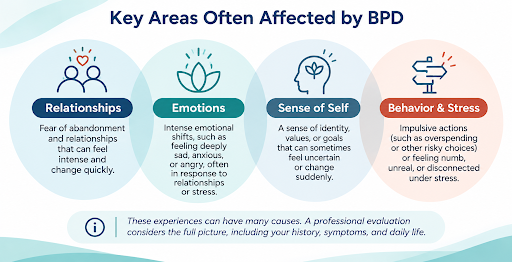
Borderline personality disorder (BPD) is a mental health condition that affects how people manage emotions, relationships, and their sense of who they are. Self-assessments like this one are based on the symptoms clinicians look for, but they can’t weigh how long those patterns have lasted, how much they affect your life, or whether another condition explains them better.
Many of these experiences overlap with depression, anxiety, trauma, and other conditions. A checklist is a way to start a conversation, not to end one.
Please note: This 14-question checklist is an educational self-reflection tool, not a validated BPD screening instrument. It cannot diagnose or rule out BPD or replace an evaluation by a qualified mental health professional.
Think about patterns that have appeared repeatedly over time, rather than during one difficult period. Choose Yes or No for each statement. The interactive checklist will summarize your responses without assigning a diagnostic score.
Consider patterns that have appeared repeatedly over time, rather than during one difficult period.
This 14-question checklist is educational, not a validated screening test. It cannot diagnose or rule out borderline personality disorder.
Please answer each question in this section before continuing.
These are counts of statements you selected, not a diagnostic score or estimate of whether you have BPD.
A clinician can help assess how long these experiences have lasted, how they affect daily life, and whether other conditions may contribute. A low count does not rule out a concern, and a high count does not establish BPD.
You do not need a diagnosis to ask for help.
Explore BPD Treatment Call (774) 619-7750If you’re thinking about harming yourself or ending your life, please reach out now. Call or text 988 to reach the 988 Suicide & Crisis Lifeline, or call 911 if you’re in immediate danger.
No number of Yes answers on this custom checklist can determine whether you have BPD. Your responses can help you identify patterns to discuss with a clinician. Consider how long they have been present, whether they affect different parts of your life, and how much distress they cause.
The bottom line: These answers are a starting point for a conversation, not a verdict. BPD is treatable, and a qualified clinician can help you understand what you are experiencing and which supports may help.
Through a careful conversation with a licensed mental health professional, such as a psychiatrist, psychologist, or clinical social worker. There’s no blood test or brain scan for BPD.
An evaluation usually involves:
BPD is usually diagnosed in late adolescence or early adulthood (1). Some people spend years being treated only for anxiety or depression before anyone puts the full picture together, so it’s okay if this is the first time you’re considering it.
BPD shares features with several other conditions, which is one reason a self-test can only go so far.
For a closer look at how the two differ, see BPD vs bipolar disorder. Our overview of the signs of BPD covers these patterns in more depth.
You don’t need a diagnosis to ask for help.
If you’re reading this for someone you love, these same steps apply. Understanding the condition is often the first thing that helps a family.
No single test can. BPD is diagnosed through a clinical evaluation with a licensed mental health professional, who looks at long-term patterns rather than a single score.
Not necessarily. Mood swings can come from many sources, including stress, depression, bipolar disorder, and trauma. BPD involves a broader, long-lasting pattern that includes relationships and sense of self, not mood alone.
Yes. Many people with BPD improve significantly with treatment, building steadier relationships, fewer crisis moments, and a stronger sense of who they are.
At Waterside Behavioral Health, our clinicians treat BPD with DBT-informed care that combines individual therapy and group skills work. Treatment can also address co-occurring anxiety, depression, and trauma-related symptoms, at a level of care that matches what you need.
You can start with one conversation. Call (774) 619-7750 to talk with our admissions team, or learn more about BPD treatment in Massachusetts.
Sources