
There’s a specific kind of pain that doesn’t scream.
It whispers.
It shows up in the quiet moments — brushing your teeth, driving home, sitting in a meeting — when your mind suddenly offers a thought you didn’t ask for:
“I don’t want to die… I just don’t know how to keep living like this.”
If you’ve been carrying those thoughts, you’re not alone. And you’re not broken. You’re exhausted. You’re overwhelmed. You’re scared. You’re trying. And you’ve likely been trying for far longer than anyone around you realizes.
Our Partial Hospitalization Program in Plymouth County, MA was built for people in this exact emotional place — not actively trying to die, but feeling worn so thin that the thought of continuing feels impossible.
Today, we’re going to move slowly. No pressure.
Just a hand reaching toward you, steady and calm.
When Staying Alive Feels Like a Full-Time Job
When people imagine suicidal ideation, they picture intensity: dramatic cries for help, clear danger, obvious red flags.
But many people experience something different:
A quiet, numb, persistent ache.
You might not want to die.
But living feels like dragging your body through wet cement.
You show up.
You function.
You reply when you have to.
You pretend when you must.
To outsiders, everything might look “fine.”
Inside, you’re worn down to the thinnest thread.
A Partial Hospitalization Program (PHP) is one of the few levels of care that acknowledges this quiet suffering and actually knows how to support it — without pushing you into a hospitalization you may not need.
You deserve care that fits the shape of what you’re feeling.
The Middle Space That No One Talks About
There is a space between, “I’m safe,” and “I’m in crisis.”
Most people never talk about it.
It’s the space where you may be thinking:
- “I’m not trying to hurt myself, but I don’t know how long I can keep feeling like this.”
- “Nobody knows how bad it is because I don’t know how to explain it.”
- “I keep going through the motions, but I feel like a ghost in my own life.”
- “I’m afraid if I tell someone the truth, I’ll be forced into inpatient treatment.”
This is the emotional limbo where a PHP becomes essential.
It’s the level of care designed exactly for this gray zone — when you need more than therapy once a week, but you don’t need to be in a hospital bed to stay safe.
What a Partial Hospitalization Program Really Is
Let’s clear up the fear right away:
A PHP is not inpatient treatment.
You are not locked in.
You keep your phone.
You sleep in your own bed.
You choose to be here.
You remain in control.
A PHP is daytime support — several hours a day, several days a week — with a skilled team that helps stabilize what feels unbearable.
At Waterside Behavioral Health, a PHP is:
- A place to rest your nervous system
- A place to tell the truth without being rushed
- A place to experience support that doesn’t scare you
- A place where you don’t have to pretend you’re okay
You come during the day.
You go home at night.
And slowly, you start to feel like you can breathe again.
If you’re in or near the area, we serve the wider region through our Plymouth County location and support nearby communities, including those in Bristol County.
You Don’t Have to Want to Live Yet
You just have to want relief.
This is important.
People often think they need to walk into treatment with hope.
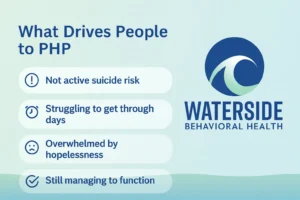
But hopeful people don’t end up in PHP.
Exhausted people do.
People hanging on by inches do.
You don’t have to walk in saying, “I want to get better.”
You can walk in saying, “I can’t keep doing this alone.”
That is enough.
A PHP is built for tiny beginnings.
Your Feelings Make Sense — Even If They Scare You
When suicidal thoughts show up without intent, it’s often because your mind is trying to find an escape hatch.
It’s not about wanting death.
It’s about wanting out — out of pain, out of pressure, out of overwhelm, out of feeling like every day is heavier than the last.
You’re not dramatic.
You’re not overreacting.
You’re not beyond help.
You’re a human being who has run out of ways to cope — and that is something we can support.
What Healing Looks Like Inside a PHP (Slow, Gentle, Real)
Healing at this level of care is not about big inspirational breakthroughs.
It’s about feeling safe again in your own body.
Here is what the day-to-day tends to look like:
1. Soft check-ins
Not interrogation.
Not pressure.
Just “How are you arriving today?”
You can say “I don’t know,” and that’s a real answer.
2. A structured day that gives your mind a break
When your brain is spiraling, structure feels like relief.
Routines soothe the body.
Consistency quiets the panic.
3. Group sessions that don’t force you to speak
You can talk when you’re ready.
You can listen when you’re not.
Both are healing.
4. One-on-one time with clinicians who understand hopelessness
Not in a clinical-detached way.
In a human way.
5. Skills that help you get through the next hour, not the next decade
Simple grounding.
Small rituals.
Short-term relief techniques.
The basics that keep you here long enough to find steadiness.
6. Time built in to rest
You’re not expected to be “on” all day.
Sometimes the bravest thing a person can do is sit still and stay.
You Don’t Have to “Deserve” Help
You just have to need it.
People in your emotional space often feel guilty for struggling.
You might think:
- “Other people have it worse.”
- “I should be stronger.”
- “I’ve made it this far — why am I falling apart now?”
Pain doesn’t need to reach a certain threshold to be valid.
You don’t need to wait until you’re unsafe to seek support.
You don’t need to be on the edge of a cliff to ask for someone’s hand.
If you’re reading this, it’s because you’re hurting — and that alone is enough.
What If You Don’t Know What You Need?
Perfect.
That is the best place to begin.
You don’t need a plan.
You don’t need clarity.
You don’t even need hope.
You just need one small willingness:
the willingness to not give up today.
A PHP gives you a place to land while you figure out the rest.
Frequently Asked Questions About Partial Hospitalization Programs (PHP) for Suicidal Ideation
Is a PHP safe for someone having suicidal thoughts?
Yes. PHP is designed specifically for people who are deeply struggling emotionally but do not require overnight monitoring.
It provides daily, structured support to help you stabilize.
Will I lose my freedom if I enter a PHP?
No. A PHP is voluntary and outpatient.
You come during the day and return home at night.
You maintain control over your decisions throughout your care.
What if I don’t want to talk about my suicidal thoughts?
You don’t have to share anything before you’re ready.
Sometimes your body needs to feel safe before your voice does.
Will I be pushed to take medication?
No. Medication discussions are collaborative.
You are never forced or pressured.
You set the pace.
How long does a PHP usually last?
Most people attend between 2–4 weeks.
Some attend longer.
Your path will be based on your needs, not a formula.
What if I’m still unsure whether I need this level of care?
Uncertainty is normal.
We can help you explore whether PHP fits your emotional state.
You don’t have to decide alone.
Is PHP covered by insurance?
Most insurance plans do cover PHP services.
Our team can confirm your coverage before you begin.
If You’re Still Reading, Something in You Wants to Stay
You might not feel hope.
But you’re still here.
You’re still searching.
You’re still reaching for something — even if it’s faint.
Sometimes surviving is quiet.
Sometimes it’s just staying one more hour.
Sometimes it’s choosing not to disappear today.
Let us help you figure out the rest.
Call 774-619-7750 to learn more about our Partial Hospitalization Program services in Plymouth County, MA.
You don’t have to know how to keep living.
You just have to let someone walk with you while you remember how.