
When you’re newly diagnosed with a mental health condition, the fear is often louder than the symptoms.
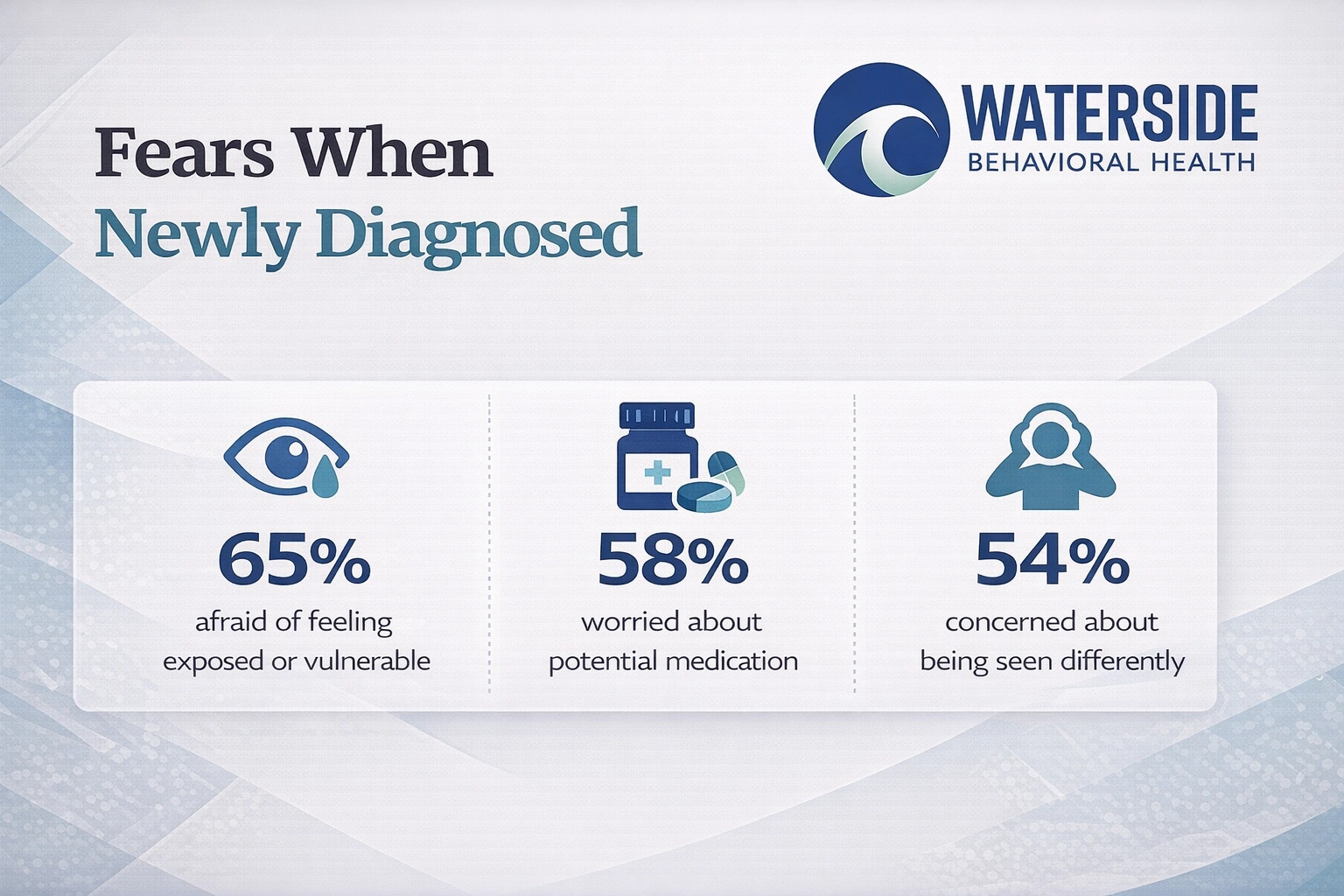
You might feel exposed, vulnerable, or even ashamed—like your entire identity just got boiled down to a word on a piece of paper. Maybe your heart pounded the first time someone said “treatment” out loud. Or maybe you nodded while your provider explained options, but inside you were screaming, “What does this mean for me?”
At Waterside Behavioral Health, we meet people every day who are navigating this exact emotional storm. And we want you to know something upfront: honesty has a place here. You don’t have to hide your fear, fake bravery, or pretend you’re ready. Good mental health treatment makes space for your truth—including the messy parts.
This isn’t about putting on a strong face. It’s about letting someone see your real one—and still being met with respect, compassion, and care.
Explore mental health treatment services in Massachusetts.
“I Was Afraid My Diagnosis Would Swallow Me”
Maya had always been the “together one.” The friend who checked in on others, the coworker who hit every deadline, the sibling who never made waves. So when her anxiety became too loud to hide, she panicked.
She feared a diagnosis would change how people saw her. Or worse—how she saw herself.
“Once they gave it a name, I thought I’d lose the parts of me that were still working.”
But over time, she realized something surprising: the diagnosis didn’t shrink her. It gave her language. It helped her stop blaming herself. And more than that, it pointed her toward mental health treatment that actually helped.
When you name something, you don’t give it more power—you take some of it back.
“I Didn’t Want Medication to Change Who I Am”
This is one of the biggest fears we hear, and it deserves more than reassurance—it deserves respect.
The decision to try psychiatric medication is personal. And if your brain is the place where you live, of course you’d worry about altering it.
We’ve sat with artists afraid to lose their spark. Parents scared of feeling numb around their kids. Teenagers terrified of being “zombied out.” And we don’t dismiss those fears—we sit with them. We explain. We explore. We adjust.
Mental health treatment isn’t about prescribing and hoping for the best. It’s about finding what works with you, not against you. And you’re allowed to ask every question before you say yes to anything.
“I Didn’t Think I Was ‘Sick Enough’ to Need Help”
Let’s get this straight: you don’t have to be in crisis to deserve care.
This belief—that only people with the most severe symptoms are allowed to seek help—keeps too many people suffering in silence.
You might be high-functioning but miserable. You might be smiling through panic. You might be “keeping it together” on the outside while unraveling inside.
You’re not weak for reaching out. You’re wise.
And in Plymouth County, Massachusetts, we see people every day who waited too long because they didn’t think they qualified. You do. Your pain is real—even if it doesn’t look dramatic. And you’re allowed to seek support before it becomes unbearable.
“What If I Start Talking and Can’t Stop?”
There’s a fear that once the dam breaks, the flood will drown everything.
Many people avoid therapy because they’re afraid they’ll be too much. Too angry. Too emotional. Too messy.
But good clinicians are not afraid of your flood. They’re trained for it. More importantly—they welcome it.
Mental health treatment isn’t about silencing emotions. It’s about holding them in ways that make them less terrifying.
You can cry through your first three sessions. You can talk in circles. You can say, “I don’t even know where to start.” And we’ll still be right there, with tissues, presence, and zero judgment.
“I Thought I Had to Trust My Therapist Right Away”
Trust is not a prerequisite—it’s a process.
You don’t have to open up on day one. You don’t even have to like your therapist immediately. What matters is that there’s space for trust to grow.
We’ve seen people start therapy with arms crossed and eyes down, speaking in monosyllables. And we’ve seen those same people, weeks later, cracking jokes, asking questions, showing up early.
The turning point? It wasn’t pressure. It was patience.
In Bristol County, Massachusetts, and surrounding communities, we serve people who are cautious with their trust—because they’ve been hurt, dismissed, or misunderstood. That caution is welcome here.
“What If They Think I’m Just Seeking Attention?”
This one breaks our hearts. Because it’s rooted in shame.
So many people—especially those assigned female at birth, or raised in emotionally suppressive environments—have been told they’re exaggerating, dramatic, manipulative.
So let us say this clearly: speaking your pain is not attention-seeking. It’s survival.
Mental health treatment is one of the only places where you’re supposed to center your experience. Where you’re invited to say, “This hurts,” and actually be heard.
You deserve that space. You always have.
“I’m Still Not Sure I Want Help. Is That Okay?”
Yes.
Ambivalence is allowed. Resistance is allowed. You don’t have to be “all in” to start.
Some people begin therapy unsure if they’ll come back. Others attend an assessment just to prove to themselves they don’t need treatment—and end up discovering they do.
What matters is that you showed up. Even if it’s just to look around. Even if you don’t say much. Even if you leave and come back weeks later.
Mental health treatment is not a one-time decision. It’s a relationship. And like all relationships, it needs space to unfold.
FAQs About Mental Health Treatment
Is it normal to be afraid of starting treatment?
Absolutely. Fear is often a sign that this matters to you. You’re not doing it wrong—you’re just stepping into something unknown, and that’s always scary.
What if I don’t click with my therapist?
It happens. And it’s okay. A good facility will help you find someone who’s a better fit. You deserve a provider who feels safe, not just available.
Do I have to take medication?
No. Medication is one tool—not the only one. You’ll work with your clinician to decide what feels right for you. There’s no forced path.
Can I do therapy virtually?
Yes. Many of our services include secure telehealth options. This can be especially helpful if you’re managing anxiety, mobility issues, or a busy schedule.
What if I get worse before I get better?
This can happen. Sometimes opening up emotions can stir things up. But with the right support, those moments become part of the healing—not signs of failure.
Is mental health treatment confidential?
Yes. What you share stays private (with a few safety exceptions). Your story is yours, and we treat it with the care it deserves.
You’re Allowed to Be Scared—and Still Begin
You might still have doubts. That’s okay. You might reread this blog three more times before reaching out. That’s okay too.
You don’t have to wait until you’re brave. You just have to be willing to be honest—about your fear, your hesitation, your hope.
At Waterside Behavioral Health, we’ll meet you there.
Call 774-619-7750 or visit our mental health treatment in Massachusetts to learn more. You don’t have to figure everything out today. You just have to take one honest step.