

You’ve been thinking about getting help.
Not in the dramatic, rock-bottom sense. More like:
“Something’s not right, and I don’t want to feel this way forever.”
Maybe it’s anxiety you can’t shake. Sleep that never feels restful. An old memory that still hijacks your mood. A past relationship that changed something in you—and never really let go.
You’ve heard about EMDR therapy. Maybe from a podcast. Maybe a friend. Maybe something your therapist mentioned in passing. But then you Googled it and thought, “Wait… is this legit?”
We get it. At Waterside Behavioral Health, we’ve worked with so many first-time clients who’ve had similar questions—and quiet fears. They weren’t sure if they were “traumatized enough.” Or if EMDR was “too intense.” Or if healing was even possible.
This blog is for you. The treatment-curious. The quietly struggling. The people who know something needs to change—and are brave enough to look for options.
Let’s walk through the myths, the truths, and what EMDR therapy actually feels like—so you can decide for yourself if it might be the next right step.
Myth #1: EMDR Is Only for PTSD or Big Trauma
EMDR (Eye Movement Desensitization and Reprocessing) was originally created to treat trauma. And yes—it’s incredibly effective for PTSD, especially for veterans and survivors of violence.
But today, EMDR is used to help people process all kinds of experiences, including:
- Emotional neglect
- Chronic stress
- Breakups and betrayal
- Medical trauma
- Panic attacks
- Childhood bullying
- Loss of a loved one
- High-conflict family dynamics
You don’t need to have experienced a life-threatening event to benefit from EMDR. If something in your past still shows up in your present—through emotion, reactivity, or avoidance—it’s valid. And EMDR may help.
Myth #2: I’ll Have to Talk About Everything in Detail
This is a big one, especially for people who’ve never been in therapy—or those who have, and found it overwhelming.
Here’s the truth: EMDR is not talk therapy. It’s memory-based, emotion-driven, and body-aware—but it doesn’t require you to recount every detail of what happened.
In fact, some of the most powerful EMDR sessions include very few words.
You may be asked to bring up an image, a phrase, or a body sensation connected to a difficult memory. But the focus is on helping your brain reprocess it—not relive it or explain it.
Many first-time clients say it was a relief to work through painful material without needing to “perform” their pain for someone else.
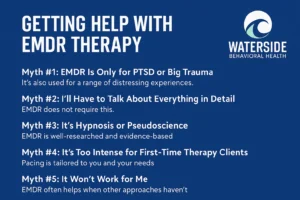
Myth #3: It’s Hypnosis or Pseudoscience
The name “Eye Movement Desensitization and Reprocessing” definitely doesn’t help EMDR sound less mysterious.
And yes—the bilateral stimulation part (eye movements, tapping, or tones) can sound odd until you try it.
But EMDR is not hypnosis. You stay fully awake, fully aware, and fully in control during every session.
It’s also not fringe. EMDR is:
- Backed by decades of clinical research
- Recommended by the World Health Organization and American Psychiatric Association
- Used in trauma centers, hospitals, and recovery programs across the globe
- Recognized as a gold standard treatment for trauma and anxiety
It’s not magic. It’s science—and it works.
Myth #4: It’s Too Intense for First-Time Therapy Clients
You might be thinking:
“I’m new to therapy. Shouldn’t I try something more… basic?”
That’s fair. EMDR is often introduced in later stages of therapy—but not always.
At Waterside Behavioral Health, we assess each person individually. If EMDR seems like the right tool to help you heal, and you’re emotionally ready for it, we’ll guide you through a preparation process before any reprocessing begins.
That includes:
- Building trust with your therapist
- Learning grounding and coping skills
- Creating a plan for what to focus on and when
You’ll never be rushed into trauma work. We go at your pace, with your consent, always.
Myth #5: It Won’t Work for Me
Many first-time seekers arrive already convinced they’re the exception.
Maybe you’ve lived with your pain for years. Maybe you’ve convinced yourself this is just “how life is” now. Or maybe you’ve tried other therapies, and nothing really landed.
Here’s the good news: EMDR is often the tool that helps people finally feel different.
It can help shift long-standing emotional patterns like:
- Overreaction to small stressors
- Deep emotional numbness
- Unexplained guilt or shame
- Constant people-pleasing
- Replaying the same memory or regret
We’ve seen clients who thought they were “beyond help” leave sessions lighter, clearer, and no longer hijacked by the past.
You don’t need to believe 100%. You just need to be willing to begin.
What EMDR Actually Feels Like
We won’t lie—it can be emotional. But it’s not chaotic.
Here’s what EMDR often feels like, according to our clients:
- Subtle but powerful
- Like connecting the dots between moments they never realized were linked
- Like finally letting go of a feeling they couldn’t name
- Sometimes uncomfortable—but never unsafe
You’re not diving into the deep end with no life jacket. You’re walking into the shallow end, with a trained guide beside you, ready to pause whenever you need.
What a Session Might Look Like
Every person is different, but a typical EMDR process might include:
1. Preparation
You and your therapist will build rapport, learn regulation strategies, and discuss goals. This phase is gentle and often lasts several sessions.
2. Target Identification
Together, you’ll identify which memories or feelings seem most “charged” or stuck. You don’t have to tell the full story—just enough to anchor the work.
3. Reprocessing
Using bilateral stimulation (eye movements, tapping, or tones), your therapist will guide you as you observe and process the memory. You’ll check in periodically, and the memory will shift as the brain reworks it.
4. Closing and Integration
You’ll close each session with grounding, reflection, and support. Over time, the emotional “charge” behind the memory decreases—and life starts to feel more manageable.
A Real-Life Example: “I Thought I’d Always Carry This”
One client—we’ll call him Marcus—came to us with anxiety that seemed “functional.” He was a high performer, good at masking, but underneath he was always tense. Sleep was shallow. Socializing drained him. He’d never been in therapy before.
EMDR in Bristol County helped him trace those feelings back to early school-age bullying—something he hadn’t thought about in years. The teasing wasn’t extreme. But it planted the belief that he had to earn belonging by being useful, agreeable, or quiet.
By the end of EMDR, Marcus could still remember the events—but without the shame, muscle tension, or emotional collapse that used to follow.
He said:
“I finally feel like I’m not dragging a 10-year-old version of myself into every meeting, every date, every conversation.”
FAQs About EMDR Therapy
Do I have to stop other treatment to do EMDR?
No. EMDR can be integrated into existing care plans. It often enhances outcomes when combined with talk therapy, psychiatric support, or group work.
How long does EMDR take?
It depends. Some clients notice major relief in 6–12 sessions. Others engage in EMDR over several months. The pacing is adapted to your emotional readiness and treatment goals.
What if I get overwhelmed during a session?
Your therapist will be monitoring your responses the entire time. If you feel flooded, you can pause, slow down, or stop completely. Safety and stability come first.
Can I do EMDR for more than one issue?
Yes. After resolving one issue or memory, you may choose to work on others. EMDR is often used for both single-event trauma and layered, complex emotional histories.
Is EMDR covered by insurance?
Often, yes—especially when it’s part of a broader outpatient or mental health treatment plan. Our team can help verify your coverage before you begin.
Curious? Cautious? That’s okay. We’re here.
Call 774-619-7750 or visit EMDR Therapy in Plymouth County, MA to learn more. You don’t have to be certain. You just have to be open.