

You didn’t expect it to hit this hard.
When a provider said, “This sounds like an anxiety disorder,” maybe part of you nodded—like, yes, that tracks. But the rest of you? Confused. Relieved. Ashamed. Scared to death of what comes next.
If you’re newly diagnosed with anxiety and wondering what to do, whether to take medication, or if this label changes who you are—you’re not alone.
At Waterside Behavioral Health, we work with people in this exact moment. Not when everything is clear. Not when they’re sure they want help. But right when it’s still murky—when the question becomes: Am I allowed to be scared of healing?
You’re Not the Only One Feeling This Way
Anxiety disorders are incredibly common. But when you get diagnosed for the first time, it doesn’t feel “common.” It feels personal. Like someone just gave a name to the thing that’s been quietly running your life for years.
Some people hear the word “anxiety” and think of panic attacks. Others picture someone who worries too much. But anxiety is quieter—and trickier—than that. It can look like:
- Overthinking every social interaction
- Constant muscle tension or stomach problems
- Feeling like you always need to be productive
- Avoiding certain places, people, or situations “just in case”
- Dreading the worst—even when nothing is wrong
When you’ve lived like that for years, it becomes your normal. And when someone names it? It can feel like a tiny unraveling. You wonder: Was it always this loud? Have I just been pushing through?
You probably have. And now that you know, you don’t have to anymore.
Why Anxiety Treatment Isn’t “Giving In”
Let’s address one of the biggest fears up front: that getting treatment means giving up, or losing control.
We hear this all the time—especially when medication comes into the conversation. You might be wondering:
- What if meds change my personality?
- What if I feel numb or flat?
- What if I’m just being dramatic and I should push through?
Here’s what we want you to hear—clearly, gently, and without pressure:
Wanting to feel better doesn’t make you weak. It makes you honest.
Anxiety treatment isn’t about changing who you are. It’s about making space for more of you to exist—without the constant buzz of fear, shame, or overthinking running the show.
What Anxiety Treatment Looks Like (And What It Doesn’t)
When people picture “treatment,” they often think it means a lifetime of meds or years of deep psychoanalysis. But anxiety treatment is actually flexible. It can be tailored to your comfort level, symptoms, and goals.
Here’s what it may include:
Individual Therapy
Working one-on-one with a licensed therapist to understand your anxiety patterns. You might explore root causes, but you’ll also learn coping tools that help in daily life.
Cognitive Behavioral Therapy (CBT)
A structured approach that helps you notice and reframe unhelpful thought patterns. For example: shifting from “I’ll definitely mess this up” to “I’m prepared, and I can handle what comes.”
Skills-Based Work
Grounding, breathwork, mindfulness, and emotional regulation skills that give you real-time ways to calm your nervous system.
Medication Support
If you’re open to it, some people find that non-addictive medications (like SSRIs or SNRIs) help quiet the constant noise so therapy becomes even more effective.
But—and this is key—you’re in charge. No one forces you to take anything. At Waterside, we help you understand all your options. You decide your path.
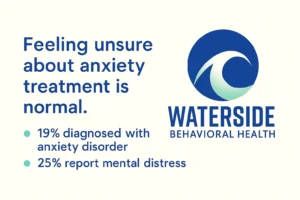
It’s Okay to Be Unsure About Medication
Maybe your first instinct is: No way. That’s valid.
Many of our clients come to us scared that medication will dull their creativity, flatten their feelings, or make them feel like someone they’re not. Especially if you identify as highly sensitive, creative, or intuitive, this can feel like a huge risk.
But here’s the reality: well-matched medication doesn’t take away your feelings. It often helps you access them more safely. It doesn’t dull your edges—it takes the edge off the panic that tells you the worst is always coming.
And if you try it and it doesn’t feel right? You’re allowed to stop. You’re allowed to try something else. This is not a lifetime sentence. It’s an invitation—not a mandate.
Healing Doesn’t Mean You’ll Lose Your Depth
There’s a myth that anxiety is part of what makes people insightful, attuned, or emotionally deep. And yes, many people with anxiety are all of those things.
But it’s not the anxiety that gives you that power—it’s you. You can keep your depth and lose the part that’s constantly afraid of being too much or not enough. You can keep your creativity and lose the sleepless nights. You can keep your insight and gain rest.
Healing doesn’t flatten you. It frees you.
Local Support That Moves at Your Pace
If you’re ready to explore care—and want something close to home—Waterside Behavioral Health provides anxiety treatment in Plymouth County, MA and the surrounding region.
We work with adults who are newly diagnosed, hesitant about medication, or just not sure what they need yet. Our team walks beside you—not ahead of you—and helps you create a care plan that fits your life, not the other way around.
And if you’re located closer to the neighboring county, we also welcome clients looking for anxiety treatment in Bristol County, MA.
You Don’t Need to Wait Until It Gets Worse
If you’re still going to work, managing your responsibilities, and doing “okay”—you might wonder: Do I even deserve help?
Here’s the truth: anxiety doesn’t have to wreck your life to be worth treating. If it’s taking your peace, your rest, your ability to enjoy the present… that’s enough.
Treatment isn’t about becoming someone else. It’s about becoming more of yourself—without fear constantly in the driver’s seat.
FAQs: Anxiety Treatment for the Newly Diagnosed
Do I have to take medication if I start anxiety treatment?
No. Medication is just one option, and many people benefit from therapy alone. At Waterside, we help you explore what feels best for your goals and comfort level.
What if I try meds and don’t like how they feel?
That’s okay. You’re not locked into anything. Your provider can adjust your dose, try a different option, or focus more on therapy. Your feedback is essential to your care.
How long does anxiety treatment usually take?
It varies. Some people benefit from a few months of therapy, while others continue longer for deeper support. We’ll collaborate with you to create a pace that works for your needs.
Can I keep my job and still attend treatment?
Yes. We offer flexible outpatient services that work with school and work schedules. Many clients attend evening or weekly therapy sessions while maintaining full-time responsibilities.
Will I always have anxiety?
Anxiety is treatable. You may always have a more sensitive nervous system—but with the right tools and support, it doesn’t have to control your life. Many people reach a point where their anxiety is quiet, manageable, and no longer disruptive.
You’re Allowed to Take the First Step
If you’re ready to explore anxiety treatment—but you want it to feel human, respectful, and safe—we’re here.
Call 774-619-7750 or visit our Anxiety Treatment page to learn more about how we help newly diagnosed adults in Plymouth County, MA move forward at their own pace.
You don’t have to feel “ready.” You just have to be willing to ask, What if there’s something better than white-knuckling through every day?