

Sometimes it’s not the pain that’s the scariest part.
It’s what happens when you let go of it.
Who are you without it? What if your anxiety is the fuel that drives your creativity?
What if the chaos is where your magic lives?
These questions aren’t irrational—they’re real.
And at Waterside Behavioral Health, we understand the fear behind them.
If you’ve ever worried that healing will erase your edge…
If you’ve stayed in the hurt because you’re afraid it’s part of your identity…
EMDR Therapy is your invitation to another way.
Let’s start here: Eye Movement Desensitization and Reprocessing (EMDR) Therapy in Massachusetts isn’t about fixing what’s broken. It’s about giving your nervous system permission to exhale—without making you less vibrant, less you, or less awake.
You’re Not Broken—You’re Overstimulated
Let’s reframe this.
You’re not too much.
You’ve just been carrying too much.
EMDR therapy doesn’t try to erase your memories. It helps your body stop treating them like they’re still happening. That’s what trauma does—it turns a moment into a loop, hijacking your creativity and energy with constant emotional reruns.
Maybe you’ve been labeled “sensitive” your whole life.
Maybe you’ve built your identity around surviving—hyper-aware, emotionally wired, quick-thinking under pressure.
That’s not failure. That’s adaptation.
But it’s also exhausting.
And it’s okay to want out without selling out your spark.
EMDR Therapy Doesn’t Flatten You—It Frees You
One of the most common fears creative or identity-driven clients share is this:
“What if therapy makes me boring?”
They’re not joking.
There’s this quiet fear that once the trauma quiets down, the music will too. Or the writing. Or the connection. Or the humor. Or whatever else felt tethered to pain.
Here’s what we’ve seen at Waterside Behavioral Health:
When the nervous system calms down, creativity gets louder.
Clarity doesn’t kill your edge—it sharpens it.
You Don’t Have to Explain Everything to Heal
EMDR is different from talk therapy.
It’s not about analyzing every memory. It’s not about retelling every painful story until it doesn’t hurt anymore.
Instead, EMDR uses structured bilateral stimulation (like guided eye movements) to help your brain process what got stuck. You don’t even have to talk about the event in detail for it to work. The magic isn’t in the talking—it’s in the processing.
Think of it like this:
Your brain has a filing cabinet. Trauma throws a bunch of files into the hallway.
EMDR helps your mind sort, file, and finally close the drawer.
And when that drawer shuts, the background noise quiets. The shame releases. The flashbacks fade. And you don’t lose yourself in the process—you recover the parts that never got a chance to fully show up.
EMDR Therapy in Plymouth County That Respects Your Fire
At Waterside Behavioral Health, we work with clients who are fiercely individual, emotionally deep, and often afraid they’ll lose something essential if they “get better.”
We get it.
You’ve worked hard to survive.
Your quirks are not flaws.
And your sensitivity is not a weakness—it’s evidence of your depth.
That’s why our EMDR therapists are trained not just in trauma protocols, but in attunement. We don’t push. We don’t pathologize your feelings. We don’t assume you want to be “normal.” We assume you want to feel safe inside your own head.
We serve individuals throughout the South Shore and are proud to support those looking for EMDR Therapy in Plymouth County, MA and nearby areas like Bristol County.
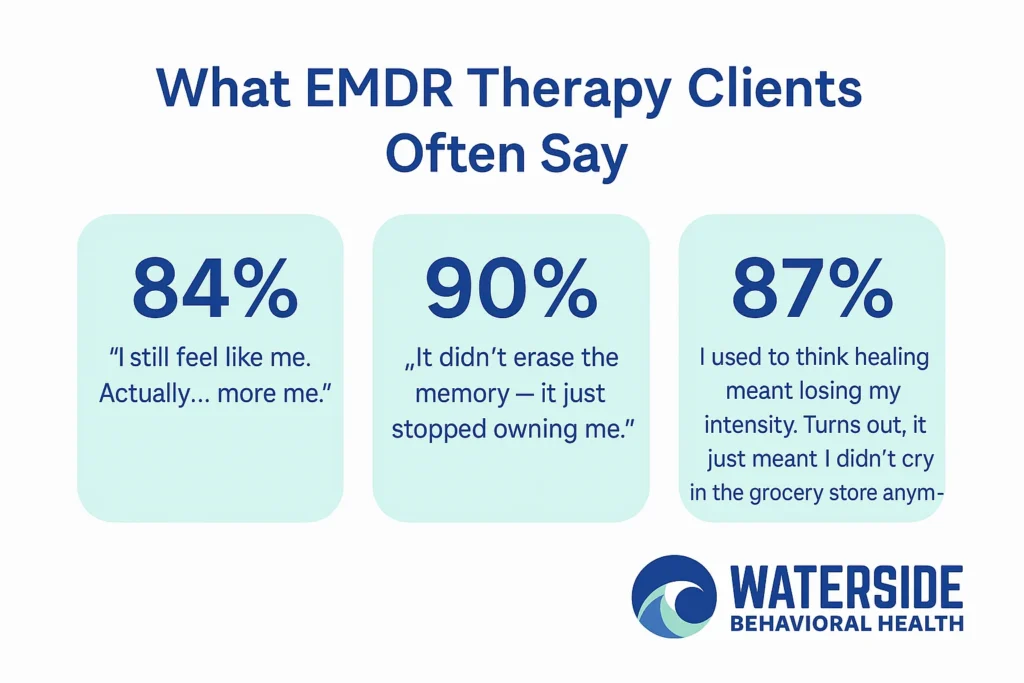
What EMDR Therapy Clients Often Say
“I still feel like me. Actually… more me.”
– Client, 2024
“It didn’t erase the memory—it just stopped owning me.”
– EMDR Client, Plymouth County
“I used to think healing meant losing my intensity. Turns out, it just meant I didn’t cry in the grocery store anymore.”
– Outpatient Client, MA
You Can Still Be Unfiltered—and Heal
Let’s get one thing straight:
You don’t have to trade your authenticity for stability.
The idea that you need trauma to be talented, anxious to be insightful, or chaotic to be charismatic?
That’s not true. That’s trauma talking.
EMDR therapy isn’t here to sanitize you.
It’s here to stabilize the parts of you that are tired of being in fight-or-flight every time you sit still.
You can still be wild and tender and creative and intense.
You just don’t have to suffer to access it.
Frequently Asked Questions About EMDR Therapy
What is EMDR Therapy, exactly?
EMDR (Eye Movement Desensitization and Reprocessing) is a trauma-focused therapy that helps the brain reprocess distressing memories. It uses bilateral stimulation—typically guided eye movements—to reduce the emotional intensity of traumatic experiences.
Do I have to talk about my trauma in detail?
No. That’s one of the advantages of EMDR therapy. You can engage in the healing process without rehashing every painful detail. Your therapist will help you access memory networks safely and gently.
Will EMDR change my personality?
No. EMDR doesn’t erase who you are—it helps you access more of yourself by clearing the emotional blocks caused by unprocessed trauma. Most clients feel more connected, more creative, and more stable—not different in a bad way.
How long does EMDR therapy take to work?
Every person is different. Some clients feel significant relief in a few sessions; others need more time, especially if there are complex trauma layers. Your therapist will work at your pace.
Is EMDR only for PTSD?
While it was originally developed for PTSD, EMDR is now used to treat anxiety, depression, grief, performance blocks, and more. If you’re feeling stuck, overwhelmed, or unable to move forward emotionally, EMDR could help.
📞 Call to Clarity
You don’t have to stay in the static.
If you’re ready to experience healing without losing your identity—if you’re done mistaking pain for depth—EMDR therapy may be exactly what your nervous system has been waiting for.
Call 774-619-7750 or visit Waterside’s EMDR Therapy services in Plymouth County, MA to learn more.