

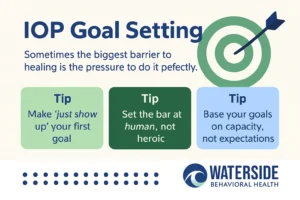
Sometimes the biggest barrier to healing is the pressure to do it perfectly.
If you stepped away from IOP—or never really got settled into it—it probably wasn’t about laziness or lack of commitment. It was likely about overwhelm. Pressure. The feeling that you were supposed to “crush it” instead of just get through the next session.
At Waterside Behavioral Health, we see it all the time: smart, hurting people who walk into an intensive outpatient program (IOP) with high hopes and tight shoulders—and slowly drift away when life gets loud. Not because they didn’t want it. But because it started to feel like one more place to fail.
If you’re thinking about trying again—good. That means some part of you still wants to feel better.
This time, let’s approach it differently. Here’s how to set realistic, compassionate, and shame-free goals so that IOP doesn’t feel like a battle—but a lifeline.
1. Make “Just Show Up” Your First Goal
That’s it. Not “open up in group.” Not “change everything.” Just—show up.
Getting back into treatment is emotionally heavy. Even just re-entering the space (in-person or virtual) might fill your chest with nerves. That’s normal. Especially if your last experience ended in ghosting or a slow fade.
So instead of overpromising yourself a life overhaul, let your first goal be attendance. Log in. Walk in. Breathe through the doorframe.
If you feel awkward, that’s okay. That’s part of the return. What matters is that you came.
2. Set the Bar at Human, Not Heroic
We hear it often: “I was trying to be better faster.”
But that kind of pressure burns people out.
You might’ve thought IOP would “fix” you in a few weeks. Or that you’d be the perfect client—on time, emotionally open, deeply insightful. When that didn’t happen, maybe shame crept in and you pulled away.
So this time, don’t write a “transformation story” in advance. Just write a post-it note that says:
- “I’ll try to tell the truth today.”
- “I can speak, or not speak. Both count.”
- “Showing up is progress.”
Small goals stick. Big ones often collapse under their own weight.
3. Let the Program Hold You—Not the Other Way Around
If IOP started to feel like another job, you’re not alone.
Clients often come in already overextended. They try to fit treatment around work shifts, parenting, medical issues, and caregiving—all without letting any plates drop. That’s a setup for collapse.
You don’t have to carry everything while you’re here. The whole point of IOP is to support you, not become one more place to perform.
Let your goal be something like:
- “Use this space to rest my brain.”
- “Let someone else ask the questions today.”
- “Be honest when I’m not okay.”
IOP isn’t a test. You don’t need to get it “right.”
4. Base Your Goals on Capacity, Not Expectations
Realistic goals aren’t just about being honest. They’re about capacity.
Ask yourself: What do I actually have the bandwidth for right now?
If you’re running on two hours of sleep and anxiety spikes by noon, setting a goal to journal nightly or cook fresh meals is probably too much. But maybe you can:
- Keep a sticky note nearby and jot one emotion word each day
- Set a 10-minute timer to breathe or stretch once a week
- Ask one person how they’re doing, and listen
None of this is flashy. But all of it is healing.
5. Track What You’re Holding Together (It’s More Than You Think)
Some clients leave IOP thinking, “I wasn’t doing enough.” But they were surviving. Quietly. Tirelessly. Invisibly.
If you’re managing work, bills, depression, caretaking, medical symptoms, or emotional trauma—you’re already working overtime.
So your IOP goals don’t need to add more. They need to hold you.
Maybe this time you keep a “capacity calendar.” Each day, mark:
- Green = I had energy
- Yellow = I pushed through
- Red = I was overwhelmed
Use that insight to pace yourself. If you’ve had three red days, maybe your goal is simply to rest in group. That counts.
6. Celebrate Maintenance as a Win
We don’t talk enough about the power of staying.
If you kept showing up but didn’t “feel better”—that’s not a failure. It’s foundational. Most change starts as invisible consistency before it becomes visible shift.
What’s worth celebrating:
- You logged in even when you wanted to cancel
- You made it through a session where you felt nothing
- You stayed off substances or self-harm, even just for a day
- You asked for help—awkwardly, imperfectly, but bravely
That’s not neutral. That’s healing.
7. Reflect on What Didn’t Work Last Time (Without Judgment)
If you ghosted, dropped out, or faded away from your last IOP experience, you don’t need to carry shame. You need space to reflect.
Ask yourself:
- Did I feel emotionally safe in group?
- Was the format (virtual/in-person) hard for me?
- Did I try to hide how overwhelmed I was?
- Did I expect myself to perform instead of process?
Those answers can guide your new goals. Maybe this time you:
- Ask for 1:1 support early
- Choose a smaller group
- Let your facilitator know what shut you down last time
At Waterside, we don’t expect perfection. We expect humanity. Your preferences, feedback, and feelings all matter.
And if you’re in the Plymouth County, MA area, your local access to IOP means you don’t need to wait for the perfect setup—we can help make adjustments in real time.
8. Borrow Someone Else’s Hope Until Yours Returns
If your self-talk sounds like:
- “This won’t work for me.”
- “I’ve already tried and failed.”
- “They probably won’t want me back.”
That’s not truth. That’s fear.
Borrow ours.
We’ve watched clients return after two weeks, two months, even two years—and find footing they never had the first time. Not because they were suddenly stronger. But because they were more honest. Softer. Slower. Willing to show up as-is.
You don’t need to bring success. Just your presence.
“I used to think IOP meant fixing myself. Now I see it as a place to sit with what I’m carrying—until it feels lighter.”
– Former Client, 2024
FAQs: Coming Back to IOP or Starting Again
What if I dropped out—will I be judged?
No. Clients leave programs for all kinds of reasons. We don’t focus on why you left. We focus on what support looks like now. You’ll be welcomed back with warmth, not judgment.
Can I request changes to my schedule or group format?
Yes. Whether you need virtual sessions, different group times, or a shift in structure, we’ll work with you to make IOP more accessible this time around.
Do I need to explain why I left?
Not unless you want to. You’re allowed to share what feels helpful—and keep the rest private. We don’t need a backstory to offer care.
What should I say when I come back?
You can say:
- “I’m not sure I’m ready, but I want to try again.”
- “I don’t know where to start.”
- “Can we talk about what didn’t work last time?”
That’s more than enough.
Is it okay to feel nervous about returning?
Absolutely. Nervousness is a sign that you care about the process—and that you’ve been hurt or disappointed before. We’ll meet you gently.
We’ll Start Where You Are, Not Where You “Should” Be
Your goals don’t need to impress anyone. They just need to fit your capacity, your reality, and your truth today.
At Waterside Behavioral Health, our intensive outpatient program in Massachusetts is designed to evolve with you—not pressure you into more than you can carry.
If you’re considering rejoining, we’re ready when you are. Call 774-619-7750 or visit our IOP page to talk about what the next chapter could look like.
Not perfect. Not polished. Just honest, and doable.