
You’ve done everything you know to do.
You’ve tried talking. You’ve tried giving space. You’ve tried calling therapists, Googling symptoms, waiting to see if things “blow over.” But your child—your smart, sensitive, once-connected young adult—isn’t bouncing back. They’re quiet. Irritable. Detached. Sometimes flat. Sometimes volatile. And nothing seems to help.
You might be wondering: Is this normal? Are they just overwhelmed—or are we in crisis?
If you’re asking that question, you’re not overreacting. You’re parenting in the dark. And you’re not alone.
At Waterside Behavioral Health, we’ve supported many families across Plymouth County and nearby areas who are facing this very moment. The emotional collapse. The middle-of-the-night worry. The sense that “talk therapy isn’t enough—but we don’t want to send them away.”
A Partial Hospitalization Program (PHP) can be the in-between solution—intensive enough to support real change, but flexible enough to keep your family intact.
This blog will explain what PHP is, how it supports young adults, and why it could be the turning point your child—and your family—needs right now.
What Is a Partial Hospitalization Program?
A Partial Hospitalization Program (PHP) is a structured, clinical treatment option for people experiencing significant mental health distress, but who do not need 24/7 hospitalization.
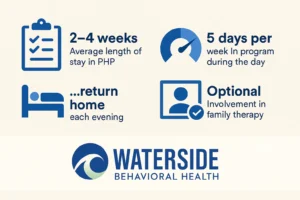
Young adults in PHP receive therapeutic support most of the day, typically 5 days a week, while returning home each evening. It offers a high level of care without removing them from their environment entirely.
A typical PHP includes:
- Group therapy (focused on emotion regulation, communication, trauma, and life skills)
- Individual therapy
- Psychiatric evaluation and medication management
- Safety planning and crisis stabilization
- Case management and care coordination
- Optional family sessions and discharge planning
The goal is to stabilize symptoms, create safety, and rebuild daily functioning—emotionally and practically.
Who Is PHP Designed For?
Young adults in crisis often don’t fit neatly into clinical boxes. They might not meet inpatient criteria, but they’re clearly not okay. PHP exists to hold that middle ground.
We often support clients who are:
- Having panic attacks that interfere with daily life
- Experiencing depressive episodes that make it hard to get out of bed
- Dealing with emotional dysregulation, self-harm urges, or suicidal thoughts
- Struggling with trauma, ADHD, or emerging personality disorder traits
- Returning home from college or a gap year, feeling directionless or stuck
- Overwhelmed by life transitions and unable to cope in healthy ways
If this sounds familiar, you’re not imagining the severity. Your child may be silently screaming for a structure that doesn’t exist at home—and PHP can offer exactly that.
Why PHP Works So Well for Young Adults
Young adults crave independence—but also need scaffolding. PHP meets both needs. It allows them to retain autonomy while receiving daily therapeutic care in a professional setting.
That’s important.
Traditional weekly therapy might feel too slow. Inpatient hospitalization might feel too extreme—or too stigmatizing. But PHP? It’s a daily reset. A place to talk, learn, process, and stabilize in real time.
“He didn’t want to go. We had to convince him just to try it. By day three, he said, ‘I like the people. I feel less alone.’ That’s when I exhaled for the first time in weeks.”
– Parent of a 19-year-old client
PHP also appeals to young adults because:
- They can sleep in their own bed
- They stay connected to friends and family
- They’re treated like adults—not patients or kids
- The format is less intimidating than inpatient care
- They gain tools, not just diagnoses
What a Day in PHP Might Look Like
Here’s what a typical day in a Partial Hospitalization Program looks like:
Morning Group Therapy
Clients begin the day with a check-in group—identifying emotions, sharing intentions, and setting the tone.
Skill-Building Sessions
Midday may involve DBT (Dialectical Behavior Therapy) or CBT (Cognitive Behavioral Therapy) sessions focused on coping tools, emotion regulation, distress tolerance, and communication.
Individual Therapy or Psychiatric Check-Ins
Clients meet one-on-one with a therapist weekly and have access to psychiatric providers for med management.
Lunch and Peer Connection
Lunch breaks are informal but supervised—time to connect with peers and reset socially.
Afternoon Processing Group or Specialized Tracks
These sessions go deeper into trauma, anxiety, family dynamics, or identity development.
Wrap-Up and Safety Planning
Each day ends with a short closing group. Clients leave with a safety plan and a sense of containment.
This consistent rhythm helps restore both emotional regulation and nervous system stability—often for the first time in months.
Signs That Your Young Adult May Need PHP
You don’t need a formal diagnosis to seek help. Trust what you’re seeing. Trust your gut.
You might consider PHP if:
- Your child has stopped attending school or work due to emotional distress
- You’ve noticed self-harm behavior or increased suicidal thoughts
- They’re withdrawing socially, avoiding responsibilities, or sleeping excessively
- Their mood swings are unpredictable or severe
- Traditional therapy isn’t working—or they’ve stopped going
- Your family is in a constant state of crisis management
It’s not about labeling your child. It’s about giving them—and yourself—support that meets the moment.
What Parents Often Say After Starting PHP
Parents often come to us tired, afraid, and skeptical. They’re scared of making the wrong choice. Scared of pushing too hard. Scared that nothing will work.
But within the first week or two, we often hear:
“This feels like the first real step.”
“They seem lighter. More present.”
“I finally feel like someone else is holding this with me.”
This isn’t a miracle cure. But it is a framework for real change.
FAQs: Partial Hospitalization Program for Young Adults
Is PHP the same as a psych hospital?
No. PHP is outpatient care. Your child will attend the program during the day and return home each evening. It offers structure without full hospitalization.
What’s the average length of stay in PHP?
Most PHP programs last between 2–4 weeks, depending on clinical needs. Some clients may stay longer or transition into Intensive Outpatient Programs (IOP) afterward.
Can my child attend PHP while on medication?
Yes. Our psychiatric providers can manage medications and make adjustments as needed during treatment.
Will my child fall behind in school or work?
PHP requires daytime attendance, so a temporary pause may be needed. Our case managers can help coordinate with schools or jobs for medical leave or accommodations.
Can families be involved in treatment?
Absolutely. While we center the client’s autonomy, family participation (when appropriate) is encouraged. Family sessions, education, and check-ins are part of care planning.
Do we have to live nearby to attend?
Most PHP clients are local. If you’re looking for a Partial Hospitalization Program in Bristol County, MA, we’d be happy to discuss eligibility and logistics with you.
You Don’t Have to Keep Holding This Alone
If you’re reading this, you’re probably exhausted. Maybe you’ve cried in the car. Maybe you’ve googled PHP three times in one night. Maybe you’ve tried everything you know—and it still doesn’t feel like enough.
You’re not failing your child. You’re fighting for them.
And you don’t have to do it alone anymore.
Call 774-619-7750 or visit our Partial Hospitalization Program page to learn how Waterside Behavioral Health supports young adults in behavioral health crisis—and the families who love them.