

Living with health anxiety can feel exhausting. A headache becomes a brain tumor. A skipped heartbeat feels like the start of a heart attack. A mild stomach ache sparks fears of cancer. Even after a doctor explains that everything looks normal, the relief often lasts only a short time before new worries take its place.
If this pattern sounds familiar, you’re not alone—and you’re not imagining your distress.
At Waterside Behavioral Health’s anxiety page, you’ll find information about how anxiety disorders affect daily life and the evidence-based approaches used to address them. For many people, understanding the cycle behind health anxiety is the first step toward breaking it.
Health anxiety is a genuine mental health condition. The fear feels real because your brain is interpreting ordinary sensations as signs of serious danger. Unfortunately, repeated reassurance often provides only temporary comfort, allowing the anxiety to return stronger than before.
What Is Health Anxiety?
Health anxiety is a persistent fear of having—or developing—a serious medical condition despite little or no medical evidence that one exists.
Many people occasionally worry about their health, especially after hearing about an illness or experiencing new symptoms. Health anxiety is different because the fear becomes persistent, difficult to control, and disruptive to everyday life.
Historically, this condition was often referred to as hypochondria. Today, mental health professionals use more specific diagnostic terms depending on the person’s symptoms.
These include:
- Illness anxiety disorder (IAD): The person has few or no significant physical symptoms but experiences intense anxiety about becoming seriously ill.
- Somatic symptom disorder (SSD): The person has physical symptoms that may be real or medically explained, but the emotional distress and preoccupation with those symptoms become excessive.
Although the names have changed, the experience remains similar.
People living with health anxiety aren’t pretending to be sick or seeking attention. They genuinely believe that subtle bodily sensations may signal a dangerous illness. Their nervous system remains on high alert, constantly scanning for evidence that something is wrong.
Over time, the anxiety itself becomes the primary problem—not because the person doesn’t experience physical sensations, but because every sensation is interpreted through the lens of fear.
Health Anxiety Symptoms
Health anxiety can affect thoughts, emotions, behaviors, and even physical sensations.
Common health anxiety symptoms include:
Constant body monitoring
Many individuals repeatedly check their body for changes, including:
- Feeling for lumps
- Monitoring heart rate
- Checking blood pressure
- Looking for skin changes
- Watching breathing patterns
- Repeatedly taking their temperature
What begins as a quick check can become a daily—or hourly—habit.
Repeated online symptom searches
Searching the internet for medical information can quickly become overwhelming.
Someone with health anxiety may spend hours researching symptoms, comparing diseases, reading patient stories, or convincing themselves that the worst-case scenario applies to them.
This behavior is sometimes called cyberchondria, and it often increases anxiety rather than reducing it.
Frequent medical appointments
Some people seek repeated reassurance through:
- Primary care visits
- Specialist appointments
- Emergency room visits
- Blood work
- Imaging studies
- Second or third opinions
Despite receiving reassuring results, the fear often returns shortly afterward.
Avoiding doctors altogether
Not everyone responds by seeking medical care.
Some individuals avoid appointments because they’re terrified a physician might confirm their greatest fear. They may ignore recommended screenings or postpone routine checkups while continuing to worry constantly.
Difficulty accepting reassurance
Perhaps the defining characteristic of health anxiety is that reassurance rarely lasts.
A clear MRI may ease fears for two days.
Normal blood work may feel comforting until a new sensation appears.
Soon, another symptom emerges—or an old symptom suddenly feels different—and the cycle begins again.
Physical symptoms caused by anxiety
Ironically, anxiety itself produces real physical symptoms, including:
- Muscle tension
- Racing heartbeat
- Chest tightness
- Upset stomach
- Nausea
- Dizziness
- Tingling sensations
- Headaches
- Fatigue
These symptoms are genuine, but they often become additional evidence in the person’s mind that something serious must be happening.
The Reassurance-Seeking Cycle
One of the most misunderstood aspects of health anxiety is the role reassurance plays.
Family members often think they’re helping by saying:
“You’re fine.”
“The doctor already checked.”
“Your tests were normal.”
While reassurance feels comforting in the moment, it usually strengthens the anxiety over time.
Here’s how the health anxiety cycle typically works.
Step 1: Anxiety appears
A normal body sensation occurs.
Examples include:
- A headache
- Muscle twitch
- Brief dizziness
- Mild stomach discomfort
- Increased heartbeat after climbing stairs
Instead of viewing these sensations as ordinary, the brain interprets them as dangerous.
“What if this is cancer?”
“What if I’m having a stroke?”
“What if the doctor missed something?”
Step 2: Checking begins
To reduce uncertainty, the person seeks reassurance by:
- Googling symptoms
- Examining their body
- Asking loved ones for reassurance
- Scheduling another medical appointment
- Comparing symptoms with others online
- Reading medical forums
- Taking repeated vital signs
At first, these behaviors feel logical.
After all, checking seems responsible.
Step 3: Temporary relief
Eventually, reassurance arrives.
Perhaps Google suggests the symptom is harmless.
A family member says everything is okay.
A physician orders tests that come back normal.
For a brief period, anxiety decreases.
This relief feels rewarding.
Step 4: Anxiety returns
Hours or days later, another sensation appears.
Or the original fear returns with a new thought:
“Maybe they tested for the wrong thing.”
“What if it was too early to detect?”
“What if my symptoms changed?”
Because the previous reassurance only reduced anxiety temporarily, the brain concludes it needs more reassurance.
The cycle repeats.
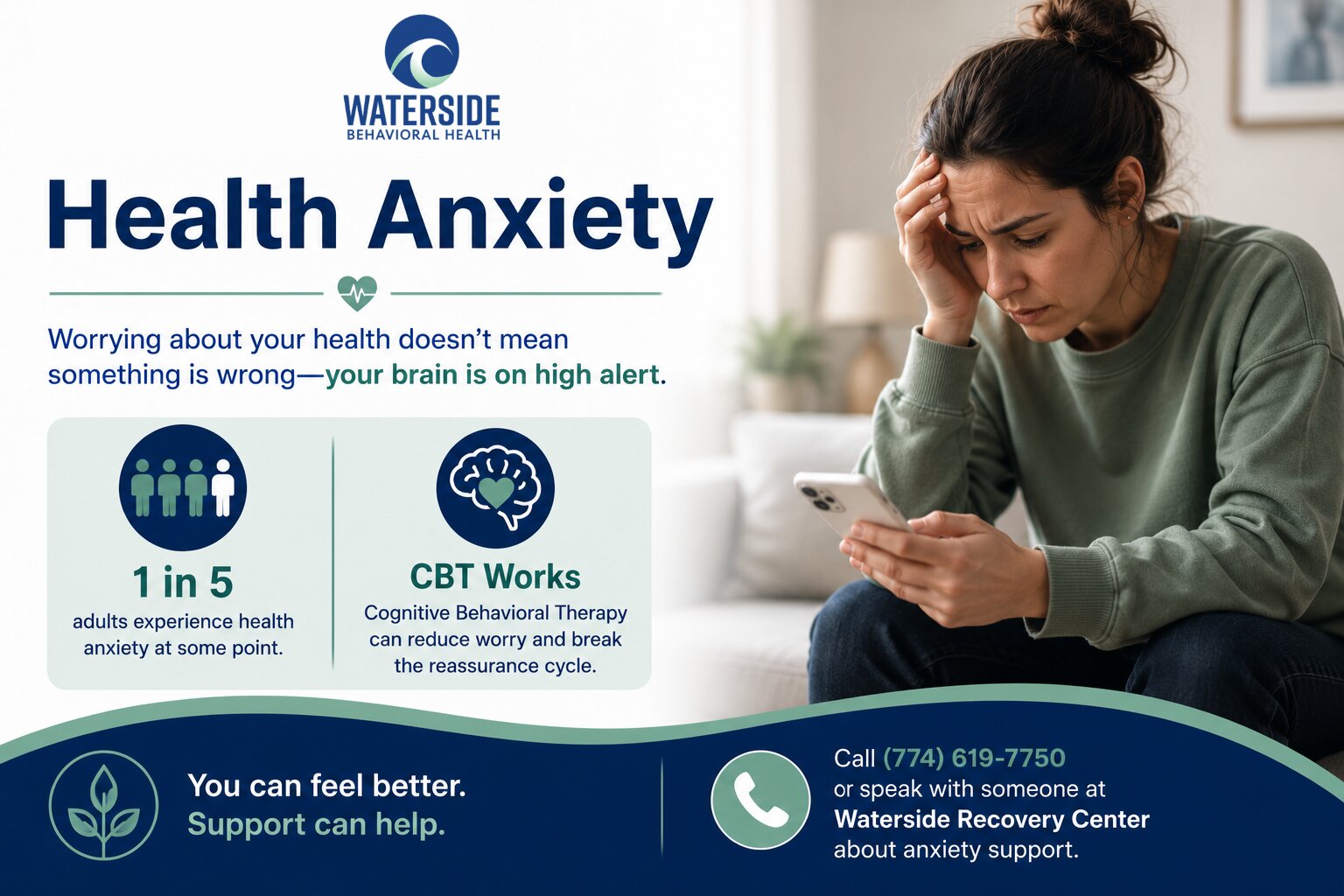
Why Reassurance Actually Keeps Health Anxiety Going
This cycle persists because reassurance provides short-term relief, which unintentionally reinforces checking behaviors.
Psychologists refer to this as negative reinforcement.
When anxiety feels unbearable, checking reduces discomfort.
Because relief follows checking, the brain learns:
“Checking keeps me safe.”
The problem is that the person never has the opportunity to discover something important:
Nothing dangerous happened—even without endless checking.
Instead, they believe they avoided catastrophe because they sought reassurance.
Over time:
- Checking increases.
- Reassurance becomes less effective.
- Anxiety becomes more frequent.
- Daily life becomes increasingly restricted.
The goal is not to eliminate uncertainty—because complete certainty is impossible—but to learn that uncertainty can be tolerated without constant reassurance.
How CBT Helps Break the Health Anxiety Cycle
One of the strongest evidence-based approaches for health anxiety is cognitive behavioral therapy (CBT).
Rather than trying to convince someone that they’re “fine,” CBT focuses on changing the thinking patterns and behaviors that keep anxiety alive.
The goal isn’t to ignore genuine medical concerns. Instead, it’s to respond to uncertainty in healthier ways.
Challenging catastrophic interpretations
CBT helps people identify automatic thoughts such as:
- “A headache means a brain tumor.”
- “This heartbeat feels different, so something must be wrong.”
- “If I don’t check, I’ll miss something life-threatening.”
Together with a therapist, these thoughts are examined realistically rather than accepted automatically.
Reducing reassurance-seeking
An important part of CBT involves gradually decreasing behaviors like:
- Googling symptoms
- Asking others for reassurance
- Body checking
- Excessive doctor visits without medical necessity
At first, this feels uncomfortable.
Over time, however, the brain learns that anxiety naturally rises—and then falls—even without checking.
Exposure and Response Prevention (ERP)
Many clinicians incorporate Exposure and Response Prevention (ERP) into CBT for health anxiety.
ERP involves carefully practicing situations that trigger anxiety while resisting the urge to seek reassurance.
Examples may include:
- Not checking a symptom immediately
- Waiting before searching online
- Avoiding repeated pulse checks
- Sitting with uncertainty after a normal medical evaluation
Initially, anxiety increases.
With repeated practice, the brain gradually learns that uncertainty is survivable and that feared outcomes rarely occur.
This process weakens the cycle that has been maintaining the anxiety.
For individuals looking to better understand evidence-based approaches to anxiety, the information available through Waterside Behavioral Health explains how CBT and related therapies can help people develop healthier responses to persistent worry.
Learning to Live With Uncertainty
Every person lives with some degree of uncertainty about their health.
Most people occasionally wonder whether a symptom deserves medical attention.
Health anxiety makes that uncertainty feel unbearable.
Recovery does not mean never noticing bodily sensations again.
Instead, it means learning that:
- Not every sensation requires immediate investigation.
- Anxiety can produce convincing physical symptoms.
- Uncertainty is part of being human.
- Reassurance is not the same as safety.
- Confidence grows by resisting compulsive checking—not by eliminating every doubt.
As people begin responding differently, the cycle gradually loses its power.
Frequently Asked Questions
What is health anxiety?
Health anxiety is a persistent fear of having or developing a serious illness despite medical reassurance or little evidence of disease. The anxiety often leads to repeated symptom checking, online health searches, or frequent requests for reassurance.
Is health anxiety a mental illness?
Yes. Health anxiety is recognized within modern diagnostic systems as illness anxiety disorder or, in some cases, somatic symptom disorder, depending on whether significant physical symptoms are present. It is a legitimate anxiety disorder that can significantly affect daily functioning and quality of life.
How do you treat health anxiety?
Research shows that cognitive behavioral therapy (CBT), often combined with Exposure and Response Prevention (ERP), is one of the most effective approaches for health anxiety. CBT helps individuals recognize catastrophic thinking, reduce reassurance-seeking behaviors, and become more comfortable with normal uncertainty about their health.
Final Thoughts
Health anxiety can make everyday physical sensations feel frightening and overwhelming. If you’ve found yourself caught in a pattern of constantly checking symptoms, seeking reassurance, or worrying that every ache or pain signals a serious illness, know that you’re not alone—and that these experiences are recognized features of a real anxiety disorder.
With the right support, it’s possible to break the reassurance-seeking cycle, build greater tolerance for uncertainty, and regain confidence in your ability to respond to your health without fear taking over.
If health anxiety is interfering with your daily life, call (774) 619-7750 or speak with someone at Waterside Behavioral Health about anxiety therapy program support.