
The next morning hits like a truck.
It’s not always dramatic. Sometimes it’s quiet. The birds are chirping. Coffee’s brewing. The world is moving like nothing happened—except everything feels different.
You know you relapsed.
And now, sitting in the stillness of “the day after,” there’s a voice in your head saying, You blew it. You’re back at square one. But here’s what we need you to hear:
You’re not at square one.
You are still worth showing up for.
And this? This is the moment that matters.
At Waterside Behavioral Health, we work with alumni all the time who relapse after 90, 120, or even 300 days. And while it hurts—and it does—it’s also an invitation to recalibrate, not a sentence of failure. For many, that next step is returning to a Partial Hospitalization Program in Massachusetts—a structured space to regroup, reflect, and re-engage.
Why Does This Kind of Relapse Cut So Deep?
Because by now, you had tasted stability.
You’d started rebuilding. Maybe relationships were mending. You knew your schedule, your triggers, your support system. Maybe you even helped someone else through their early recovery.
That’s what makes relapse at this stage feel like a betrayal—not just to others, but to yourself. It’s a gut punch to your identity: I thought I was past this.
But relapse isn’t proof you’re broken. It’s proof you’re human—and still healing.
And no, it doesn’t mean treatment didn’t work.
It means something shifted, and it’s time to take a closer look.
The Most Dangerous Lie: “I’ll Figure This Out Alone”
One of the biggest risks after a relapse is isolation. The shame voice gets louder. You might think:
- I should be stronger than this.
- They won’t understand.
- If I go back, it proves I’m a failure.
But the truth is: going back proves you’re still fighting.
That’s what PHP (Partial Hospitalization Program) offers—a structured place to come back without starting over. You don’t need detox. You don’t need a fresh diagnosis. You need safety. Support. Time to regroup. And a team that knows this phase isn’t the end—it’s a checkpoint.
What Does a Partial Hospitalization Program Look Like?
A PHP isn’t a punishment—it’s a container.
At Waterside, PHP offers daytime structure (typically 5–6 hours a day) with a combination of clinical care and therapeutic support. But here’s the key difference: you go home at night. It’s designed for people who need more than outpatient therapy—but don’t need inpatient care.
Here’s what you can expect:
- Daily group therapy with others who “get it”
- One-on-one counseling to untangle the deeper “why”
- Psychoeducation about relapse triggers and nervous system healing
- Medication support if needed (for mental health stability)
- Family involvement (if helpful—not forced)
- A team who won’t judge you for relapsing
We work with clients across the South Shore, including those looking for Partial Hospitalization Program in Plymouth County, MA, and even neighboring areas like Bristol County.
“I Don’t Want to Tell Anyone I Relapsed”
That makes sense. Really.
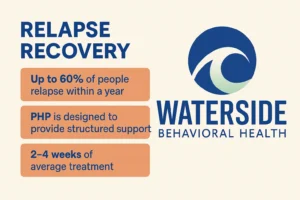
The fear of disappointing others is real—especially if you’ve shared your recovery publicly. But relapse happens more often than most people talk about. According to national data, up to 60% of people relapse within the first year after treatment.
Relapse is not a moral failing. It’s a sign that the support you had may no longer be enough—or that something else (stress, grief, trauma, loneliness) was never fully addressed.
And that’s fixable. With help.
What Makes Waterside’s PHP Different?
We don’t just treat symptoms. We track your patterns, your stress cycles, and your emotional flashpoints. We look at what held you up—and what knocked you sideways. Because relapse is rarely random. It’s often a signal that something needs more attention.
And for alumni, it can be extra tricky. You’ve heard the lectures. You know the drill. So we don’t start from scratch—we start from you. Where you are now. What you’ve already survived. And what you still want for your life.
“Is PHP Really Necessary If I Already Did Treatment?”
Maybe not. But here’s the real question:
Is white-knuckling it working?
If you’re waking up anxious, spinning in shame, and isolating again, a return to structured care could be what steadies you—not forever, but for this stretch of road.
And let’s be honest: being back in a supportive space can make a massive difference. Not because you have to, but because you deserve a soft place to land while you get your footing again.
FAQ: Partial Hospitalization Program After Relapse
What if I feel too ashamed to come back?
You’re not the only one. We hear this all the time—and we’ve seen people come back and thrive. There is no penalty for being human. Our doors stay open.
How long would I need to be in PHP?
Most clients attend for 2–4 weeks, but it’s flexible. We work with you to decide what makes sense for your goals and responsibilities.
Will I lose progress or have to restart everything?
Not at all. We honor your past work. PHP adds support—it doesn’t erase anything you’ve already built.
Is this just group therapy all day?
No. PHP includes individual sessions, psychoeducation, recovery planning, and other supports in addition to groups.
Can I return to work or family afterward?
Absolutely. Many clients use PHP as a way to re-stabilize so they can return to life with more clarity and support.
You Are Still in This
Relapse isn’t a verdict. It’s a detour.
You can still recover. You can still reconnect. You can still be proud of yourself—not because you stayed perfect, but because you chose to come back after the fall.
And if that first call feels too hard—just breathe. One step. That’s all we ask. One step toward support. Toward stability. Toward yourself.
📞 Call 774-619-7750 or visit our PHP program page to learn more about Partial Hospitalization Program services in Plymouth County, MA.
If you’re looking for Partial Hospitalization Program in Bristol County, MA or other nearby areas, we’d be honored to help you find your next step.