

For as long as people have reflected on life, they’ve asked difficult questions.
Why are we here? What happens when we die? Does life have meaning? How do we live knowing that life is uncertain?
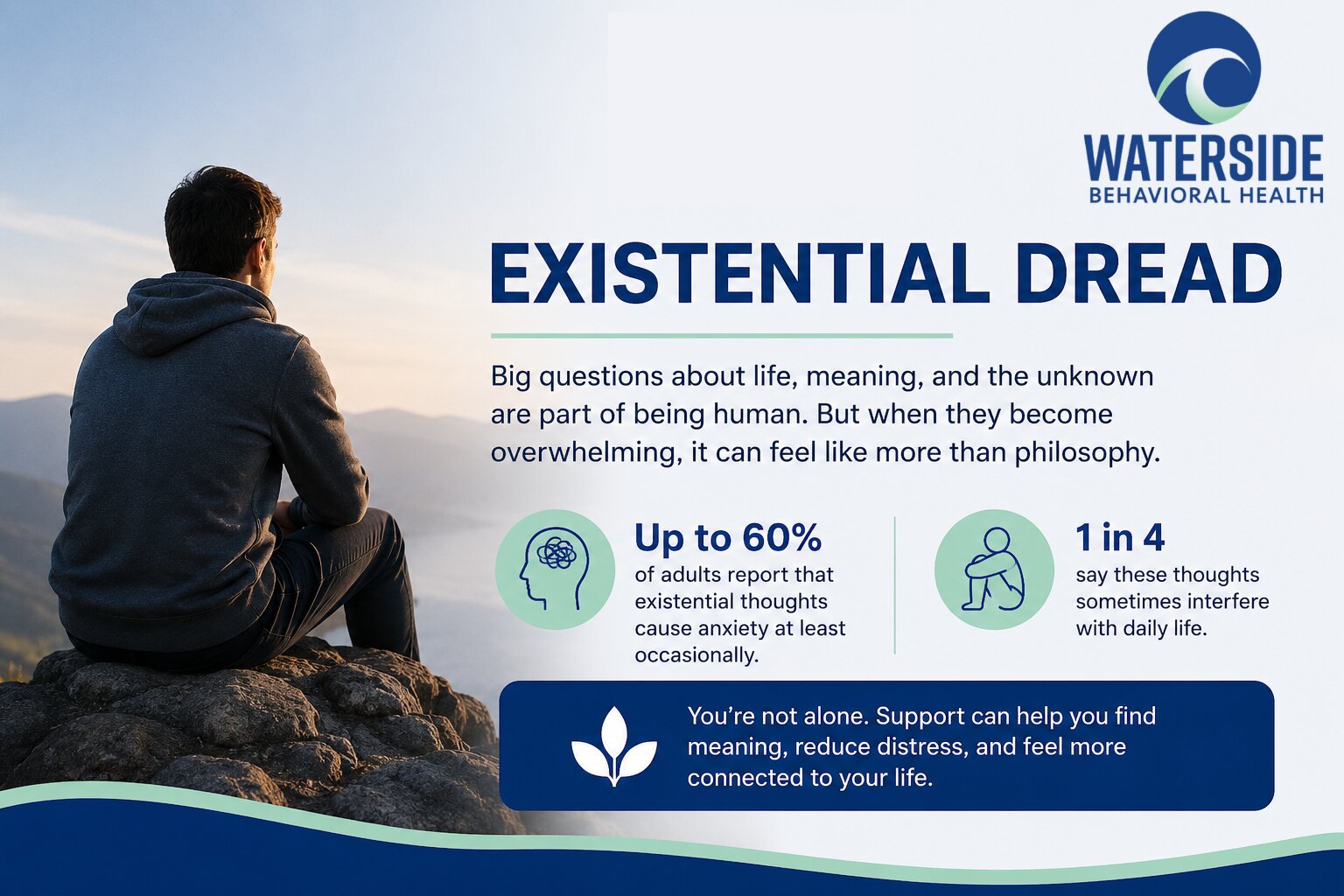
These questions have inspired philosophers, artists, and spiritual traditions for centuries. But for some people, these thoughts don’t remain abstract or intellectually interesting. Instead, they become overwhelming, intrusive, and emotionally exhausting.
This experience is often called existential dread.
While existential dread is a deeply human experience, it can sometimes become intertwined with anxiety in ways that affect daily life. If you’re exploring why these thoughts feel so intense, the information available through Waterside Behavioral Health explains how anxiety can influence thinking, emotions, and overall well-being. Understanding the difference between normal existential questioning and clinically significant anxiety can help you determine when additional support may be helpful.
What Is Existential Dread?
Existential dread refers to feelings of anxiety, fear, or unease related to the fundamental realities of human existence.
Rather than worrying about everyday responsibilities, existential dread centers on questions such as:
- What is the meaning of life?
- Why do people suffer?
- What happens after death?
- How should I spend my life?
- Am I living authentically?
- How do I know my choices matter?
These questions are not signs that something is wrong.
In fact, they have occupied some of history’s most influential thinkers.
Philosophers including Søren Kierkegaard, Martin Heidegger, and Jean-Paul Sartre explored the tension between freedom, mortality, uncertainty, and the search for meaning.
Although their ideas differ, they shared an understanding that confronting life’s uncertainties is part of being human.
Common features of existential dread include:
- Preoccupation with mortality
- Fear of the unknown
- A sense that life lacks meaning
- Feeling isolated in your experience
- Awareness of life’s uncertainty
- Worry about making the “right” choices
- Difficulty accepting that some questions have no clear answers
Experiencing these thoughts occasionally is not considered a mental health disorder.
For many people, existential reflection can even lead to personal growth, stronger values, and greater appreciation for life.
Why Does Existential Dread Happen?
Existential questions often become more intense during periods of change or uncertainty.
Certain life experiences naturally encourage people to think more deeply about mortality, identity, and purpose.
Major life transitions
Significant changes often prompt existential reflection.
Examples include:
- Graduating from school
- Starting a new career
- Becoming a parent
- Retirement
- Divorce
- Children leaving home
Transitions invite people to reconsider who they are and what matters most.
Personal experiences with mortality
Nothing tends to intensify existential fear more than confronting death directly.
This may happen after:
- Receiving a medical diagnosis
- Losing a loved one
- Witnessing a serious accident
- Recovering from a life-threatening illness
These experiences naturally raise questions about life’s fragility.
Global events
Events that remind us of uncertainty can also increase existential anxiety.
Examples include:
- Pandemics
- Natural disasters
- Climate concerns
- Armed conflicts
- Economic instability
When the future feels unpredictable, people often begin questioning larger aspects of existence.
Developmental stages
Certain periods of life involve more existential reflection than others.
Adolescence often brings questions about:
- Identity
- Independence
- Purpose
- Personal values
Later, many adults experience similar questions during midlife.
The so-called “midlife crisis” often reflects deeper concerns about time, mortality, accomplishments, and how one wants to spend the years ahead.
These periods don’t necessarily indicate mental illness—they represent normal developmental transitions.
Existential Dread vs. Everyday Anxiety
One of the most important distinctions is understanding when existential concerns remain part of normal human experience and when they begin functioning like an anxiety disorder.
Normal existential reflection
Healthy existential questioning is typically:
- Temporary
- Triggered by meaningful life events
- Balanced with everyday functioning
- Sometimes uncomfortable but manageable
- Capable of leading to personal insight
Someone might spend several days reflecting after attending a funeral or reading a thought-provoking book before gradually returning to their usual routines.
Clinically significant existential anxiety
Sometimes, however, existential questions become persistent and emotionally overwhelming.
Instead of thoughtful reflection, they become repetitive worry.
This pattern is sometimes referred to as existential anxiety or existential crisis anxiety.
Signs may include:
- Constant intrusive thoughts about death
- Feeling unable to stop philosophical worry
- Panic attacks triggered by thoughts of mortality
- Difficulty sleeping because of existential fears
- Avoiding reminders of death or uncertainty
- Feeling trapped in endless rumination
- Difficulty concentrating on daily responsibilities
- Significant emotional distress
The important difference isn’t the subject matter.
It’s the impact.
The content of the worry may be philosophical, but the experience itself begins functioning like anxiety.
The thoughts become difficult to control.
They interfere with work, relationships, sleep, or quality of life.
Simply thinking harder rarely provides relief because anxiety continuously searches for certainty where complete certainty isn’t possible.
Coping With Existential Dread—and When to Seek Help
While there are no simple answers to life’s biggest questions, there are healthy ways to respond when existential concerns begin feeling overwhelming.
Focus on meaning rather than certainty
Many people discover that searching for absolute certainty becomes exhausting.
Instead, it can be more helpful to focus on creating meaning through:
- Relationships
- Creativity
- Personal values
- Community involvement
- Spiritual practices
- Acts of kindness
Meaning often develops through lived experience rather than intellectual certainty.
Limit rumination
Reflection can be healthy.
Rumination is different.
Rumination involves repeatedly thinking about the same questions without moving toward acceptance or action.
If you notice yourself trapped in endless mental loops, gently redirecting your attention to the present moment may help interrupt the cycle.
Practice acceptance
Some questions simply cannot be answered with complete certainty.
Acceptance-based approaches emphasize learning to tolerate uncertainty rather than eliminating it.
For many individuals, this shift reduces the emotional intensity of existential fear.
Acceptance doesn’t require liking uncertainty.
It means recognizing that uncertainty is an unavoidable part of being human.
Stay connected
Existential dread often creates feelings of isolation.
Maintaining meaningful relationships can provide perspective, emotional support, and reminders that you don’t have to navigate difficult questions alone.
When should you seek professional support?
It’s reasonable to consider professional support if existential dread:
- Persists for weeks or months
- Interferes with work or school
- Causes significant sleep problems
- Leads to panic attacks
- Prevents you from enjoying life
- Results in avoidance of everyday situations
- Feels impossible to control
Mental health professionals often use evidence-based approaches that help people develop healthier relationships with uncertainty and distressing thoughts.
One example is Acceptance and Commitment Therapy (ACT), which encourages people to accept difficult internal experiences while living according to their personal values rather than fear.
If persistent existential anxiety is affecting your daily life, the information available through Waterside Behavioral Health offers additional guidance about evidence-based care and emotional support.
Asking Big Questions Doesn’t Mean Something Is Wrong
One of the most reassuring things to remember is that existential dread is part of the human experience.
Nearly everyone reflects on mortality, purpose, freedom, or uncertainty at some point in life.
The goal isn’t to eliminate these questions forever.
Instead, it’s to prevent them from becoming so overwhelming that they overshadow everyday living.
When curiosity becomes constant fear, or thoughtful reflection turns into relentless anxiety, additional support may help you regain balance while continuing to explore life’s deepest questions in healthier ways.
Frequently Asked Questions
What is existential dread?
Existential dread is anxiety or emotional discomfort related to fundamental questions about life, death, purpose, freedom, and uncertainty. It is a common human experience and is not, by itself, a mental health disorder.
Is existential dread a form of anxiety?
It can be. Occasional existential questioning is normal, but when these thoughts become persistent, intrusive, difficult to control, and interfere with daily functioning, they may reflect clinically significant existential anxiety or another anxiety-related condition.
How do you stop existential dread?
Rather than trying to eliminate existential thoughts completely, many people benefit from focusing on personal values, limiting rumination, practicing acceptance of uncertainty, maintaining meaningful relationships, and seeking professional support if the anxiety becomes overwhelming or disruptive.
Final Thoughts
Existential dread reminds us that being human includes living with uncertainty, mortality, and questions that may never have complete answers. While these reflections can sometimes inspire growth and a deeper sense of purpose, they can also become overwhelming when anxiety takes over.
If thoughts about meaning, mortality, or uncertainty are causing persistent distress or interfering with your daily life, you don’t have to face them alone.
Call (774) 619-7750 or speak with someone at Waterside Behavioral Health about anxiety support.