

You showed up. Maybe not every time—but enough to know what it felt like.
And then something in you pulled back.
Not dramatically. Not all at once. Just a quiet drift… a missed session, then another, and suddenly you weren’t going anymore.
If you’re here, trying to figure out what comes next, you’re not alone. You can revisit options like our intensive outpatient programs for behavioral health in Massachusetts, but before you choose anything, we need to slow this down.
Because this part matters more than the program itself:
You didn’t fail treatment.
Something about it didn’t fit you.
And that’s something we can actually work with.
Step 1: Stop Turning This Into a Personal Failure
Let’s name what usually happens after someone leaves care early.
You replay it.
“I should’ve stuck it out.”
“I wasted that opportunity.”
“Maybe I’m just not someone this works for.”
That narrative will keep you stuck longer than anything else.
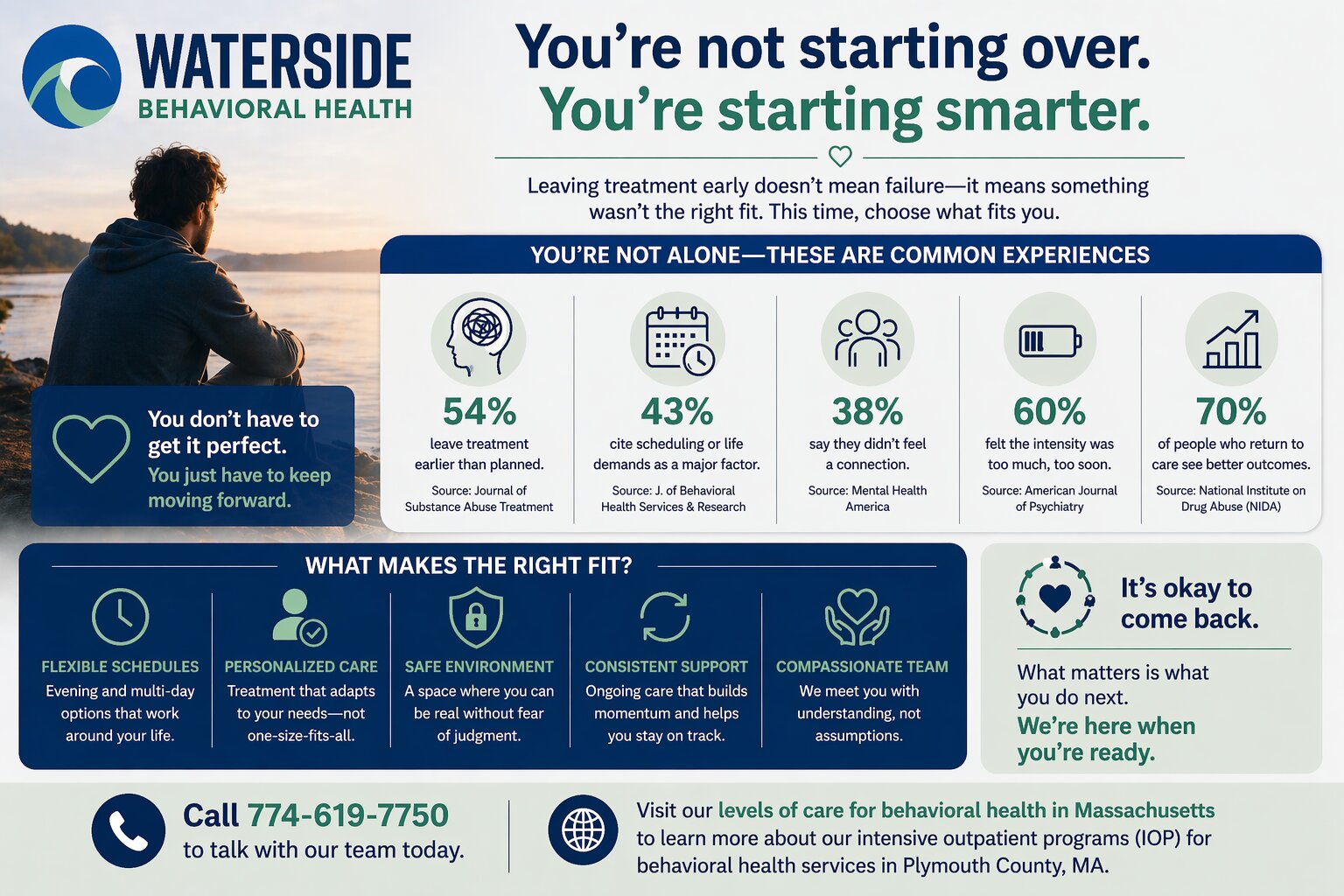
From a clinical perspective, dropping out isn’t uncommon. It happens when:
- The emotional intensity doesn’t match your readiness
- The schedule clashes with real life in ways that aren’t sustainable
- The environment doesn’t feel safe enough to open up
- The support feels either too shallow—or too overwhelming
None of those are character flaws.
They’re mismatches.
And mismatches can be corrected.
Step 2: Get Specific About What Didn’t Work (Even If It’s Uncomfortable)
This is where most people rush past the truth.
They say, “It just didn’t help,” and move on.
But if you want something different this time, you need clarity.
Try to get precise:
- Did sessions leave you emotionally flooded with no time to recover?
- Did it feel like you were talking around the real issue?
- Were you trying to maintain work, relationships, and treatment—and burning out?
- Did you feel disconnected from the group or clinicians?
- Did you stop going right when things started getting deeper?
There’s no wrong answer here.
But there is a useful one.
Because whatever made you step back before—that’s the thing your next level of care needs to address directly.
Step 3: Understand the Gap Between Weekly Therapy and “Too Much”
A lot of people land in a confusing middle space.
Weekly therapy starts to feel like it’s not enough.
But the idea of something more structured feels intimidating.
So you stall.
You tell yourself to “try harder” with what you’re already doing.
But here’s the reality:
There’s an entire middle ground between once-a-week sessions and full hospitalization.
Options like:
- Multi-day weekly treatment that gives you consistency without removing you from your life
- Structured daytime care for when things need more attention and containment
- Live-in support if safety or stability becomes a concern
If you’ve been scrolling through different mental health programs Boston options and feeling overwhelmed, it’s not because you’re incapable.
It’s because no one explains how to match the level of care to your actual experience.
That’s what we’re doing here.
Step 4: Choose Based on Capacity—Not Just Symptoms
This is where people often make the same mistake twice.
They choose based on how bad things feel.
Instead, you need to choose based on what you can realistically sustain.
Ask yourself:
- How much time can I consistently commit each week?
- How emotionally intense can my current life actually handle?
- Do I need more support between sessions—or more space to process?
The right level of care sits at the intersection of need and capacity.
Too little support, and nothing changes.
Too much too fast, and you burn out again.
This isn’t about pushing yourself harder.
It’s about choosing something you can stay with.
Step 5: Prioritize Consistency Over Intensity
Let’s say this clearly:
Consistency changes people. Intensity overwhelms them.
You don’t need the most extreme option.
You need something that:
- Happens regularly
- Builds on itself week after week
- Gives you room to practice new ways of thinking and responding
A steady rhythm matters more than a dramatic start.
If you’ve ever left treatment thinking, “I couldn’t keep up,” this is likely where things went off track.
Step 6: Find Care That Flexes With You (Because Life Will)
One rigid schedule can undo everything.
You miss a session. Then you feel behind. Then you feel embarrassed. Then you stop going.
That’s not resistance. That’s human.
Look for programs that:
- Adjust schedules when life shifts
- Offer different session times
- Reassess your needs as you go
If you’re exploring care in Massachusetts, this kind of flexibility is not a luxury—it’s what helps people stay engaged long enough to actually benefit.
Step 7: Remove the Pressure to “Do It Perfectly This Time”
This is subtle—but it stops a lot of people from re-entering care.
You think:
“If I go back, I have to commit fully.”
“I can’t mess this up again.”
That pressure is heavy.
And it’s unnecessary.
You’re not being graded.
You’re not on your final attempt.
You’re learning what works for you.
Start with something manageable.
Let it build.
Progress isn’t about proving anything—it’s about staying.
Step 8: Walk Back In Without Explaining Your Absence
Here’s something I want you to hear clearly:
You don’t owe anyone a perfect explanation for why you left.
You don’t have to justify your gap in care.
Programs that understand real behavioral health don’t operate on punishment.
They operate on access.
You can come back.
You can try again.
You can do it differently.
And you’ll likely be met with more understanding than you expect.
The Quiet Truth Most People Carry
There’s usually one fear underneath all of this:
“What if it still doesn’t work?”
That fear makes sense.
But it’s also incomplete.
Because this time, you’re not walking in blind.
You know:
- What overwhelmed you
- What didn’t go deep enough
- What didn’t fit your life
That awareness changes the outcome.
Getting support in Massachusetts now isn’t about repeating the same experience.
It’s about building one that actually holds you.
FAQ: Starting Again After Leaving Treatment
Is it common to leave treatment early?
Yes. It happens more often than people talk about. Life, timing, emotional readiness, and program fit all play a role.
Does leaving mean treatment won’t work for me?
Not at all. It usually means the specific setup didn’t work—not the concept of treatment itself.
How do I know if I need more or less structure this time?
Look at why you left. If you felt overwhelmed, you may need a more gradual or flexible approach. If it felt like not enough, more consistency may help.
What if I feel embarrassed going back?
That’s very normal. But treatment teams are used to this. You won’t be the first person to return—and you won’t be judged for it.
Can I switch to a different type of care instead of trying the same thing again?
Absolutely. In fact, that’s often the best move—adjusting the level or structure based on what you learned the first time.
How long should I stay in care this time?
There’s no fixed timeline. The goal is to stay long enough for change to stabilize—not just start.
You don’t have to disappear just because it didn’t work the first time.
You’re allowed to come back—with more insight, more clarity, and a different plan.
Call 774-619-7750 or visit our levels of care for behavioral health in Massachusetts to learn more about our levels of care for behavioral health in Massachusetts, intensive outpatient programs iop for behavioral health in Massachusetts services in Plymouth County, MA.