

I’ve sat across from people who say, “I’ve tried treatment before, and it never stuck.” I hear exhaustion, bitterness, fear. I understand. You don’t want another cycle of hope → disappointment. But one of the hardest truths is: sometimes what failed you was the program, not you. A partial hospitalization program (PHP) can correct patterns that make treatment fade. Here’s how—and how I’ve seen people finally stay changed.
The Common Pattern: Treatment That Slips Away
First, let me describe what “doesn’t stick” often looks like. It’s not always dramatic. It’s subtle:
- You go to therapy regularly; you feel better, for a while.
- Then life stress resurfaces. You relapse—not with a big explosion, but in small slips.
- You feel shame. You drop out or hide.
- Over months, everything reverts. The old messages return louder.
- You conclude: “I must be unfixable.”
I’ve seen this replay countless times. The treatment was not strong enough to hold through the friction of life. It wasn’t wrong for you to leave—it was probably wrong for your life.
Why Many Treatments Fail to Stick
These are the weaknesses I see again and again:
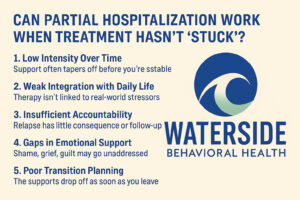
1. Low Intensity Over Time
Too many programs taper off support before you’ve built internal stability. Weeks into “independent life,” the cracks open again.
2. Weak Integration with Daily Life
What you talk about in therapy often doesn’t translate the moment you walk into your chaos. The “clinical room” becomes a sandbox—none of real life’s torque applies until later.
3. Insufficient Accountability
In outpatient models, there’s often no real consequence or follow-up if you drift. Without that feedback loop, relapse becomes easy to rationalize.
4. Gaps in Emotional Support
Programs sometimes skip the parts no one wants to talk about—shame, grief, relapse guilt—leaving those wounds unhealed.
5. Poor Transition Planning
Many programs end abruptly. You exit the safe container and reenter a world unprepared. The supports drop off just when you’re most fragile.
When the structure doesn’t match the depth of what you struggle with, treatment becomes a well‑worn script, not a life change.
What Partial Hospitalization Program (PHP) Changes—How It Creates Stickiness
Here’s where a well‑designed PHP can disrupt the cycle. These are the differences I emphasize in my work at Waterside Behavioral Health in Bristol County, MA.
High Frequency + Daily Repair
PHP compresses therapy, group work, emotional processing into daily or near‑daily sessions. That density means you don’t wait days or weeks for an issue to surface. The drift window shrinks.
Real-Time Application
You bring real stressors: at work, with family, relational friction, emotional spillovers—into treatment while they’re live. You don’t wait until the weekend to unpack it. You get support in the moment.
Tight Accountability & Visibility
There’s no hiding. Your choices, your slips, your emotional cracks are seen in the therapy container. That visibility lets clinicians intervene early—not after the damage is done.
Healing Community
There’s something sticky in sitting in a room with people who know your inner chaos. When shame shrinks under shared vulnerability, you’re less likely to bounce into isolation. The group becomes a landing place when your self-belief wobbles.
Gradual Step-Down and Longhaul Support
PHP isn’t just an intense sprint and then vanish. It’s designed to taper you into lower levels of care (IOP, outpatient) with continuity so change travels with you. You don’t drop off a cliff on day 1 after discharge.
Adaptive Responsiveness
A good PHP adjusts with you—if one method isn’t landing, you’ll shift to another approach. More trauma work. More experiential. More medical support. The program evolves with your needs—not rigidly stick to a plan.
How I Describe the Shift to Someone Who’s Skeptical
Let me talk to you as one who’s been disappointed:
You might say: “I gave therapy a real shot. I showed up. I gave time. But nothing stayed.”
I’ll say: You tried a cycle that wasn’t designed to hold you through chaos. The treatments that stick are the ones that stay with you in your life, not just in sessions.
PHP is like teaching someone to walk while running through wind and rain, not just inside a gym. It builds strength in a storm—not in ideal conditions alone.
Embedded FAQ Moments (Without a Formal FAQ Section)
Does multiple sessions per week burn people out?
Yes, early on. I counsel people: it feels heavy. But we pace. We build rest. The friction is part of the growth if we don’t let it break you.
What if I relapse during PHP?
That’s not failure. It’s a signal. In many PHPs, relapse or slips become material to bring into group—not shame to hide. We re-route, repair, adjust. The container holds through those moments.
Will I lose my life outside treatment?
You remain yourself. The aim isn’t erasure. We build around your commitments. We don’t demand you drop everything unless absolutely necessary. You bring your life in, piece by piece.
What if treatment has always felt clinical and distant?
Then you’ve been in a container built for general risk, not you. PHP gives space for intimacy, tailoring, emotional depth. It becomes the “real” practice place for your life.
A Story of Treatment That Didn’t Stick—and Then One That Did
Case: “Morgan” (pseudonym)
Morgan had done outpatient therapy, weekend intensives, medication trials. Each time, the world would crack, she’d slip, then retreat. She believed nothing lasts.
When she came to our PHP, the first few days were frightening. She saw her reactions that she’d ignored—anger, guilt, longing. She cried. She tried to mask. Clinicians encouraged her to name what she felt.
In week two she vocalized a craving. We didn’t shame. We listened. We traced its roots (overwhelm, hidden grief). She brought it into group. Others echoed. She felt less alone.
By week four she was rewriting her story—not as someone who falls again, but someone building structures strong enough to withstand the fall.
She left PHP thinking: “Maybe I don’t trust treatment—but maybe I can trust how this one sticks to me when I’m raw.”
What You Can Look for in a PHP (So It Won’t Slip)
If you’re skeptical, vet the program like you’d vet a car. Look under the hood:
- Daily or near‑daily services
- Clinical intensity (not just psychoeducation)
- Group + individual + experiential modalities
- Transition planning built in
- Relapse or slip protocols
- Flexible responsiveness
- A container that expects—not punishes—humanity
You want treatment that doesn’t just “drop you off” when you’re “well enough.” You want a structure that journeys with you into the hard places.
If you’ve been burned by hope before, I don’t ask you to believe everything I say. But I ask this: Could change stick if the program holds differently? If your design mismatch was the problem, maybe the right PHP can feel like a home you carry, not a brief shelter.
Call 774‑619‑7750 to learn more about our partial hospitalization program services in Plymouth County, MA. If what you tried before slipped—maybe the missing piece was the program, not your resolve.