

You’re not okay.
But you’re still showing up.
You answer emails. You get through meetings. You do what needs to be done. And then, somewhere in between all of that, you feel it—the quiet unraveling you can’t really explain to anyone.
If you’ve been searching for something—anything—that fits into your life without forcing you to step away from it, you’re not alone. A lot of people end up here, looking into options like intensive outpatient programs for behavioral health in Massachusetts while thinking:
“I need help… but I can’t afford to stop everything.”
I’ve been in that space. And I want to walk you through this in a way that actually respects your reality.
Step 1: Stop Waiting for Life to Slow Down
If you’re like most people in this position, you’re waiting.
Waiting for a lighter week.
Waiting for things to calm down.
Waiting until you “have time” to deal with this.
But here’s the truth most people learn the hard way:
Life doesn’t pause so you can catch up.
And the longer you wait, the heavier this gets.
It doesn’t mean you have to overhaul your entire life overnight.
But it does mean this—waiting for the perfect moment is what keeps you stuck in the same cycle.
You don’t need perfect timing.
You need a starting point.
Step 2: Get Honest About How Close You Feel to the Edge
This part is uncomfortable, but it matters.
Because “falling apart” doesn’t always look dramatic.
Sometimes it looks like:
- You’re constantly tired, no matter how much you sleep
- You feel disconnected in conversations, even with people you care about
- You’re going through the motions, but nothing feels grounded
- You’re relying on habits just to get through the day or night
You might still be functioning.
But you’re doing it at a cost.
And that cost doesn’t stay invisible forever.
Step 3: Redefine What “Help” Has to Look Like
A lot of people avoid getting support because they think it means:
- Taking time off work
- Leaving their responsibilities behind
- Explaining everything to everyone
That’s not the only option.
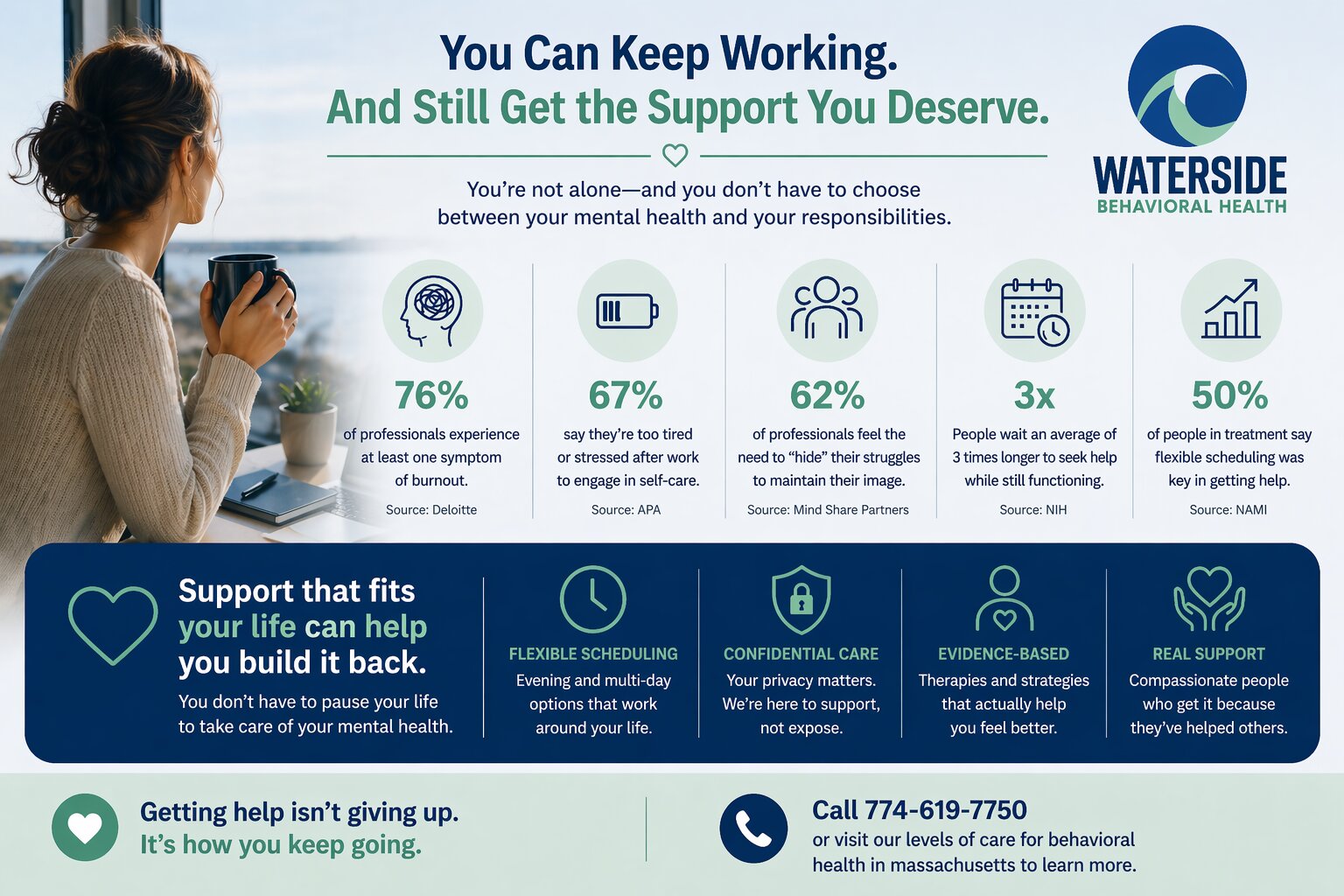
There are levels of care designed for people exactly in your position—people who need real support but can’t step away from their lives.
That might look like:
- Multi-day weekly treatment that happens outside work hours
- Structured support a few hours at a time
- Consistent care that builds over the week instead of once-a-week check-ins
If you’ve been searching for mental health help Massachusetts, what you’re really looking for is something that fits your life—not something that replaces it.
That exists.
Step 4: Start With What You Can Sustain—Not What Sounds Ideal
This is where people get tripped up.
You start thinking:
“If I do this, I need to fully commit.”
“If I can’t do it perfectly, I shouldn’t start.”
That pressure will keep you frozen.
Instead, ask yourself:
- What can I realistically show up for this week?
- What feels manageable, even if it’s not perfect?
Because here’s the shift:
The goal isn’t intensity.
It’s consistency.
Something you can actually stay with will help you more than something that overwhelms you and pushes you out.
Step 5: Expect Some Resistance (It Doesn’t Mean You’re Failing)
Even if you find something that fits your schedule, part of you might still push back.
That’s normal.
Especially if you’ve:
- Left treatment before
- Stopped showing up
- Felt like something “didn’t work”
You might think:
“What if I do that again?”
That fear makes sense.
But it doesn’t mean you shouldn’t try.
It just means this time, you approach it differently:
- You go at a pace you can handle
- You choose something that fits your real life
- You give yourself room to not do it perfectly
You don’t need to prove anything.
You just need to stay.
Step 6: Stop Minimizing What You’re Feeling
This one runs deep.
Because you’re still functioning, it’s easy to tell yourself:
- “It’s not that bad”
- “Other people have it worse”
- “I should be able to handle this”
But here’s the reality:
If it feels like you’re falling apart, that matters.
You don’t need a crisis to deserve support.
You don’t need to hit a breaking point to take this seriously.
You’re allowed to get help before everything collapses.
Step 7: Let Someone Help You Narrow It Down
You don’t have to figure this out alone.
And honestly, trying to research every option when you’re already overwhelmed usually makes things worse.
If you’re exploring support in Massachusetts, the most helpful thing you can do is talk to someone who understands how different levels of care actually work in real life.
Even exploring structured approaches like help in Massachusetts can give you a starting point without locking you into anything.
One conversation can replace hours of overthinking.
Step 8: Protect Your Life by Taking Care of Yourself—Not Avoiding It
This is the part that shifts everything.
Right now, it might feel like getting help is a risk.
Like it could interfere with your work, your responsibilities, your stability.
But not getting help?
That’s a slower risk.
It’s the kind that builds quietly:
- More exhaustion
- Less focus
- Less patience
- Less capacity to keep everything together
Taking care of yourself isn’t stepping away from your life.
It’s how you protect it.
The Part That’s Hard to Admit
You don’t want everything to fall apart.
That’s why you’re still pushing through.
But pushing through isn’t the same as being okay.
And you don’t have to keep living in that gap.
There is a version of support that fits into your life.
There is a version of this where you don’t feel like you’re barely holding it together.
You don’t have to figure all of it out today.
But you don’t have to stay here either.
FAQ: If You Feel Like You’re Falling Apart But Can’t Miss Work
Can I actually get help without taking time off work?
Yes. There are structured programs designed specifically for people who need to maintain their job while getting consistent support.
What if I’ve started something before and didn’t finish?
That’s more common than people admit. It doesn’t mean you failed—it usually means the fit or timing wasn’t right.
How do I know what level of support I need?
You don’t have to decide that on your own. A conversation with a provider can help match you to something realistic and sustainable.
What if I’m too overwhelmed to even start?
Then starting small matters most. One step—like reaching out or asking questions—is enough for now.
Do I need to be in crisis to get help?
No. You don’t need to be at your worst. Getting support earlier often makes things easier to manage.
What if I’m worried I won’t stick with it?
That’s a valid fear. The key is choosing something that fits your life so it feels possible to continue—not overwhelming to maintain.
If any part of this feels like you, you don’t have to keep carrying it alone.
Call 774-619-7750 or visit our levels of care for behavioral health in massachusetts to learn more about our levels of care for behavioral health in Massachusetts, intensive outpatient programs iop for behavioral health in Massachusetts services in Plymouth County, MA.