
Even high-functioning people break.
They just do it differently—quietly, efficiently, often alone.
You keep showing up. You hit deadlines. You manage your household, stay late for work, remember birthdays, maybe even squeeze in a workout. But it’s not sustainable anymore. Underneath the schedule and smiles, something hurts. You’ve stopped feeling like yourself.
If that sounds familiar, it’s not in your head—and you’re not overreacting.
When life starts feeling harder than it should and nothing external has changed, it’s time to look inward. For many people in this exact space, an Intensive Outpatient Program (IOP) can offer the structure and support needed to actually turn things around.
The Invisible Weight High-Functioners Carry
People assume you’re fine because you’re still performing.
What they don’t see: the energy it takes to get out of bed. The quiet panic during meetings. The way your smile feels mechanical. The mental math you do to figure out how many hours you have to “act normal” before you can collapse again.
High-functioning depression and anxiety don’t look like the stereotypes. They look like overachievement. Like saying “I’m tired” when you mean “I feel like I’m disappearing.”
“I was doing everything I was supposed to—but I hadn’t felt anything in months.”
– IOP Client, 2024
Why You Might Be Struggling More Than You Realize
Mental health symptoms don’t always scream. Sometimes they whisper for years before you realize they’ve taken something from you.
- You get irritable with people you love.
- You lose interest in things that used to bring joy.
- You lie awake at night with your heart racing, for no clear reason.
- You cry in the car and wipe your face before going back inside.
These aren’t just “bad days.” They’re signals. And while one therapy session a week might offer temporary relief, many high-functioning people need more to make a meaningful shift.
What an Intensive Outpatient Program IOP Really Is
Let’s get one thing straight: IOP is not inpatient treatment.
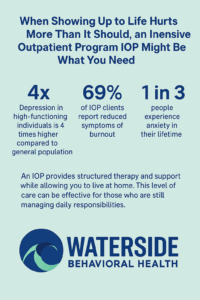
There’s no overnight stay. No being “locked in.” It’s a flexible level of care that allows you to live at home and continue managing your responsibilities while receiving clinical, group, and individualized therapeutic support multiple times per week.
At Waterside Behavioral Health, our Intensive Outpatient Program in Plymouth County meets you where you are. You don’t have to be in crisis to qualify. You just need to be ready to stop pretending everything’s fine when it isn’t.
Who IOP Helps—and Why It Works
IOP is designed for people who are struggling but not necessarily in acute crisis. Think of it as the in-between space—more than outpatient therapy, but less intensive than full-time residential treatment.
It’s especially effective for people who:
- Are dealing with anxiety, depression, trauma, or emotional fatigue
- Can’t afford to take weeks off from work or caregiving
- Have plateaued in weekly therapy
- Want to feel something again—other than dread or numbness
With consistent support, group process work, and skilled clinicians helping you reconnect to yourself, IOP provides space for healing that doesn’t derail your life—it helps restore it.
The Plymouth County Reality: Functioning Isn’t Healing
In places like Plymouth County, high-functioning burnout is often normalized. The rhythm of life in coastal Massachusetts—commuting, caregiving, navigating seasonal stress—can make quiet suffering look like discipline.
But there’s a difference between pushing through and actually coping.
If you’re located in Plymouth or Bristol County and looking for options, we offer care that doesn’t shame you for being exhausted. Our team specializes in working with people who look fine on the outside but feel everything collapsing underneath.
Looking for Intensive Outpatient Program IOP in Bristol County, MA? We serve that region too.
One Client’s Story: “I Didn’t Know I Was Allowed to Ask for This”
One client shared that for years, they believed help was reserved for people who were “worse off.” People with visible breakdowns. People who couldn’t work or keep up.
But after three weeks in IOP, they said this:
“For the first time in a long time, I don’t feel like I’m faking my life. I’m actually living it again.”
That’s the kind of shift IOP is designed to create. Not perfection. Not magic. Just movement—back to feeling like yourself.
You Don’t Need to Prove Your Pain
You don’t have to wait until you’re in pieces. You don’t have to justify why you feel heavy, flat, or off. You just have to notice it—and allow yourself to wonder what healing might actually feel like.
Ready to Talk?
Call 774-619-7750 or visit our Intensive Outpatient Program IOP page to learn more about services in Plymouth County, MA. We’ll listen. We’ll help. And we’ll never ask you to be more put together than you are.
FAQ: Intensive Outpatient Program (IOP) for High-Functioning Clients
What does a typical IOP schedule look like?
Most IOPs meet three to five days per week for 2–4 hours per day. At Waterside Behavioral Health, we work with you to build a schedule that respects your work and family commitments while giving you enough structure to support actual healing.
Will I have to explain my situation to a group?
Group therapy is part of IOP, but you won’t be forced to share more than you’re ready to. Many clients are surprised by how validating it feels to be around others who are also high-functioning and silently struggling.
Is this only for people with diagnosed disorders?
Not at all. Many IOP clients come in with stress, burnout, anxiety, or depressive symptoms that haven’t been formally diagnosed. Part of our role is helping clarify what’s happening—and offering a path forward.
Can I do IOP while working full-time?
In many cases, yes. Our team will work with you to find a schedule that fits. We understand that stepping away from work entirely isn’t an option for everyone—and we don’t expect you to.
What makes Waterside’s IOP different?
We don’t assume that high-functioning means healthy. Our clinicians are trained to spot hidden signs of distress. And our programs are built for real life—designed to help you function better not just on paper, but internally.