

Even if you’ve stopped going, the program might still be on your mind.
You might wonder: “Was it working?” “Did I mess it up?” “Would it be different if I went back?”
Here’s the truth: you’re not alone—and you’re not beyond help. At Waterside Behavioral Health, we’ve worked with hundreds of clients across Plymouth County, MA and beyond who felt the same hesitation.
Let’s talk about what it really means to “feel better” in IOP—without the sugarcoating, without the shame, and without pretending it’s easy.
1. The First Few Weeks Might Feel Worse—And That’s Okay
A lot of people drop out of IOP not because it isn’t helping, but because it starts stirring things up.
When you’ve been surviving in survival mode, stillness can feel like a threat.
You might feel more tired. More emotional. More exposed.
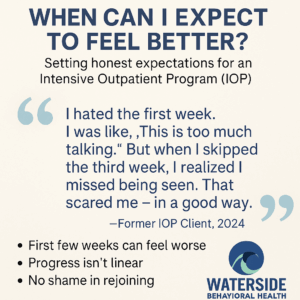
“I hated the first week. I was like, ‘This is too much talking.’ But when I skipped the third week, I realized I missed being seen. That scared me—in a good way.”
– Former IOP Client, 2024
What’s happening? You’re not regressing. You’re thawing. It’s common to feel worse before you feel better. You’re beginning to face what you’ve been numbing or avoiding. That’s not failure. That’s a sign of real movement.
2. Progress in IOP Isn’t Linear—It’s Layered
Let’s kill the myth that healing looks like steady, upward progress.
More often, it looks like this:
- Week 2: You finally share something real in group
- Week 3: You’re so exhausted you consider quitting
- Week 4: You laugh—like, really laugh—for the first time in weeks
- Week 5: You question everything
- Week 6: You realize you’re sleeping better and snapping less
This back-and-forth rhythm is the work. In fact, one of the best predictors of lasting change is a client’s ability to stay engaged even when they’re not sure it’s working.
3. Ghosting Isn’t the End of the Story
Let’s get real: plenty of people ghost after a session or two. Life gets complicated. Shame creeps in. You miss a day, then two… then it feels easier not to go back.
But you don’t need a grand apology tour to return.
You just need to want to feel better—still.
And if that’s where you’re at, then yes: you’re welcome back.
We’ve had people from all across Plymouth County and Bristol County rejoin IOP after ghosting for weeks, even months. The bravest ones? They came back quietly. No fanfare. Just readiness.
“I thought they’d judge me for leaving. But when I called back, they just said, ‘We’re glad you called. Let’s get you in.’ That’s all I needed.”
– IOP Client, 2023
4. Feeling Better Looks Different Than You Expect
Here’s what “feeling better” often looks like in real life:
- You stop dreading your alarm in the morning
- You don’t explode over a missed call or dirty dish
- You walk out of group and think, That made sense
- You catch yourself saying something kind—to yourself
You might still have anxious days. You might still get triggered. But your reactions start shifting. And those shifts matter more than a mood score.
5. Vulnerability Accelerates Healing (Even When It Feels Risky)
You don’t have to overshare in IOP. But here’s the secret: when you name what you’re actually feeling—even if it’s, “I don’t trust this place yet”—you speed up your own healing.
The group isn’t judging your pain. They’re in it, too.
“The day I said I wanted to disappear was the day I felt the safest. Nobody flinched. They just nodded. That was the first time I believed I wasn’t alone.”
– Waterside Client, 2022
6. You Don’t Have to Be “Fixed” on a Schedule
Some people feel a shift by week 3. Others take longer.
There’s no timer on your healing. And the truth is, lasting change doesn’t usually feel dramatic.
It feels like capacity: You have more space in your brain. More breath in your lungs. More pause between trigger and reaction.
That’s real. That’s IOP working—even if it’s slow.
7. You Can Come Back Mid-Journey—No Explanations Needed
Maybe you’re still using. Maybe you’re not sure you believe in therapy anymore.
Maybe you just miss the group and don’t know how to say it.
You don’t need to explain yourself to walk back in. You don’t need to start over.
You just need to say: “Hey. I think I want to come back.”
And we’ll say: Welcome.
Real Words from Real People
Here’s what some past IOP clients told us about their process:
“I kept thinking I wasn’t making progress because I still had bad days. But someone said, ‘You’re handling the bad days better.’ That clicked.”
“IOP didn’t fix everything. But it gave me a rhythm. And from there, I rebuilt.”
“Leaving and coming back was the hardest part. But it reminded me—I’m allowed to want help more than once.”
Frequently Asked Questions About IOP at Waterside
How long does it take to feel better in IOP?
Everyone’s timeline is different. Some people feel more emotionally regulated within 3–4 weeks. Others take longer. The key is showing up consistently and giving yourself permission to heal slowly.
What if I stopped coming—can I rejoin?
Yes. We welcome returning clients all the time. Whether you ghosted for a week or a few months, you’re not disqualified. Just call and ask about re-entry options. No lectures, no shame.
Do I have to start over if I come back?
Not necessarily. We’ll meet you where you left off and help you integrate into the current phase or find a better-fitting group. Every case is individualized.
What happens in a typical IOP session?
IOP usually includes group therapy, skills-building, and check-ins with clinicians. Sessions run 3–4 days a week, often for 3 hours at a time. The vibe is structured but supportive—not sterile or formal.
What if I’m not sure I need this level of care?
That’s okay. We can help you assess what’s right for you. Whether it’s IOP or something else, we’ll walk you through the options and tailor a plan that fits your needs.
📞 It’s Not Too Late to Come Back
Whether you paused because life got messy or you just weren’t ready yet, you’re still allowed to want help.
Call 774-619-7750 or visit our IOP page to learn more about Intensive Outpatient Program IOP services in Plymouth County, MA. We’re ready when you are.