

You’re still getting through your days.
Deadlines are met. Messages are answered. From the outside, nothing looks off.
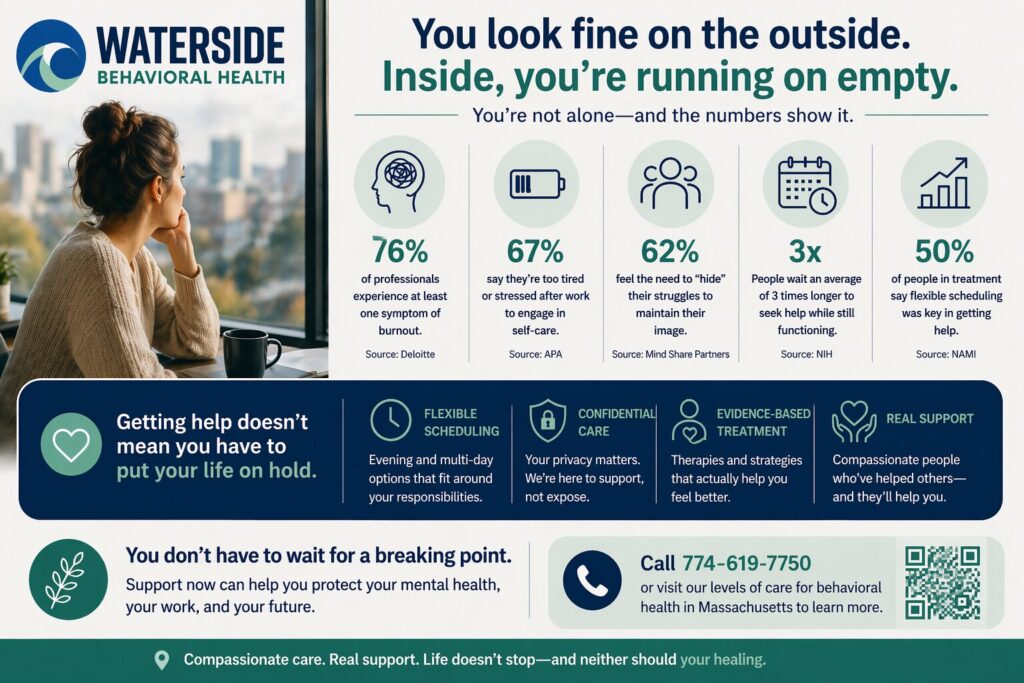
But internally, something is tightening. Slipping. Wearing down.
We see this all the time—people who don’t look like they need help, but are quietly trying to figure out options like intensive outpatient programs for behavioral health in Massachusetts.
Not because everything has fallen apart.
Because it hasn’t—but it might if nothing changes.
You’re Not “Overthinking”—You’re Trying to Solve This Without Anyone Noticing
High-functioning clients don’t usually come in saying, “I need help.”
They come in after weeks—sometimes months—of research.
Tabs open. Comparisons running. Terms like PHP vs IOP Massachusetts circling in your head while you try to decode what each option means for your life.
But what you’re really asking is quieter:
“How do I fix this without disrupting everything I’ve built?”
That question makes sense.
It’s also where people get stuck.
Because the goal becomes minimizing impact… instead of maximizing support.
One of the First Signs: You’re Stuck in Research Mode
At first, researching feels productive.
You’re learning. Comparing. Getting informed.
But then it stretches out.
- You reread the same information multiple times
- You wait until you feel “fully ready”
- You keep thinking one more piece of clarity will make the decision obvious
It won’t.
There’s a point where research stops being helpful and starts becoming a buffer.
A way to stay in control without actually stepping into change.
We see this often—people who know exactly what their options are, but haven’t moved toward any of them.
Not because they don’t care.
Because they’re trying to make the perfect choice.
And that pressure keeps them still.
Another Sign: What You’re Doing Now Isn’t Reaching You Anymore
Most high-functioning people don’t jump straight into structured care.
They start smaller.
Weekly therapy. Self-management. Pushing through.
And for a while, it works—enough.
Until it doesn’t.
You might notice:
- You’re repeating the same conversations without new insight
- You leave sessions and immediately get pulled back into the same patterns
- You’re aware of the problem, but not changing it
That’s usually when the question shifts from “Do I need help?” to “What kind of help actually works?”
That’s where comparisons like structured daytime care vs multi-day weekly treatment start to matter.
Not in theory—in practice.
The Tug-of-War Between Stability and Relief
There’s a tension you probably haven’t said out loud.
One side of you wants relief:
“I can’t keep carrying this the same way.”
The other side wants stability:
“I can’t afford to disrupt my life.”
So you hover in between.
Looking for an option that solves the problem… without touching your schedule, your responsibilities, your identity as someone who “handles things.”
Here’s the honest part:
Any level of care that actually helps will ask for some change.
Not collapse. Not chaos.
But enough of a shift to create space for something different.
What People Miss When Comparing Levels of Care
When people search PHP vs IOP Massachusetts, they often focus on surface-level differences:
Time commitment. Schedule. Structure.
But that’s not where the decision lives.
The real difference is this:
- One option asks you to step further out of your routine to stabilize
- The other asks you to stay in your routine while building support around it
Neither is better.
But one will fit your current reality better than the other.
And if you choose based only on what feels least disruptive, you risk choosing something that doesn’t actually move the needle.
The Moment It Starts to Click
There’s usually a quiet turning point.
Not a breakdown. Not a crisis.
Just a moment where you realize:
“I’ve been managing this… but I’m not actually getting better.”
That realization changes the question.
It’s no longer:
“What can I fit into my life?”
It becomes:
“What will actually help me feel different?”
That’s when people start choosing differently.
Not perfectly—but more honestly.
What Happens When the Fit Is Right
When someone lands in the right level of care, you see it quickly.
Not in big, dramatic ways.
In subtle ones:
- They stop bracing for the next day
- They don’t feel like they’re performing all the time
- They start processing things instead of avoiding or managing them
There’s relief—but more importantly, there’s movement.
That’s the goal.
Not perfection. Not instant change.
Progress that actually sticks.
You Don’t Have to Earn the Right to More Support
This is where a lot of high-functioning people hesitate the longest.
You tell yourself:
- “It’s not bad enough yet.”
- “Other people need this more.”
- “I should be able to handle it.”
But here’s the truth:
Functioning isn’t the same as being okay.
And waiting until things get worse doesn’t make the decision easier—it just makes the recovery longer.
If you’ve been looking for real care in Massachusetts, you’re allowed to choose it before things fall apart.
If you’ve been searching for help in Massachusetts, you don’t need a breaking point to justify it.
The Quiet Pattern We See Again and Again
People don’t come to us because everything collapsed.
They come because something didn’t feel sustainable anymore.
They’ve been:
- Holding it together longer than most people realize
- Managing more than they let on
- Quietly reaching a point where effort isn’t enough
That’s not failure.
That’s awareness catching up to reality.
FAQ: What High-Functioning Clients Usually Ask
How do I know if I need more than weekly therapy?
If you feel like you’re maintaining but not improving—or repeating the same patterns without change—it may be time for more consistent support.
What’s the main difference between higher levels of care?
It’s less about labels and more about structure. Some options require stepping out of your daily routine more, while others work around it with consistent weekly engagement.
What if I choose the wrong level of care?
That happens sometimes—and it’s adjustable. The goal isn’t to get it perfect immediately, but to start somewhere that moves you forward.
Can I keep working while getting more support?
In many cases, yes. Some programs are specifically designed to fit around work and responsibilities.
Do I have to feel “bad enough” to start?
No. You don’t need a crisis to justify getting help. If something isn’t sustainable, that’s reason enough.
What if I’m still unsure?
Uncertainty is normal. Most people don’t feel fully confident before starting—they feel ready enough to try.
If this feels familiar, you’re not behind.
You’re at the point where awareness is turning into action.
And that’s where real change begins.
Call 774-619-7750 or visit our levels of care for behavioral health in massachusetts to learn more about our levels of care for behavioral health in Massachusetts, intensive outpatient programs iop for behavioral health in Massachusetts services in Plymouth County, MA.