

So… you stopped showing up.
Maybe it was sudden. Maybe it was slow.
Maybe it was one missed session that turned into three, or maybe you closed the laptop mid-group and never logged back in.
However it happened—you left. And now you’re not sure how (or whether) to come back.
Let’s clear one thing up right away:
You are still allowed back.
You are not the only one who’s ghosted.
And you haven’t ruined your shot at healing.
At Waterside Behavioral Health’s intensive outpatient program in Massachusetts, we work with humans, not robots. Life happens. People disappear. People reappear. What matters most isn’t the gap in between—it’s what you do next.
If you’re thinking about coming back, here’s how to rebuild trust with your IOP team—without guilt, pressure, or shame.
1. You Don’t Need an Epic Explanation—Just a Starting Point
You may feel like you owe everyone a dramatic story.
Some perfect “reason” that explains why you left. But you don’t.
You can say:
- “Hey, I fell off for a while. I’d like to come back.”
- “I ghosted. I’m nervous, but I want to rejoin.”
- “Is it okay if I start over?”
That’s enough.
Your team won’t demand a full account. We’re not interested in shaming you into an apology. We’re interested in making space for you now.
What you don’t say matters less than the fact that you said something at all.
2. No One’s Mad at You
This might be the most important thing to hear: no one is mad.
When you’re the one who left, it’s easy to imagine your spot being filled with judgment:
- “They probably think I’m flaky.”
- “They’re disappointed in me.”
- “They don’t want to waste time on someone who bailed.”
But treatment teams know better than that. We know what happens when overwhelm collides with real life. We know that avoiding treatment is sometimes part of the illness—not a character flaw.
We’re not here to make you feel bad. We’re here to help you feel safe enough to try again.
3. If You’re Feeling Embarrassed—That’s Normal
Ghosting can come with a strange mix of guilt, fear, and “what now?”
You might feel:
- Embarrassed to see staff again
- Afraid you’ve lost credibility
- Unsure whether the group will accept you
We get it.
Coming back can feel like walking into a room where everyone kept going without you. But here’s the thing: they didn’t.
Other people drop out. Other people come back. You won’t be the first—and you won’t be judged for it.
You don’t have to explain yourself to every group member. You don’t have to wear your absence like a name tag. If anything, your honesty might make someone else feel less alone.
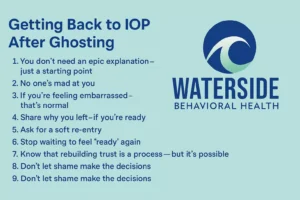
4. Share Why You Left—If You’re Ready
You don’t have to unpack your departure, but if you’re willing, it can help us help you.
Sometimes people leave because:
- The schedule didn’t work anymore
- A certain group felt unsafe
- Treatment felt too fast or too slow
- They weren’t ready emotionally
- Life outside the program just… took over
All of those reasons are valid. And all of them are workable.
When you tell us what made you ghost, we can build something better this time—together.
5. Ask for a Soft Re-Entry
You don’t have to walk back in at full speed.
Want to ease in quietly? Cool.
Need a few one-on-one sessions first? We can do that.
Not ready for group yet? Let’s talk about what’s possible.
Re-entry doesn’t have to look like a comeback tour. It can look like one small step—a phone call, a private session, a trial day. We’ll work with your pace.
Our intensive outpatient program in Plymouth County, MA is designed to flex with real-life needs, not punish you for struggling.
6. Stop Waiting to Feel “Ready” Again
Maybe you keep thinking:
“I’ll come back when I’m more stable.”
“I’ll reach out when I have something to show.”
“I don’t want to return just to leave again.”
But waiting to feel ready is a trap. Readiness isn’t a magic feeling. It’s a decision you make despite your doubts.
You don’t have to be perfectly regulated, highly motivated, or totally certain to return. You just have to be open.
Open to trying. Open to connection. Open to something new.
That’s enough.
7. Know That Rebuilding Trust Is a Process—But It’s Possible
If you’re worried that your team won’t trust you now—or that you’ve burned your bridge—breathe.
Trust isn’t about showing up perfectly. It’s about showing up honestly.
You rebuild it by:
- Following through, even imperfectly
- Speaking up when things get hard
- Letting us support you, even when you feel unworthy
You’re not coming back to prove anything. You’re coming back to heal.
And we’re here for that.
8. Don’t Let Shame Make the Decisions
Shame is sticky. It whispers that you already blew it, that you’re too inconsistent, that people have moved on without you.
But shame doesn’t tell the truth.
Your story isn’t too messy. Your return isn’t too late.
And your spot? It’s still here.
Even if you’re in Bristol County and looking for an intensive outpatient program, our team can help you reconnect with care, no matter how long it’s been.
FAQ: What to Know About Returning to IOP After Ghosting
Is it normal to drop out of IOP and come back?
Completely normal. Many people leave treatment for all kinds of reasons. What matters most is that you’re thinking about reengaging. That’s a win.
Do I have to explain to the whole group why I left?
No. You never have to share more than you want. We can help you rejoin in a way that’s private and comfortable. The focus is on your next step—not your absence.
Will I have to start the program over?
Not always. It depends on how long you’ve been gone and how far along you were. Your treatment team will work with you to decide what makes sense and what supports your goals now.
What if I left because something in the program wasn’t working?
That’s totally valid. We want to know what didn’t feel right so we can adjust and improve. Your feedback isn’t inconvenient—it’s valuable.
Can I request different group times or formats this time?
Yes. Our intensive outpatient program is flexible. If your schedule, needs, or comfort level has changed, we’ll explore options that work better for you.
What if I ghost again?
Then we’ll meet you again with compassion. Treatment isn’t about perfection—it’s about progress. If you leave again, you’re still welcome back. Every time.
Still thinking about returning? You don’t have to do it alone.
Call 774-619-7750 or visit our intensive outpatient program page to reconnect with care in Plymouth County, MA. No guilt. No lectures. Just people who still believe in you.