

It happens.
You miss a group. Then two.
Life gets complicated, heavy, overwhelming—and suddenly, you’re not in your Intensive Outpatient Program anymore.
Maybe it wasn’t a conscious decision. Maybe you were too tired, too anxious, or too ashamed to keep showing up.
Now the holidays are here. You’re scrolling past smiling faces and hearing the same old story in your head:
You had your chance. You blew it.
But what if that story isn’t true?
At Waterside Behavioral Health in Plymouth County, we believe healing has room for reentry. Whether you’ve missed a week, a month, or the better part of the year—you’re still allowed to come back. No groveling. No guilt trip. Just a quiet invitation to begin again. Especially before the holidays try to tell you who you used to be.
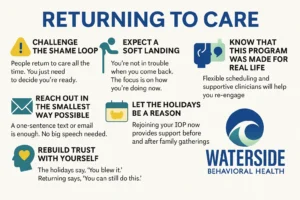
Step 1: Challenge the Shame Loop
You might be stuck in a cycle that sounds like this:
- “I should’ve stayed in.”
- “I always ruin things.”
- “They’re probably done with me.”
That inner voice—harsh, punishing, absolute—is shame talking.
But shame doesn’t know your whole story. And it doesn’t run this program.
People return to care all the time. Some after two days. Some after two years.
The one thing they all have in common? They came back anyway.
You don’t need to “earn” your way back. You just need to decide you’re ready. We’ll meet you there.
Step 2: Reach Out in the Smallest Way Possible
You don’t need a big speech or an apology essay to return.
A one-sentence text. A short voicemail. An email with one line:
- “I’d like to come back.”
- “Is it okay to restart?”
- “Can we talk?”
That’s enough.
We know it can feel awkward to make the first move after ghosting. But at Waterside, we treat every return with care and calm—not questions or judgment.
Especially during seasons like Thanksgiving, when emotions are louder and expectations are heavier, we want to make reentry simple and supportive.
Step 3: Expect a Soft Landing, Not a Scolding
One of the biggest fears we hear is:
“Will I be in trouble?”
Let us say this clearly:
You’re not in trouble. You’re in life.
When you return to your Intensive Outpatient Program, you’ll be welcomed with curiosity, not criticism.
We’ll ask how you’re doing. What’s been hard. What kind of support you want now.
That’s it.
You won’t need to “explain yourself.” You just get to be here.
Step 4: Talk About What Got in the Way—If You Want
Some people want to process what happened. Others want to just start fresh.
Both are okay.
But if you do want to unpack why you left, we’re here to help. Not to dissect it, but to make meaning of it—so it doesn’t feel like a personal failure, just a part of the journey.
Was it burnout? Schedule chaos? A tough group session you weren’t ready to face?
Let’s talk about it. Not to dwell—just to understand and adjust.
That’s how we build plans that work for real people. Not ideal versions of you, but the actual you.
Step 5: Let the Holidays Be a Reason, Not a Roadblock
Thanksgiving can feel like pressure in disguise.
Family expectations, emotional landmines, or just the ache of being reminded what “togetherness” used to feel like.
But it can also be an opportunity.
What if this holiday didn’t have to follow the same script?
Rejoining your IOP now gives you:
- A space to ground yourself
- Support before and after family gatherings
- Language for what you’re feeling—not just reactions
And if you’re looking for care near family in Bristol County, MA or closer to home in Plymouth County, our teams are here through the holidays. You’re not too late. You’re right on time.
Step 6: Rebuild Trust With Yourself, Not Just the Program
Coming back isn’t about proving anything to us. It’s about proving something to yourself:
That you can return. That you still care. That it’s not over.
Even if your voice shakes, even if it’s your third try, even if you’re unsure whether this time will stick—coming back means you’re still in the fight.
The trust doesn’t have to be instant. Let it grow, little by little, every time you show up again.
You’re not broken. You’re rebuilding.
Step 7: Know That This Program Was Made for Real Life
Waterside’s Intensive Outpatient Program isn’t built for perfect attendance or flawless follow-through.
It’s built for real humans with real obstacles. That means:
- Flexible scheduling
- Supportive group facilitators
- Clinicians who understand backslides, doubt, and messy motivation
We’ve seen hundreds of clients come back after leaving—and often, they return with more insight, more honesty, and more readiness than before.
You didn’t fail. You paused.
Let’s pick up from here.
Frequently Asked Questions About Rejoining IOP
What if I missed a lot of sessions?
That’s okay. We’ll help you review your treatment goals and decide how best to re-engage. You won’t be “behind”—you’ll just be starting again, with more context this time.
Do I have to go back into the same group?
Not necessarily. If your previous group is still running and feels like a good fit, you can rejoin. If not, we’ll match you with another group that suits your needs and timing.
Will I be judged or questioned about why I left?
No. Our job is to support you, not interrogate you. You can share as much or as little as you want. The focus is on now—not what happened before.
What if I’m embarrassed to face people in group again?
Many people feel that way—and many also find that returning helps reduce shame. You might even find your openness gives someone else the courage to keep going.
Is it okay to restart right before the holidays?
Absolutely. The holidays can be challenging for mental health, and many clients find it’s actually the best time to rejoin. You’ll have structure, support, and people who understand what you’re going through.
Call 774-619-7750 to connect with our Intensive Outpatient Program in Plymouth County, MA. No matter how long you’ve been away, your place is still here. Let this Thanksgiving be the one where you return.