

Sometimes you just stop going.
Not because you don’t care. Not because it didn’t help.
You just… didn’t show up one day. Then another. And then the thought of going back felt heavier than staying away.
You’re not alone in that. And you’re not the first person to wonder:
Is it too late to return to my Intensive Outpatient Program?
At Waterside Behavioral Health in Plymouth County, we see people come back to care all the time—especially during the holidays. And not one of them has to explain everything. They just have to start again.
If you’ve ghosted your IOP, skipped out mid-treatment, or quietly disconnected, this blog is for you. Here’s how to ask for help again without shame—and how to let this season be different.
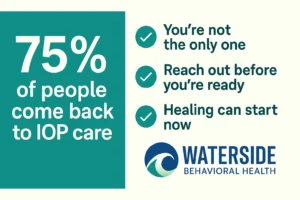
Step 1: Know That You’re Not the Only One
Missing sessions or stopping treatment altogether is more common than you think.
Life gets hard. Motivation dips. Holidays stir up emotions you didn’t expect. Or maybe the pace of IOP felt too much—and too little—at the same time.
You might be telling yourself:
- “I should’ve tried harder.”
- “They probably wrote me off.”
- “I messed up too much to be welcomed back.”
But none of that is true.
In reality? You’re exactly the kind of person this program was designed for. Someone who still wants help—even if it took a while to say it.
Step 2: Reach Out Before You’re Ready
If you’re waiting to feel fully ready to come back—you might wait forever.
The truth is, reaching out will always feel a little awkward. That’s okay. You don’t need to have the right words. You just need a first sentence.
Start with something simple like:
- “Hi, I was in IOP a while ago. Can I come back?”
- “I’ve been struggling again. Is it okay to restart?”
- “I’m not sure what to say, but I want to return.”
We won’t push. We won’t quiz you. We’ll just help you take the next step—at a pace that feels doable.
Especially if you’re local to Bristol County, MA or nearby areas, we can talk about what IOP reentry looks like close to home.
Step 3: Expect Welcome—Not Judgment
You might be bracing for awkwardness, side-eyes, or that feeling of being the kid who fell behind in class.
But here’s what actually happens when you return:
You’re welcomed. Quietly. Kindly. No spotlight.
You’ll get:
- A check-in about how you’re feeling now
- A conversation about what you want from treatment going forward
- Flexible options to rejoin a group or explore a new one
No lectures. No shame. Just a path forward.
You didn’t fail. You paused. And now you’re here.
Step 4: Let the Holidays Be a Reason, Not a Roadblock
This time of year brings up a lot—grief, pressure, loneliness, old wounds, messy families, and memories you thought you’d buried.
Sometimes the thought of starting again during the holidays feels… wrong. Too busy. Too late. Too emotional.
But it’s actually one of the most powerful times to return.
Here’s why:
- You’ll have support during a season that usually knocks you sideways
- You’ll walk into holiday gatherings with tools—not just tension
- You’ll get to end the year doing something for yourself—not just surviving it
You don’t need to make big declarations. Just come back quietly, and let the healing start in a small way.
Step 5: Redefine What “Showing Up” Means
If you left because IOP felt like too much… or too vulnerable… or like something you weren’t “good” at—you’re not alone.
Therapy isn’t always comfortable. Group work isn’t always easy.
But showing up doesn’t mean having perfect attendance or the right answers.
It means:
- Being honest about what you need
- Letting people support you when things feel too heavy
- Giving yourself permission to try again
We meet clients every day who once ghosted or drifted away. Many of them come back stronger—not because they’re “fixed,” but because they’re ready to be real.
Step 6: Let Reentry Feel Small
Coming back doesn’t have to be dramatic.
It can look like:
- Sitting quietly in a group without saying much
- Showing up late and staying anyway
- Crying during check-in because you forgot how hard it is to start again
That’s all welcome here.
Our IOP was built for humans—not machines. Your pace is your own.
And if you need help adjusting your schedule, switching groups, or starting slowly, we’ll help you do that without any pressure.
Step 7: Know That This Is What Healing Looks Like
People think healing is a straight line. It’s not. It looks like:
- Leaving before you’re ready
- Missing sessions you swore you’d attend
- Coming back with your head down and your heart aching
And still being worthy of care.
You don’t have to prove anything to us. You just have to walk through the door.
FAQs About Rejoining an Intensive Outpatient Program
Is it normal to leave IOP and come back?
Yes. Many people pause or stop treatment and return later. We’re always ready to meet you wherever you are now—not where you left off.
Do I have to explain why I left?
Not unless you want to. We’ll ask what you’re feeling now and what you hope to get from returning. You don’t owe us a full story.
Can I restart during the holiday season?
Absolutely. In fact, the holidays are one of the best times to have extra support. Many clients rejoin in November or December.
Will I have to go back to the same group?
Not necessarily. If your original group is still running and feels like a good fit, we’ll explore that. If you’d prefer a different one, we’ll help you transition.
What if I’m embarrassed to return?
That’s completely valid—and completely common. Most clients feel awkward at first, then relieved within the first session. You won’t be judged. You’ll be met with warmth.
Call 774-619-7750 to connect with our Intensive Outpatient Program in Plymouth County, MA. Whether you’ve been away for a week, a month, or longer—you’re not too late. You’re right on time. Let this holiday season be the one where you come back.