

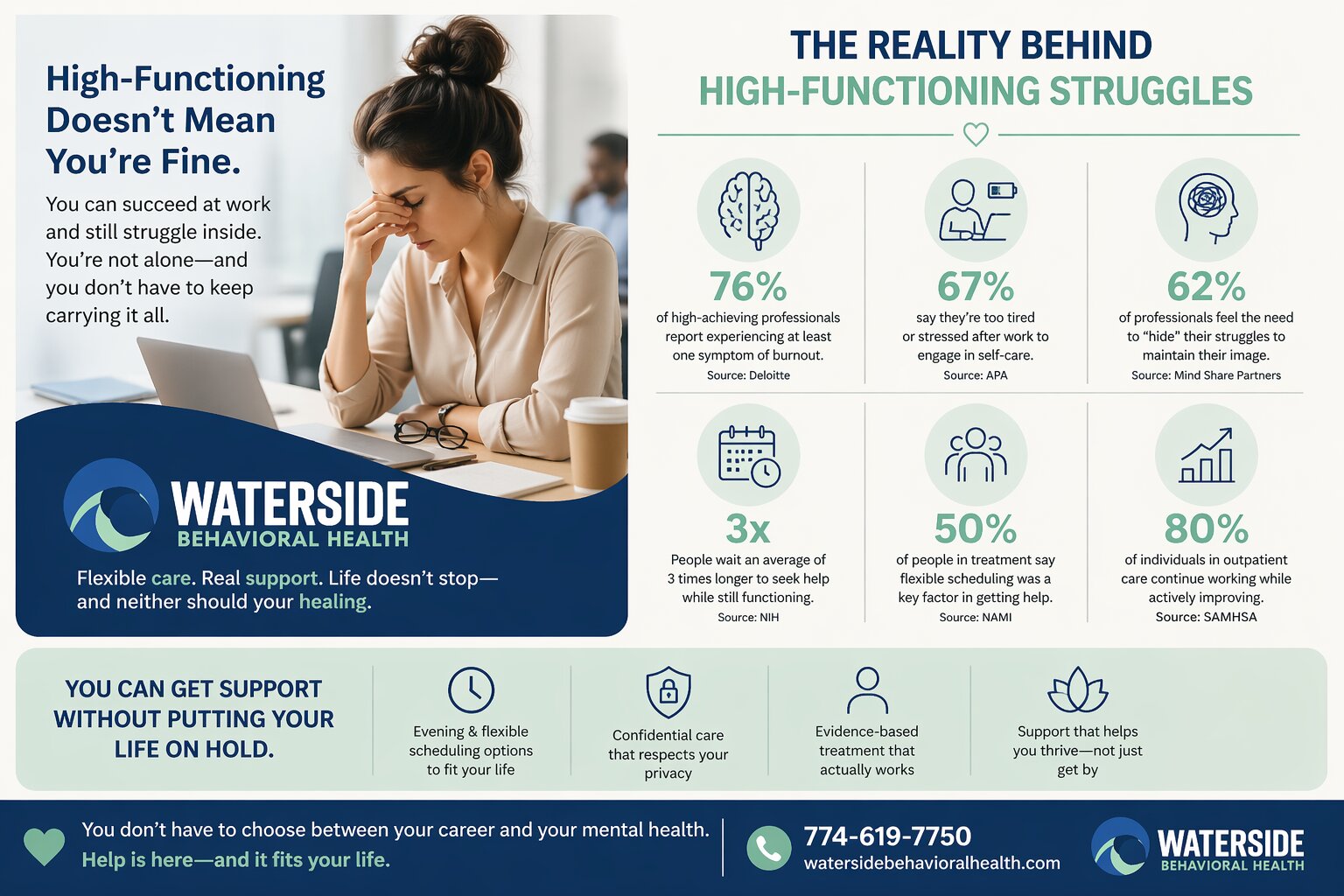
You’re still showing up.
That’s the part everyone sees.
What they don’t see is how much effort it takes just to get through a normal day now. The mental juggling. The constant pressure. The way even small things feel heavier than they should.
This is usually the point where people start quietly looking into options like an intensive outpatient program for behavioral health in Massachusetts.
Not because they’re falling apart in a visible way.
Because they can feel how close they are.
You’re Not Trying to Quit Your Life—You’re Trying to Keep It
Most high-functioning people don’t come in asking for help directly.
They come in asking:
- Can I keep working while I do this?
- Will this interfere with my responsibilities?
- Is there a way to fix this without everything changing?
That’s how searches like outpatient mental health program boston start happening.
You’re not looking for an escape.
You’re trying to protect what you’ve built.
But here’s the tension you’re sitting in:
The way you’re managing things right now isn’t sustainable—and you know it.
The Hidden Cost of “Doing Fine”
From the outside, it looks like you’re okay.
From the inside, it often feels like:
- You’re running on low energy all the time
- You’re pushing through conversations instead of being in them
- You’re constantly trying to stay one step ahead of how you actually feel
This is the part people miss.
Because nothing has collapsed, it’s easy to dismiss what’s happening.
But “holding it together” can quietly become a full-time job.
And eventually, something gives.
Why Pushing Through Stops Working
At some point, the strategies that used to work… don’t.
You can’t reset over the weekend anymore.
You can’t shake off stress the same way.
You don’t bounce back as quickly.
So you push harder.
And for a little while, that works too.
Until it doesn’t.
This is usually when people realize they need something more structured—not because they’re failing, but because the weight they’re carrying has changed.
What You’re Actually Looking For (Even If You Haven’t Said It)
You’re not just looking for help.
You’re looking for help that:
- Fits into your schedule
- Doesn’t expose everything all at once
- Doesn’t require you to step away from your life
- Actually works
That combination matters.
Because if something is too disruptive, you won’t stay.
And if it’s too light, it won’t help.
What Makes a Program Work for Someone Like You
Not every flexible option is the right fit.
Here’s what we see actually work for high-functioning people:It respects your starting point
You’re not coming in relaxed and open.
You’re coming in tired, guarded, and still in “work mode.”
A good program meets you there.
It doesn’t let you hide behind productivity
You’re used to performing well.
That doesn’t automatically translate to doing the internal work.
The right environment gently challenges that.
It builds structure into your week
You’re not relying on one conversation to carry you.
You’re getting repeated support that builds over time.
It fits your life—but still asks something of you
You don’t need something that blows up your schedule.
But you do need something that creates enough space for change.
That balance is what makes it sustainable.
The Moment It Becomes Clear
There’s usually a quiet realization that happens.
Not dramatic. Not obvious.
Just something like:
“I can keep doing this… but I don’t want to keep feeling like this.”
That’s when people start making different choices.
Not perfect ones.
But more honest ones.
You Don’t Have to Choose Between Stability and Support
A lot of people believe it’s one or the other.
Either:
- Keep working and manage it alone
- Or step away completely to get help
That’s not the only path.
There are real care in Massachusetts options that allow you to do both.
If you’re exploring treatment options in Massachusetts, what you’re actually looking for is something sustainable.
Not extreme. Not minimal.
Sustainable.
What Changes When the Fit Is Right
When someone finds the right level of care, the shift isn’t dramatic at first.
It’s subtle.
- The day doesn’t feel as heavy
- You’re not bracing for everything
- You have moments where your mind is quieter
That’s how it starts.
And over time, those moments build into something more stable.
The Part Most People Don’t Say Out Loud
You’re tired.
Not just physically.
Mentally. Emotionally. Constantly.
And you’ve gotten so used to carrying it that it almost feels normal.
But it’s not.
And it doesn’t have to stay this way.
FAQ: What High-Functioning Professionals Usually Ask
Can I really keep working while getting this kind of support?
Yes. Many structured programs are designed specifically for people who need to maintain their job while receiving consistent care.
What if I’m too exhausted after work to participate?
That’s a real concern. The right program accounts for your energy level and builds engagement in a way that’s manageable, not overwhelming.
How do I know if this is the right level of care?
You don’t have to figure that out alone. A conversation with a provider can help match you to something that fits both your needs and your schedule.
What if I’ve tried something before and it didn’t work?
That usually means the fit wasn’t right—not that support won’t work for you. Adjusting the structure often makes a big difference.
Will I have to tell my employer?
Not necessarily. Many people are able to keep their care private, depending on how their schedule is structured.
What if I start and can’t stick with it?
That happens. The goal isn’t perfection—it’s finding something you can realistically stay with.
If you’ve been holding this together quietly, you don’t have to keep doing it alone.
Call 774-619-7750 or visit our levels of care for behavioral health in Massachusetts to learn more about our levels of care for behavioral health in Massachusetts, intensive outpatient programs IOP for behavioral health in Massachusetts services in Plymouth County, MA.