

There’s a specific kind of exhaustion that doesn’t always look serious from the outside.
You’re still going to work. Still answering some texts. Still showing up enough to convince people you’re okay. But internally, something feels off again. The coping skills that once felt solid suddenly feel harder to reach. Your thoughts get louder at night. Small things feel overwhelming. You start isolating without fully realizing it.
For a lot of alumni, this is the stage where shame starts whispering:
“You should be past this by now.”
And because of that shame, many people wait far too long before reaching back out for support.
At Waterside Behavioral Health, we’ve seen something important happen over the years. Some alumni no longer wait for complete emotional collapse before returning to care. They come back earlier now. Not because they failed — but because they’ve learned what happens when they try to carry everything alone for too long.
For some, returning to structured daytime care becomes less about crisis management and more about self-awareness. They recognize the warning signs sooner. They know what emotional burnout feels like now. And instead of waiting until life becomes unbearable, they ask for support while there’s still something left to stabilize.
That shift matters more than people realize.
Most Emotional Spirals Don’t Look Dramatic at First
Mental health struggles rarely announce themselves all at once.
Usually, it starts quietly.
You stop sleeping well again. Your motivation disappears. You begin cancelling plans because being around people feels exhausting. You feel emotionally flat one week and deeply overwhelmed the next. Tasks that used to feel manageable suddenly feel impossible.
Sometimes there’s no huge event attached to it. No catastrophe. Just the slow return of heaviness.
That’s part of what makes it confusing.
A lot of alumni expect another crisis to look obvious. But often, the early signs are subtle enough to dismiss:
- “I’m just stressed.”
- “Everybody feels burned out.”
- “I’ll snap out of it.”
- “I don’t need help again.”
The problem is that untreated mental health symptoms tend to grow in isolation.
And isolation is sneaky.
It convinces people to disappear quietly instead of reaching out honestly.
Returning for Support Isn’t the Same as Starting Over
One of the biggest fears alumni carry is the idea that coming back somehow erases all the progress they made.
It doesn’t.
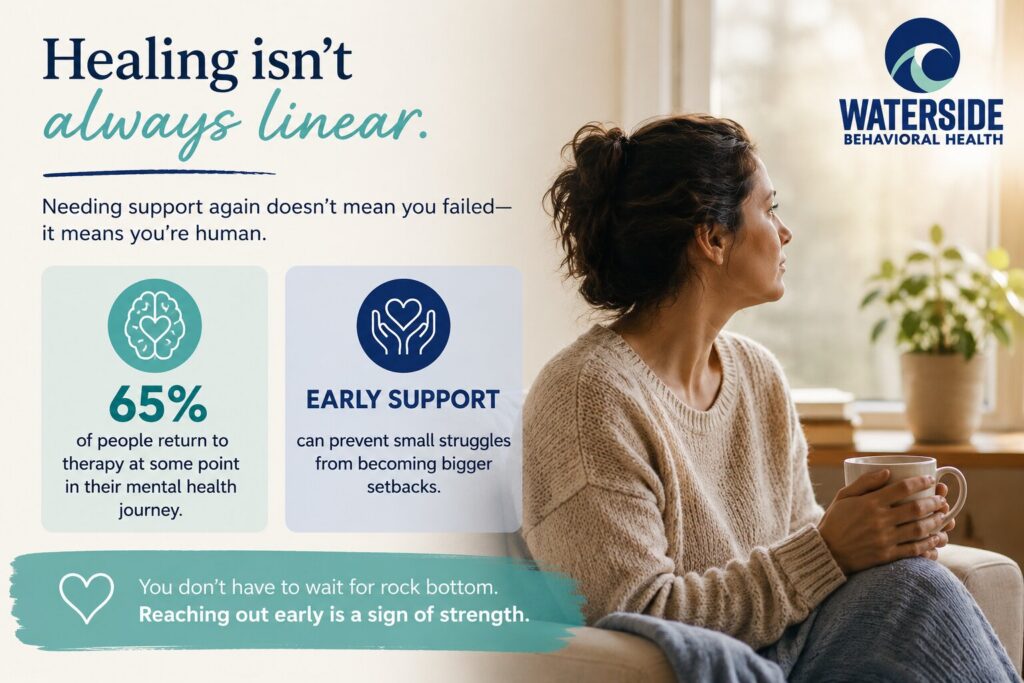
Needing support again is not proof that treatment “didn’t work.” It’s proof that you’re human.
People return to therapy after difficult seasons all the time. They revisit support after grief, trauma, burnout, relationship stress, major life changes, or emotional exhaustion. Mental health recovery isn’t linear simply because someone had several good months before struggling again.
The truth is, many alumni who return earlier actually demonstrate more self-awareness than they had before.
They recognize patterns sooner now.
They know what emotional shutdown feels like in their body. They notice the signs before things fully unravel:
- Sleeping too much or not enough
- Pulling away from support systems
- Increased anxiety or panic
- Emotional numbness
- Irritability that feels unfamiliar
- Loss of routine
- Difficulty functioning day-to-day
That awareness can become protective.
And sometimes, coming back before a full crisis happens prevents a much deeper fall later.
Shame Keeps More People Away Than Symptoms Do
Many alumni don’t stay away because they don’t need support.
They stay away because they feel embarrassed.
There’s often this internal belief that needing help again means they somehow “failed treatment.” So instead of talking honestly about what’s happening, they hide it. They minimize it. They try to outwork it or outthink it.
But shame has a way of growing louder in silence.
We’ve had alumni tell us they spent months debating whether they were “allowed” to return.
Allowed.
As if support has to be earned through suffering first.
That mindset keeps people stuck far longer than necessary.
The reality is this: most people who work in behavioral healthcare understand that healing isn’t perfectly linear. They’ve seen people leave treatment thriving, struggle later, and return stronger because they asked for help sooner this time.
There’s no gold medal for waiting until things become unbearable.
Some People Return Because They Remember the Relief
Not every alumni return begins with a breaking point.
Sometimes it begins with memory.
They remember what it felt like to finally breathe again after months of anxiety. They remember sitting in a room where they didn’t have to pretend anymore. They remember structure helping them feel safe when their thoughts felt chaotic.
That memory matters.
Because once someone experiences genuine emotional support, it becomes harder to ignore how heavy things have gotten again.
One alumni described it this way:
“I didn’t come back because I completely fell apart. I came back because I remembered I didn’t have to live feeling numb all the time.”
That’s often the turning point.
People stop viewing support as punishment and start viewing it as care.
For alumni navigating depression, anxiety, emotional dysregulation, or burnout, returning to a daytime mental health program MA residents can access may offer enough structure to regain stability without needing live-in treatment.
And for many people, that middle ground matters deeply.
Waiting for “Rock Bottom” Can Be Dangerous
There’s a harmful idea that people should only seek mental health support once things become severe enough.
But emotional suffering doesn’t become more legitimate simply because it gets worse.
You do not need to completely collapse before reaching for help.
In fact, early intervention often makes healing more manageable. Addressing symptoms while someone still has some stability, awareness, and connection can prevent deeper emotional deterioration later.
That’s one reason structured daytime care can be helpful for alumni who notice themselves struggling again. It provides consistency, accountability, therapeutic support, and emotional grounding during periods where life starts feeling unsteady.
Some people need support after major life changes.
Others after losing emotional momentum.
Others because anxiety slowly became unmanageable again.
Every story looks different.
What matters is recognizing that asking for help early is not dramatic. It’s responsible.
Healing Sometimes Means Returning to What Helped Before
There’s a strange pressure people feel to “graduate” from needing support permanently.
But mental health doesn’t always work that way.
Someone can make enormous progress and still need additional care later during difficult seasons of life.
That doesn’t invalidate the growth that already happened.
In many cases, alumni return with more emotional insight than they had during their first experience. They’re more honest. More open. Less focused on appearing okay. They know how exhausting masking can become.
And sometimes the second experience feels different because they’re no longer trying to prove anything.
They simply want relief.
There’s courage in that.
Real courage is often quieter than people expect.
It looks like admitting:
“I don’t think I’m okay again.”
“I need support before this gets worse.”
“I don’t want to disappear into myself another time.”
That kind of honesty can change everything.
You Don’t Have to Earn Support Through Suffering
A lot of alumni wait until their symptoms become undeniable because they feel guilty asking for help too soon.
But support is not reserved only for emergencies.
You are allowed to need care during the in-between stages too:
- While functioning but struggling
- While emotionally exhausted
- While feeling disconnected from yourself
- While trying to prevent things from escalating
- While quietly falling apart behind routines and responsibilities
That’s still real pain.
And sometimes, those quieter struggles deserve attention before they become life-altering ones.
At Waterside Behavioral Health, we understand that returning for support can feel vulnerable. That’s why we approach alumni with compassion, not judgment. Many people simply need a place to regroup, reconnect, and stabilize during difficult seasons.
If you’ve been struggling lately, there’s support available through compassionate help in Massachusetts and evidence-based care in Massachusetts. Reaching back out doesn’t erase your progress. Sometimes it protects it.
FAQ: Returning to Mental Health Treatment After Struggling Again
Is it normal to return to treatment after doing well for a while?
Yes. Many people return to treatment or structured support during difficult periods in life. Mental health recovery isn’t always linear, and needing help again does not mean previous treatment failed.
Does coming back mean I’m starting over?
No. You still carry the insight, coping skills, and progress you built before. Returning for support is often a continuation of healing — not a reset button.
What if my symptoms don’t seem “serious enough” yet?
You do not have to wait for a full crisis before reaching out. Many alumni benefit from support during the earlier stages of emotional burnout, anxiety, depression, or overwhelm before symptoms become more severe.
Can a structured daytime program help without requiring overnight care?
For some people, yes. A structured daytime program can provide therapeutic support, routine, and accountability while still allowing individuals to return home in the evenings.
What if I feel embarrassed about needing help again?
That feeling is incredibly common. Many people fear judgment after struggling again, but mental health professionals understand that healing often involves periods of re-engagement and additional support.
How do I know if it’s time to come back?
Some common signs include emotional exhaustion, increasing anxiety, isolation, trouble functioning day-to-day, loss of motivation, disrupted sleep, or feeling like you’re slowly slipping back into unhealthy patterns.
Will people think I failed?
Most people who understand mental health recovery know that needing support again is not failure. In many cases, reaching out earlier shows growth, awareness, and strength.
Call 774-619-7750 or visit our levels of care for behavioral health in Massachusetts, partial hospitalization programs php for behavioral health in Massachusetts to learn more about our levels of care for behavioral health in Westborough, MA, partial hospitalization programs for behavioral health services in Plymouth, MA.