

When you’re in recovery, even the calendar can feel like a minefield. Holidays, birthdays, weddings, long weekends—these moments might once have been bright spots or escapes. Now they can stir up confusion, grief, and loneliness. And if you’ve recently stopped attending your Intensive Outpatient Program (IOP) or missed a few sessions, you might feel like you’ve lost your footing just when the world is dancing. You haven’t. You’ve just hit a pause.
As clinicians at Waterside Behavioral Health, we see this more often than you might think—especially among clients in mid-treatment or those navigating early mental health recovery. The pull to disconnect when others are celebrating can feel strong. So can the shame when you want to come back but don’t know how.
Here’s what we want you to know: You’re not behind. You’re not broken. You’re still allowed to heal.
This guide is for anyone who’s stepped back, ghosted their IOP, or just feels out of sync right now. Whether you’re dealing with depression, anxiety, trauma, or something you don’t even have a name for yet—here are some clinician-backed ways to stay grounded when the rest of the world feels like it’s throwing a party without you.
1. First, You Didn’t Fail—You Just Paused
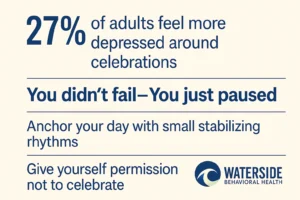
Let’s get this out of the way: disappearing doesn’t make you weak. Needing space isn’t the same as giving up. Sometimes, people leave their IOP group or skip a session because showing up feels too vulnerable that day. Or the pressure of having to explain yourself feels heavier than the healing you’re hoping for.
If that’s you—come as you are. No dramatic re-entry needed. We’ve seen the courage it takes just to send that one-line email or show up late to a group after weeks away. You are still welcome. Always.
At Waterside Behavioral Health’s Intensive Outpatient Program, we work with clients across Plymouth County and nearby areas who’ve dropped out, returned, tried again, or needed to re-find their footing. No judgment. Just support.
2. Anchor Your Day—Even if It’s Not “Festive”
In treatment, we talk about structure because it creates safety. But outside the program, it’s easy to fall into long, blurry days—especially when everyone else is focused on parties, trips, or gifts. If you’re trying to stay grounded while others celebrate, look for small, stabilizing rhythms.
Try this:
- Wake up at the same time, even on weekends.
- Step outside every day, even for 5 minutes.
- Keep one tiny daily ritual—tea, music, prayer, pet time.
- Text your group facilitator or a trusted peer—even just “thinking of you.”
These are not recovery hacks. They’re lifelines. When things feel chaotic or isolating, repeatable actions can help anchor your nervous system and remind you: you’re still here, and that’s enough.
3. Give Yourself Permission Not to Celebrate
Maybe this year, you’re skipping the New Year’s party. Or choosing not to go to a family gathering that drains you. That doesn’t make you antisocial or broken. It makes you honest. Celebration can feel overwhelming when your internal world is trying to stabilize.
Healing doesn’t always look like smiling. Sometimes, it looks like canceling. Or sitting still. Or watching old movies instead of raising a glass. You’re allowed to choose peace over pressure.
“I told my family I wasn’t coming to Christmas. They were surprised, but not mad. I stayed home and felt more grounded than I have in months.”
— Outpatient Client, 2023
4. Reach Out Without the Speech
The longer you’ve been gone from a program, the more you might feel like you need to explain yourself. The truth? You don’t. The people who run IOP groups—especially here in Plymouth County—have seen this before. We know the silence isn’t indifference. It’s usually pain. Or confusion. Or fear.
You can simply say:
“Hey, I think I’m ready to come back. Is that okay?”
Or:
“I’m not sure what I need, but I want to try again.”
That’s enough. You don’t owe a monologue. Just connection.
5. Use the “One Moment at a Time” Mindset
When the world around you is celebrating big things—engagements, new jobs, family milestones—it can feel like you’re shrinking. Like your small wins don’t count. But staying grounded in recovery isn’t about catching up. It’s about staying here.
Start small:
- This hour
- This meal
- This bedtime
Let your focus shrink until it fits inside your current capacity. That’s not avoidance—it’s wisdom. Healing often begins in micro-moments.
6. Ask: “What Would Ground Me Right Now?”
Instead of pressuring yourself to be social, productive, or “better,” ask what would ground you.
- A walk without your phone?
- A return to your IOP group just to listen?
- Writing in a journal instead of answering every holiday text?
Grounding isn’t the same as fixing. It’s choosing one stabilizing thing at a time. When you’re unsure what to do, look for what helps you feel real—not overwhelmed.
7. Normalize the Return, Not Just the Start
Too often, we celebrate people entering treatment but stay quiet when someone returns after stepping away. Let’s be clear: coming back is brave. Returning to IOP after a break takes immense courage.
Whether you left because you felt overwhelmed, unready, unseen—or just disappeared without a plan—you can always come back. There’s no penalty. No closed door. Just a seat waiting for you.
Our team at Waterside Behavioral Health works with clients from across Bristol County and beyond who’ve restarted after pauses. Sometimes, returning is when the real breakthroughs begin.
FAQs: Navigating Recovery When the World Is Celebrating
What if I ghosted my IOP group—can I still come back?
Yes. It’s very common for clients to pause and return. You don’t need to explain everything. Just reach out. We’re here.
I feel guilty about missing sessions. Is that normal?
Yes. Guilt often shows up when we break a commitment. But it doesn’t mean you’ve failed—it just means you care. Let guilt be a signal to reconnect, not a reason to spiral.
How do I tell my family I’m skipping holiday events for my mental health?
Start simple. Try: “I’m focusing on my mental health right now and need to keep things low-key.” Most people will understand. The people who matter will support your decision, even if they’re surprised.
Will I lose my spot in IOP if I take a break?
That depends on the program’s policies, but at Waterside, we always invite return conversations. We understand that healing isn’t always linear—and we work with you to re-engage safely and effectively.
What’s the difference between an IOP and other levels of care?
An Intensive Outpatient Program provides structured support (usually 3–5 days per week for a few hours each day) while allowing clients to live at home. It offers more support than weekly therapy, but more flexibility than residential care. It’s a middle ground—ideal for people who need consistent help but still want to manage daily life.
You’re Allowed to Return
Recovery isn’t about proving yourself. It’s about staying open to the next right step. If you’ve paused your Intensive Outpatient Program—or are thinking about it—you’re not alone, and you’re not off the path.
Whether you’re in Plymouth County, MA or neighboring towns, we’re here to meet you where you are. No shame. No big speech needed.
Call 774-619-7750 or visit our Intensive Outpatient Program page to learn more about how Waterside Behavioral Health can support your next step—whether it’s your first, your fifth, or somewhere in between.