
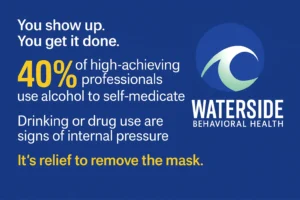
You show up. You get it done. You carry the weight—at home, at work, in every conversation where someone says, “I don’t know how you do it all.”
But no one sees the 3 a.m. panic. The 5 p.m. drink you promised you wouldn’t need. The nights you scroll job listings just to feel in control of something. You’ve held the mask for so long that even you don’t always remember what your real face looks like.
If this is resonating, you’re not broken. You’re just tired. Really tired.
At Waterside Behavioral Health, we work with people in exactly this space—smart, capable individuals who are quietly unraveling under the weight of what looks like success. They don’t need lectures. They don’t want judgment. They just want a way forward that doesn’t involve blowing up their entire life.
That’s where an Intensive Outpatient Program (IOP) can be a life-changer. Here’s how.
You’re Not the Only One Living Two Lives
The professional who drinks just enough to feel steady before meetings.
The parent who shuts the bathroom door and cries into the sink.
The caregiver who gives every drop to others and can’t feel joy anymore.
We see you. And not because you’re doing it wrong—but because you’ve been doing too much, too well, for too long.
You’re not lazy. You’re not weak. You’ve simply been surviving in a world that doesn’t pause for burnout, anxiety, trauma, or substance use that stays just under the radar. Until it doesn’t.
The Quiet Cost of High-Functioning Struggle
You don’t need a dramatic rock bottom to be in danger.
What we see more often are the quiet symptoms of internal collapse:
- Sharpness at work turning into numbness at home
- Overachieving that covers up emotional emptiness
- Drinking to manage—not celebrate
- Crying in short bursts when no one’s around
- Feeling exhausted even after sleeping all weekend
These are signs—not of failure—but of a system under pressure. And just like any system, it needs release, structure, and repair.
IOP: Designed for People Who “Can’t Stop Their Life”
One of the most common things high-functioning clients say is, “I can’t go away for 30 days—I have too much to manage.”
That’s not an excuse. It’s real. And it’s exactly why our Intensive Outpatient Program in Plymouth County, MA exists.
IOP bridges the gap between weekly therapy (which often isn’t enough) and inpatient treatment (which might be too much). Here’s what it looks like:
- 3 to 5 days per week of group therapy, skills-building, and clinician support
- Sessions held in the morning, afternoon, or evening
- A flexible structure that works with professional or family schedules
- Space to speak honestly without being the one in charge
- Support for both mental health and co-occurring substance use
You still live at home. You still parent your kids. You still go to work. But now, you also get help.
What Happens When the Mask Comes Off?
For many high-functioning clients, the scariest part of treatment isn’t the time or the content—it’s being seen.
We understand. You’ve built an identity around reliability, intelligence, and control. The idea of walking into a room and saying, “I’m not okay” might feel impossible.
But something sacred happens when you do. You stop performing. You stop managing perception. And in that space, real healing begins.
You find people who don’t need you to be polished. Clinicians who speak plainly. Peers who’ve been there and are still holding their own version of complicated.
And most importantly: you start feeling like yourself again. Not the version people admire. The version you miss.
This Isn’t Just Stress—And You Know It
If you’re wondering whether this is just a phase, consider this:
- Has your substance use increased over time?
- Do you feel emotionally flat, even during joyful events?
- Have your relationships become more performative than personal?
- Are you managing symptoms instead of addressing causes?
- Do you say “I’m fine” when you really mean “I’m unraveling”?
If yes, it’s not just stress. And while therapy can help, IOP offers a container strong enough to hold more than just talk. It gives you action, feedback, insight, and strategy.
And for many clients from Bristol County, MA, that’s the difference between surviving and rebuilding.
What You Gain in IOP
Clients often expect to feel overwhelmed by treatment. But what they actually feel is relief.
- Relief that they don’t have to hold everything alone
- Relief that they can speak honestly without consequences
- Relief that someone is tracking the pieces they’ve dropped
But over time, they also gain things they hadn’t expected:
- Sleep that feels restorative, not just numbing
- Communication that deepens real connection at home
- Coping tools that replace silent suffering
- A plan for what happens next
You don’t lose your edge. You sharpen it—by tending to the parts of you that have gone numb.
Frequently Asked Questions
Is IOP confidential? What if I work in a high-visibility role?
Yes. All participation in treatment is confidential and protected by HIPAA. Many high-functioning clients work in education, healthcare, business, or public service—your privacy is our priority.
How long does an Intensive Outpatient Program last?
Most programs run anywhere from 6 to 12 weeks, depending on clinical need and progress. You’ll work with your treatment team to determine what’s right for you.
Can I do IOP if I’m still drinking or using sometimes?
Yes. Many clients begin IOP while still navigating their relationship with substances. You don’t need to be 100% sober to start. You just need to be open to change.
What if I don’t want anyone to know I’m in treatment?
You don’t have to tell anyone outside your treatment team. Sessions are scheduled with flexibility so you can maintain work or family routines.
How do I know if IOP is better than weekly therapy for me?
If you’ve been doing therapy but feel stuck—or like progress is slow—IOP may offer the structure and depth you need. Especially if there’s co-occurring alcohol use, anxiety, or emotional dysregulation, IOP can address more in less time.
You’re Not Alone—And You’re Not “Too High-Functioning” for Help
It’s easy to assume that because things look okay, you should be okay. But appearance is not the same as peace. And you don’t have to wait for things to collapse before choosing something better.
If you’re feeling the slow erosion of your energy, your clarity, or your joy, don’t wait. This is your sign. And you don’t have to go it alone.
Call 774-619-7750 or visit our Intensive Outpatient Program page to learn how Waterside Behavioral Health supports high-functioning professionals and caregivers across Plymouth County, MA—and helps them get real support without losing the life they’ve built.