

You don’t have to hit rock bottom to want change. Maybe you’ve started to notice a loop—same relationship dynamics, same internal shutdowns, same overreactions that make you think, “Why did I do that again?”
If you’re rethinking your habits, exploring your emotions, or simply trying to feel more like yourself again—without blowing up your life—EMDR therapy might be worth exploring. Especially if you’re someone who’s sober curious, emotionally stuck, or just tired of repeating patterns that no longer fit who you’re becoming.
At Waterside Behavioral Health, we use EMDR therapy to help clients release what’s stuck—not through endless talking, but by working directly with the brain and body to reshape emotional responses and gently rewire old belief systems.
Let’s walk through how EMDR works, why it’s not just for trauma survivors, and how it could help you create actual change—not just insight.
What Is EMDR Therapy, Really?
EMDR stands for Eye Movement Desensitization and Reprocessing, a therapeutic technique originally developed to treat post-traumatic stress. But its reach goes far beyond trauma. EMDR works by helping the brain reprocess distressing or unresolved experiences that still impact the way you think, feel, and behave today.
Unlike traditional talk therapy, EMDR doesn’t require you to explain everything in detail. It works with your brain’s natural processing system, using bilateral stimulation—like guided eye movements, taps, or tones—to activate both sides of the brain while you focus on a specific memory, feeling, or belief.
This process allows your brain to refile the experience—not delete it, but store it in a way that feels resolved instead of raw.
EMDR Isn’t Just for “Big Trauma”
Let’s be real: most people walking around have unresolved emotional experiences, but not everyone identifies with the word trauma. That’s okay. You don’t need a specific diagnosis to benefit from EMDR therapy.
- Ever been told you’re too sensitive, and now you flinch at any sign of conflict?
- Do you freeze when you feel judged, even in safe relationships?
- Do you keep ending up in situations where you shrink, perform, or self-sabotage?
These patterns didn’t come out of nowhere. They likely started as protective strategies—your nervous system’s way of keeping you safe. EMDR helps you identify where those patterns began, and more importantly, gives your brain a chance to complete the story in a new, healing way.
You don’t have to label your experience as “trauma” for it to matter. If it’s affecting your present, it’s worth working through.
Why Sober Curious People Are Turning to EMDR
Being sober curious doesn’t mean you’ve hit a wall—it means you’re starting to notice what’s not working. That you’re wondering if the way you cope, unwind, or socialize might be masking something deeper.
Maybe alcohol or weed helped you quiet your mind, loosen your guard, or feel momentarily confident. But now you’re wondering: What’s underneath that need? What am I avoiding?
EMDR can help uncover and address the emotional patterns that substances were numbing, without needing to declare yourself an addict or commit to a rigid identity. This is especially helpful for:
- People noticing recurring emotional triggers
- Those seeking therapy but unsure where to begin
- Individuals who’ve tried talk therapy but feel stuck
- Clients who are sober but still feel emotionally reactive or flat
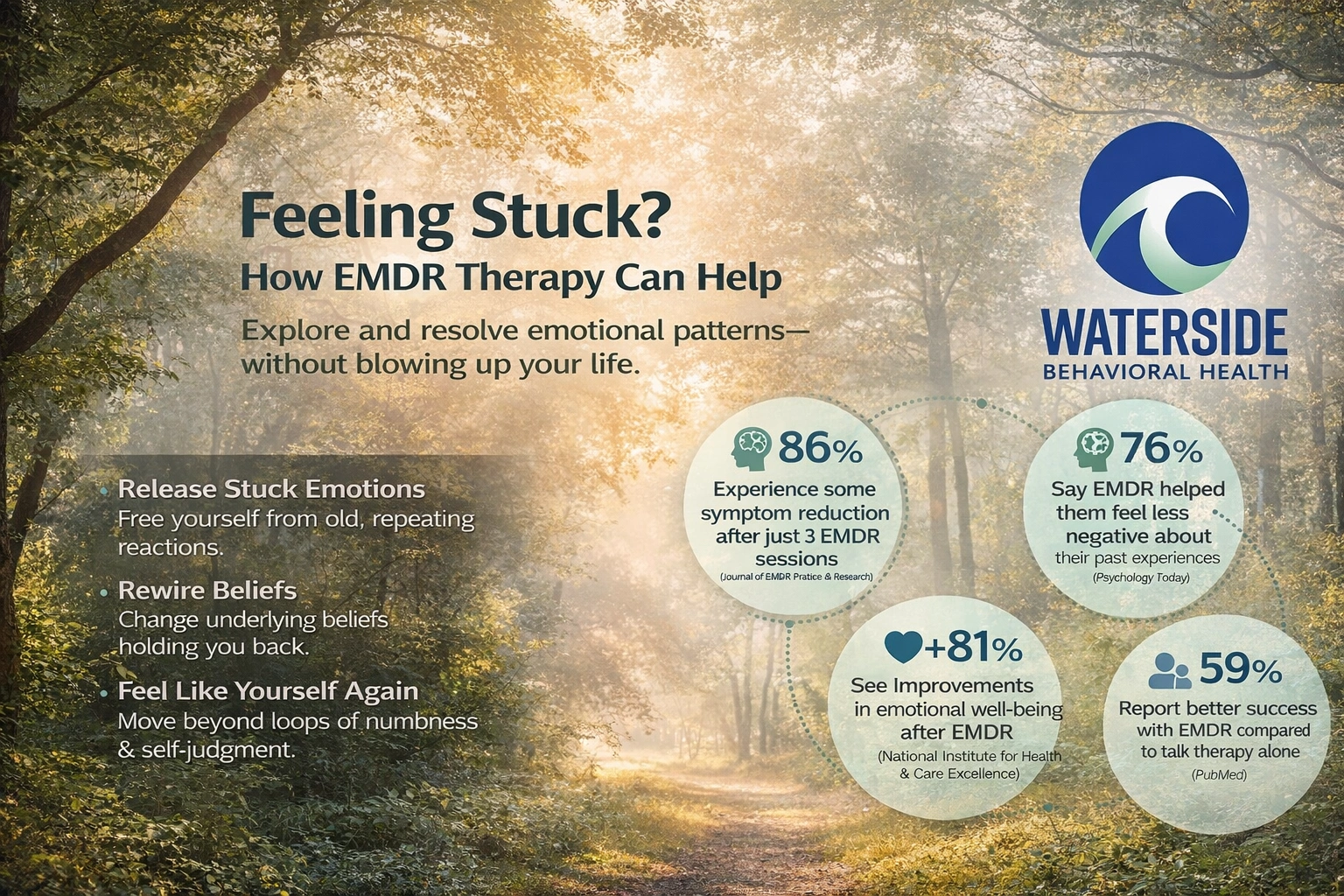
How EMDR Therapy Works, Step by Step
At Waterside, we tailor every EMDR session to the individual—but here’s a general flow of what you can expect:
1. Preparation and Safety First
Before jumping into any memory work, your therapist helps you build emotional regulation tools. You’ll learn how to ground yourself, create a safe mental space, and understand the process.
2. Identifying Your “Targets”
This isn’t just about picking a traumatic event. A “target” might be:
- A recent interaction that triggered a big emotional response
- A persistent negative belief (e.g., “I’m not good enough”)
- A body sensation or anxiety spike that seems out of proportion
Your therapist helps you trace it back to earlier experiences that shaped how you react today.
3. Reprocessing with Bilateral Stimulation
You’ll focus on a specific image, thought, or emotion while following eye movements (or another form of bilateral stimulation). This allows the brain to make new connections, often reducing distress in real time.
4. Allowing the Shift
You might notice that what once felt overwhelming now feels neutral. Or that your body feels lighter. EMDR isn’t magic—but it can feel remarkably different from just talking about it.
5. Closure and Integration
Each session ends with grounding exercises to help you feel stable. In between sessions, your therapist may offer journaling prompts or reflection tools to help you notice emerging changes.
Real Stories: “I Didn’t Know I Needed EMDR—Until I Did”
One client came in feeling “stuck” but couldn’t explain why. She wasn’t in crisis. She just kept reacting with anxiety in new relationships and couldn’t trust her own emotional responses. After three EMDR sessions focused on a middle-school bullying experience she’d long dismissed, she said:
“I thought I was over it. But I realized I’d internalized that I wasn’t worth standing up for. EMDR helped me actually feel different—not just understand it differently.”
Another client, sober for six months, said:
“I didn’t want to keep using, but I didn’t know how to feel safe in my own skin without something taking the edge off. EMDR gave me access to parts of myself I didn’t even realize were shut down.”
Who Can Benefit from EMDR Therapy?
EMDR is used successfully with people dealing with:
- Anxiety or panic
- Low self-worth or shame
- Fear of intimacy or vulnerability
- Grief or ambiguous loss
- Emotional numbness
- Social anxiety or fear of judgment
- Perfectionism or overachievement as a shield
- Early sobriety unease
You don’t have to fit a diagnostic box to benefit. You just need to feel like something is still running the show—and want your reactions to finally feel like yours, not echoes of the past.
You Don’t Have to Do This Alone
If you’ve tried mindfulness, journaling, self-help books—or even therapy—and still feel stuck in loops that don’t make sense, EMDR could be the missing piece.
It’s not always comfortable. But it’s often relieving. And the best part? You don’t need to do it alone or figure it out before you come in.
We’re here to walk through it with you—gently, steadily, without judgment.
Looking for compassionate, brain-based help in Massachusetts? We offer EMDR therapy and other trauma-informed services in a calm, non-clinical environment designed to meet you where you are.
Frequently Asked Questions About EMDR Therapy
Do I have to talk about everything that happened to me?
No. One of the benefits of EMDR is that you don’t need to relive or retell the entire story. You just need to bring your attention to the thoughts or body sensations associated with the memory—your therapist will guide the rest.
What if I don’t know what the root cause is?
That’s very common. You don’t need to come in with answers. Many people start EMDR by working with current triggers, and the deeper layers unfold naturally with support.
Is EMDR safe if I’m new to therapy?
Yes, and it’s often a great entry point for people who feel overwhelmed by traditional talk therapy. Your therapist will spend time building trust, safety, and emotional coping tools before starting the reprocessing phase.
Can EMDR be done online or does it have to be in person?
EMDR can be effective both in-person and via secure telehealth platforms. At Waterside, we offer both formats based on your needs and comfort level.
How fast does it work?
Some people experience shifts after just a few sessions, while others need more time depending on what they’re working through. What makes EMDR unique is how efficient it can be for deep emotional processing.
Will EMDR change my memories?
No. EMDR doesn’t erase or alter your memories—it changes how they live in your nervous system. After reprocessing, many clients report that the memory feels distant or less charged, and no longer hijacks their emotions.
Ready to Try Something Different?
You don’t have to keep living on a loop. If you’re ready to feel more like yourself—not the reactive version of you shaped by old pain—we’re here to help.
Call 774-619-7750 to learn more about our emdr therapy services in Massachusetts.
We’ll help you find your way forward—even if you’re not sure what that looks like yet.