

When you’re young and sober, especially in your 20s, it’s easy to feel like a glitch in the matrix. Your friends are posting highlight reels, juggling work, dating, and parties like they’ve got it all figured out. Meanwhile, you’re sitting on your bed Googling “Why do I overthink everything?” or wondering why your chest feels tight for no reason.
You’re not the only one.
Starting anxiety treatment can feel awkward at first. Like you’re officially admitting you’re different. But here’s the truth most people don’t say out loud: the things that feel “weird” about you are often the signs that you’re healing—finally, slowly, honestly.
These 11 moments might not show up on your Instagram feed, but they are milestones. They’re proof that anxiety treatment isn’t about fixing a broken you. It’s about peeling back the noise until you see the real you—the one who’s still here, still trying, still worthy.
1. When You Catch a Thought Before It Spirals
You know the cycle. One tiny trigger leads to a five-hour mental horror show. But in treatment, something shifts. You start hearing the thought instead of becoming it.
Instead of “What if they hate me?” becoming “Everyone always leaves me,” it becomes:
“Whoa. That’s my anxiety voice again.”
It’s not about stopping the thoughts. It’s about recognizing you don’t have to believe all of them.
2. When You Don’t Cancel Plans (Even If You Kind of Wanted To)
There’s something wildly brave about texting “I’ll be there” and actually showing up. Even when your stomach’s in knots.
Even when your brain whispers, “You’ll be weird.”
Because every time you override that reflex to isolate, you teach your nervous system: It’s safe to connect. And you show yourself: I can do hard things.
3. When You Say “I Don’t Know” in Group—and Don’t Cringe After
Anxiety makes silence feel like danger. You’re always trying to fill it, prove something, make everyone comfortable.
So when you sit in group therapy and say, “I don’t really know how I feel right now,” and nobody judges you?
That’s emotional safety. That’s growth.
4. When You Realize Avoiding Things Was Actually Making It Worse
You thought skipping the party or putting off that email was “self-care.” But eventually, treatment holds up a gentle mirror:
Avoidance is a short-term comfort that fuels long-term fear.
This isn’t about blame—it’s about patterns. And once you see it, you can shift it.
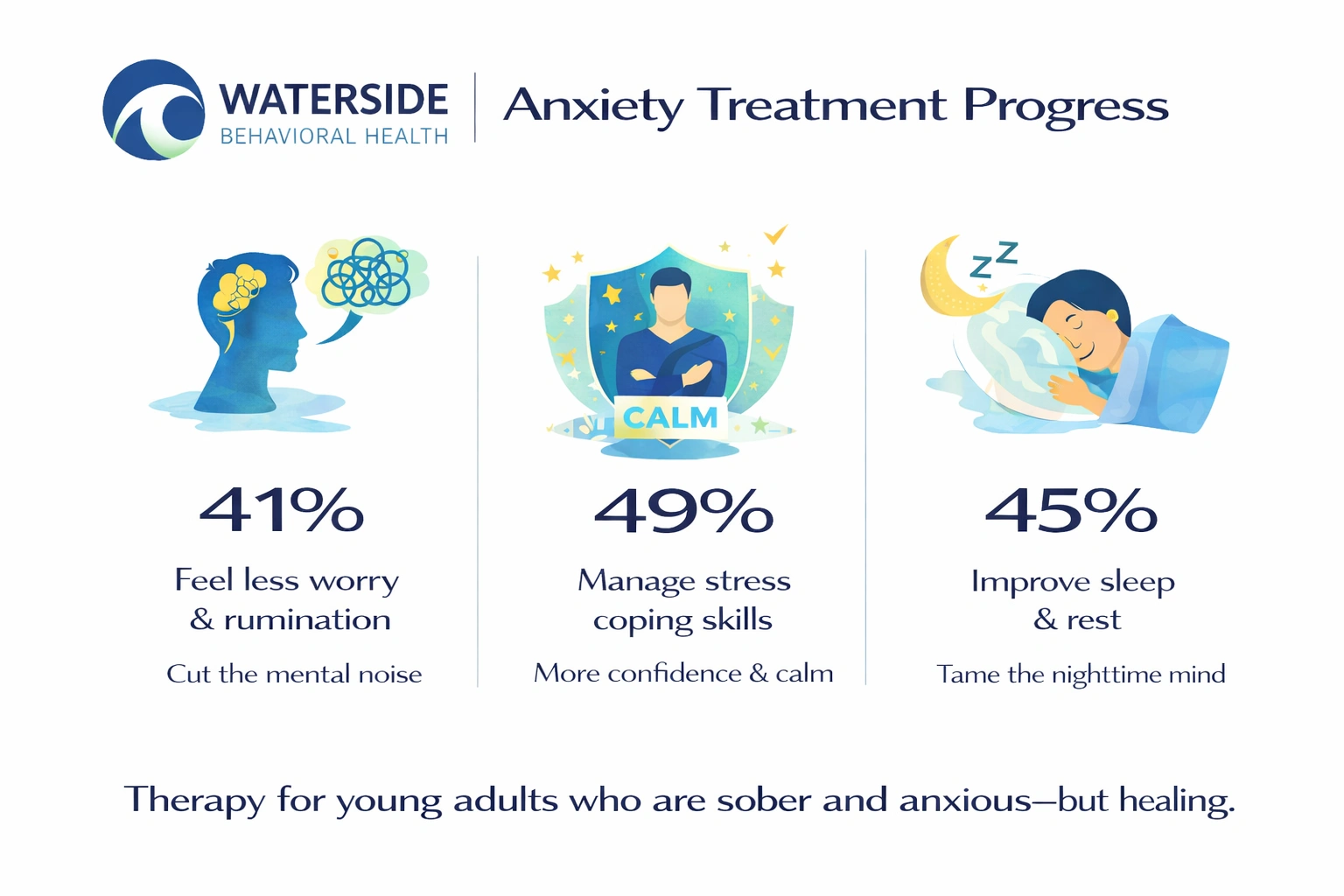
5. When You Feel Something and Actually Let Yourself Feel It
Numbness can feel like control—until it doesn’t.
There’s a reason crying in therapy feels like both a breakdown and a breakthrough.
Because letting the feelings through means you’re not bottling them up or shoving them away anymore.
You’re letting them live. And pass. And that’s healing.
6. When You Stop Googling What’s Wrong With You
Anxiety will have you deep in Reddit threads at 2 a.m., convinced you’re secretly broken.
But something shifts when you start trusting your therapist more than your worst-case scenario thoughts.
You realize: Maybe I don’t need to be diagnosed with a new thing every week. Maybe I just need to breathe and talk it out.
7. When a Therapist Says Something That Finally Lands
You’ve heard versions of it before. But suddenly they say it just right:
“Anxiety isn’t you—it’s something that’s happening inside you. And it can be unlearned.”
And it clicks. Not in a cheesy “aha moment” way—but in a deep-in-your-gut kind of way.
8. When You Can’t Fix It Fast, But You Don’t Panic
Your old self needed answers—now. Needed to solve it, fix it, fix you.
But in treatment, you start learning how to sit with uncertainty.
You start saying, “I don’t feel okay, and I don’t need to panic about that.”
That’s emotional regulation—not perfection, but progress.
9. When You Laugh at Your Anxiety (Just a Little)
You might still overthink that text you sent. Or reread your email three times.
But one day, you laugh about it. Like, “Wow, I really thought the barista was mad at me for ordering soy milk.”
That laughter? That’s power. That’s proof the anxiety doesn’t run the show anymore.
10. When You Start Thinking About Next Week
Anxiety can trap you in the now—in the worst version of now.
So when you catch yourself planning something, even something small—a friend hang, a concert, a job application—you realize your brain is letting in possibility again.
Not because you’re “cured.” But because you’re more than the symptoms now.
11. When You Hear Someone Else Say What You’ve Been Hiding
Maybe it’s in group therapy. Maybe it’s a podcast. Maybe it’s a random TikTok.
But someone says something and it hits:
“I used to think I was just too much. Turns out, I just never felt safe enough.”
And you feel seen in a way that matters. Because connection starts with recognition. And you’re not alone in this.
Real Talk: Anxiety Treatment Isn’t Always Instant—But It Is Worth It
You’re not here to be “fixed.” You’re here to be understood.
You’re here to learn how to exist without your thoughts constantly punching you in the gut.
If you’re in Plymouth County and looking for therapy that actually gets you—not just symptom charts—Waterside Behavioral Health offers anxiety treatment designed to meet you where you are.
And if you’re closer to New Bedford or Fall River, we also support those looking for anxiety treatment in Bristol County, MA. You don’t have to do this alone—or explain why you’re not like everyone else. We already know. That’s the point.
FAQ: Starting Anxiety Treatment When You’re Young and Sober
Is it normal to feel like the odd one out in therapy?
Yes. Especially if you’re young and sober in a world that seems obsessed with partying and perfection. But the truth is, there are a lot more people like you in therapy than you think—they just aren’t posting about it. Therapy isn’t about fitting in; it’s about feeling safe in your own skin.
What if I’ve tried therapy before and it didn’t work?
That’s valid. Sometimes it’s the wrong therapist, the wrong style, or just not the right timing. But it doesn’t mean you can’t get better. Waterside’s anxiety treatment in Plymouth County includes personalized care and options like group support, which can make a huge difference.
Can I go to therapy even if I’m not in full-blown panic attacks?
Absolutely. Anxiety shows up in tons of ways—perfectionism, overthinking, social fear, constant worry. You don’t need to hit “rock bottom” to get help. If you’re tired of living in your head, that’s reason enough.
What kind of anxiety treatment is offered at Waterside?
We offer individual therapy, group sessions, and customized mental health treatment plans that focus on understanding—not judging—your experiences. If you’re in or around Plymouth County, MA, we’re here to support your healing.
I feel like I’m too much. Will treatment make me less… “me”?
This feeling is common. But therapy doesn’t shrink you—it helps you hold all of who you are without being overwhelmed by it. You’re not too much. You’re just finally letting yourself feel.
Ready to feel a little more human again?
Call Waterside Behavioral Health at 774-619-7750 to learn more about anxiety treatment in Plymouth County, MA.
We’re not here to fix you. We’re here to help you feel like you again—even if it takes time.