

There comes a point where you stop asking, “Why am I so tired?” and start asking a much heavier question:
“Why can’t I make myself do anything anymore?”
Maybe you’ve been staring at a pile of laundry for three days.
Maybe your phone is full of unanswered messages because replying feels like climbing a mountain.
Maybe you’ve stopped cooking, stopped cleaning, or stopped enjoying hobbies that once made you feel like yourself.
The hardest part is that you cannot always explain why.
From the outside, people may think you’re simply unmotivated. Inside, it feels as though someone quietly unplugged the part of your brain that makes life feel manageable.
If you’ve been searching for answers, know this first:
You are not alone.
And what you’re experiencing is more common than you might think.
Many people who eventually seek mental health treatment in Massachusetts begin exactly where you are now—trying to understand why they no longer feel like themselves.
Feeling Numb Is Different From Simply Feeling Tired
Everyone has difficult weeks.
Stressful jobs.
Busy families.
Financial worries.
Major life changes.
Those situations naturally leave people feeling exhausted.
Emotional numbness is something different.
Instead of simply feeling worn out, you may feel disconnected from nearly everything around you.
You know something should make you happy.
It just doesn’t.
You know something should upset you.
It barely registers.
Even good news can feel strangely flat.
Some people describe it as existing behind glass.
Others compare it to watching life happen instead of participating in it.
That emotional distance can become frightening because you begin wondering whether you’ll ever feel normal again.
The encouraging reality is that emotional numbness often develops for understandable reasons. It is not evidence that you are broken.
Why Basic Tasks Suddenly Feel Impossible
One of the most confusing experiences is realizing that ordinary responsibilities suddenly require extraordinary effort.
Getting dressed.
Making breakfast.
Taking a shower.
Walking the dog.
Returning a simple email.
These tasks have not become objectively harder.
Yet your brain experiences them differently.
Mental health challenges can affect the parts of the brain responsible for motivation, concentration, planning, memory, and decision-making. When those systems become overwhelmed, even choosing what to wear can feel mentally exhausting.
This is why people often spend more energy thinking about completing a task than actually completing it.
Unfortunately, many begin blaming themselves.
“I must be lazy.”
“I just need more discipline.”
“I’m failing at being an adult.”
Those thoughts are understandable.
They’re also usually untrue.
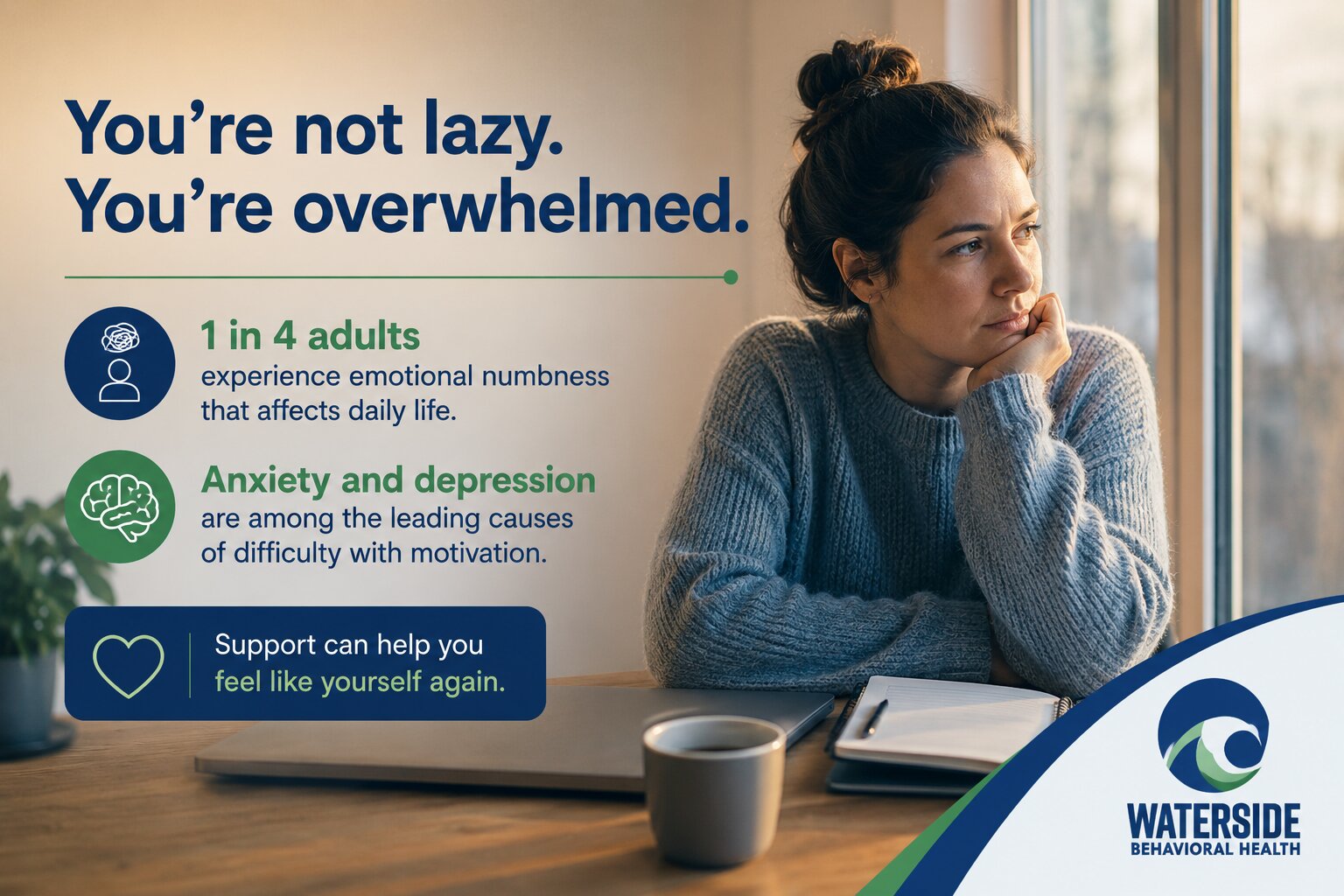
What often looks like laziness from the outside is actually emotional depletion on the inside.
Your Brain May Be Trying to Protect You
One surprising fact about emotional numbness is that it can sometimes be your brain’s way of coping.
Human beings are not designed to carry endless emotional pressure without consequences.
Months—or even years—of anxiety, grief, chronic stress, trauma, burnout, relationship conflict, caregiving responsibilities, or constant pressure can gradually overwhelm the nervous system.
When that happens, your brain sometimes shifts into survival mode.
Rather than continuing to experience every emotion at full intensity, it begins turning down the emotional volume.
Unfortunately, it rarely turns down only painful emotions.
Joy.
Excitement.
Curiosity.
Hope.
Those feelings often become quieter too.
Imagine your emotions as the dimmer switch in a room.
Instead of lowering only the harsh lights, the entire room becomes darker.
That does not mean the lights are broken.
It means the system is trying to conserve energy.
The Cycle That Keeps You Feeling Stuck
Many people become trapped in a frustrating cycle.
You wake up already exhausted.
Simple responsibilities feel overwhelming.
Tasks pile up.
You begin feeling guilty.
The guilt makes everything feel heavier.
You withdraw from friends and family because you don’t know how to explain what’s happening.
The isolation increases the emotional burden.
Then the cycle starts all over again.
Over time, this pattern can become so familiar that it feels permanent.
It isn’t.
The cycle can be interrupted.
Often, the first step is recognizing that what you’re experiencing deserves compassion instead of criticism.
If your best friend described these struggles, you probably wouldn’t call them lazy.
You’d recognize they were struggling.
You deserve that same kindness.
It May Be Time to Look Beyond Stress
Stress usually improves after the stressful situation passes.
Emotional numbness that continues for weeks—or begins affecting work, relationships, sleep, hygiene, eating habits, or daily responsibilities—deserves attention.
This is also when many individuals begin recognizing other signs of depression adults may experience.
Depression is often misunderstood.
Many people picture someone crying constantly.
In reality, depression can appear much quieter.
It can look like:
- Feeling emotionally flat
- Losing interest in hobbies
- Constant fatigue
- Difficulty concentrating
- Feeling disconnected from loved ones
- Changes in appetite or sleep
- Feeling hopeless about the future
- Struggling to complete basic responsibilities
Not everyone experiences depression the same way.
That is why comparing yourself to someone else’s experience is rarely helpful.
What matters most is noticing how dramatically your own life has changed.
What Happens When You Reach Out for Help?
Many people delay getting support because they fear what treatment might involve.
Some imagine being judged.
Others worry someone will immediately tell them they need hospitalization or medication.
In reality, seeking help often begins with something much simpler.
A conversation.
Someone listens without rushing you.
Questions are asked—not to judge you, but to understand what you’ve been carrying.
Together, you begin identifying patterns that may have been invisible while you were living through them.
From there, treatment is tailored to your needs.
Some people benefit from individual therapy.
Others find structured daytime care helpful because it provides routine, accountability, and professional support while they rebuild daily functioning.
Others may explore medication alongside therapy if appropriate.
Many individuals also benefit from evidence-based approaches like care in Massachusetts, where unhelpful thought patterns and behaviors are gradually replaced with healthier ways of responding to life’s challenges.
Healing is not about becoming a different person.
It is about reconnecting with the person you were before emotional exhaustion took over.
Recovery Often Starts Smaller Than You Think
People sometimes imagine recovery as a dramatic breakthrough.
Sometimes those moments happen.
More often, healing begins quietly.
You answer one text message.
You make one healthy meal.
You take one short walk.
You attend one therapy appointment.
You sleep a little better.
You laugh unexpectedly.
Those moments may seem small.
They’re not.
Small victories become routines.
Routines become stability.
Stability creates confidence.
Confidence creates momentum.
Little by little, life begins feeling possible again.
Recovery rarely happens overnight.
But neither did the struggle that brought you here.
Giving yourself permission to heal gradually is one of the greatest acts of self-compassion you can practice.
You Do Not Have to Keep Carrying This Alone
One of the cruelest parts of emotional numbness is how convincing it can be.
It tells you that nothing will ever change.
That you’ve become this way forever.
That everyone else seems to handle life better than you.
Those thoughts often feel true.
They are not facts.
Every day, people who once believed they would never feel motivated again begin rediscovering parts of themselves they thought were gone.
Not because they suddenly became stronger.
Because they stopped carrying everything by themselves.
If you’ve been wondering why life feels so heavy, asking that question is not weakness.
It may be the first step toward feeling hope again.
You deserve more than simply surviving each day.
You deserve the chance to feel present in your own life again.
Frequently Asked Questions
Is feeling emotionally numb a normal response to stress?
Short periods of emotional numbness can happen during times of intense stress or grief. However, if the feeling lasts for weeks, worsens over time, or begins affecting your work, relationships, or daily responsibilities, it may be helpful to speak with a mental health professional.
Why can’t I make myself do simple things anymore?
When emotional health is affected, the brain’s ability to plan, focus, and stay motivated can also change. Tasks that once felt automatic may suddenly require much more mental energy. This does not mean you are lazy or lacking willpower.
Does emotional numbness always mean depression?
Not always. Emotional numbness can be associated with depression, anxiety, trauma, burnout, prolonged stress, or other mental health concerns. A professional evaluation can help identify what may be contributing to your symptoms and recommend appropriate support.
Can therapy help if I don’t even know what’s wrong?
Yes. Many people begin therapy without having a clear explanation for how they feel. Therapy provides a safe place to explore your experiences, understand emotional patterns, and develop practical strategies for moving forward.
When should I seek professional help?
If emotional numbness, lack of motivation, or difficulty completing everyday tasks continues for several weeks, becomes more severe, or interferes with your ability to function, it is a good time to reach out for support. Early care often makes recovery easier and helps prevent symptoms from becoming more overwhelming.
What if I’m nervous about starting treatment?
Feeling uncertain is completely normal. Many people worry they will be judged or pressured into making decisions before they are ready. In reality, treatment usually begins with a conversation focused on understanding your experiences and helping you explore options at a pace that feels comfortable.
Call 774-619-7750 or visit our mental health treatment in Massachusetts to learn more about our mental health treatment in Plymouth, Massachusetts.