

You don’t hit pause on your life.
That’s the unspoken rule you’ve been living by.
So when things start slipping internally—more stress, more drinking, more anxiety, less control—you don’t look for help the way people expect. You look for something that fits around your life.
That’s how you end up here. Quietly researching options like our intensive outpatient programs for behavioral health in Massachusetts, wondering if there’s a version of this that doesn’t require everything to fall apart first.
And underneath all of it, there’s a sharper question:
“Can I fix this without anyone knowing how bad it’s gotten?”
You’re Not Avoiding Help—You’re Trying to Contain the Damage
Let’s be direct.
You’re not in denial. You’re calculating.
- How to keep performing
- How to keep people from noticing
- How to keep your responsibilities intact
So your search becomes strategic:
- Evening options
- Insurance coverage like Blue Cross Blue Shield
- Programs that don’t interfere with your day
That’s how phrases like evening IOP Boston show up in your search history.
It’s not random. It’s controlled.
But control has a cost.
And eventually, the system you’ve built to hold everything together starts to strain.
Why “After Work” Isn’t Just a Schedule—It’s a State of Mind
Evening care sounds simple on paper.
You work all day. Then you go to treatment.
But what most people don’t think about is who you are at 6 or 7pm.
You’re:
- Mentally drained
- Emotionally guarded
- Still carrying the stress of the day
You don’t walk into care as a blank slate.
You walk in mid-battle.
And if the program isn’t designed for that version of you—the tired, distracted, still-in-performance-mode version—you won’t fully engage.
You’ll attend.
But you won’t land.
The Insurance Question (And the Trap Inside It)
Let’s talk about Blue Cross Blue Shield.
Yes, coverage matters. It’s one of the first filters people use—and for good reason.
But here’s where people get stuck:
They pick the option that’s easiest to access…
not the one that’s most likely to help.
And when it doesn’t work, they don’t blame the fit.
They blame themselves.
We see this often:
- You choose based on coverage alone
- The program doesn’t match your needs or energy
- You disengage
- You conclude that treatment “isn’t for you”
That’s not a failure of motivation.
That’s a mismatch in design.
The Reality of Staying High-Functioning Too Long
From the outside, nothing looks urgent.
You’re still working. Still managing. Still showing up.
But internally, the pressure builds:
- You need more to unwind at night
- You’re shorter with people you care about
- You feel like you’re always “on,” even when you’re exhausted
And the hardest part?
You don’t have a clean breaking point.
Just a slow erosion.
It’s like running a machine past its limits—it doesn’t explode right away. It just starts wearing down in ways that are harder to ignore over time.
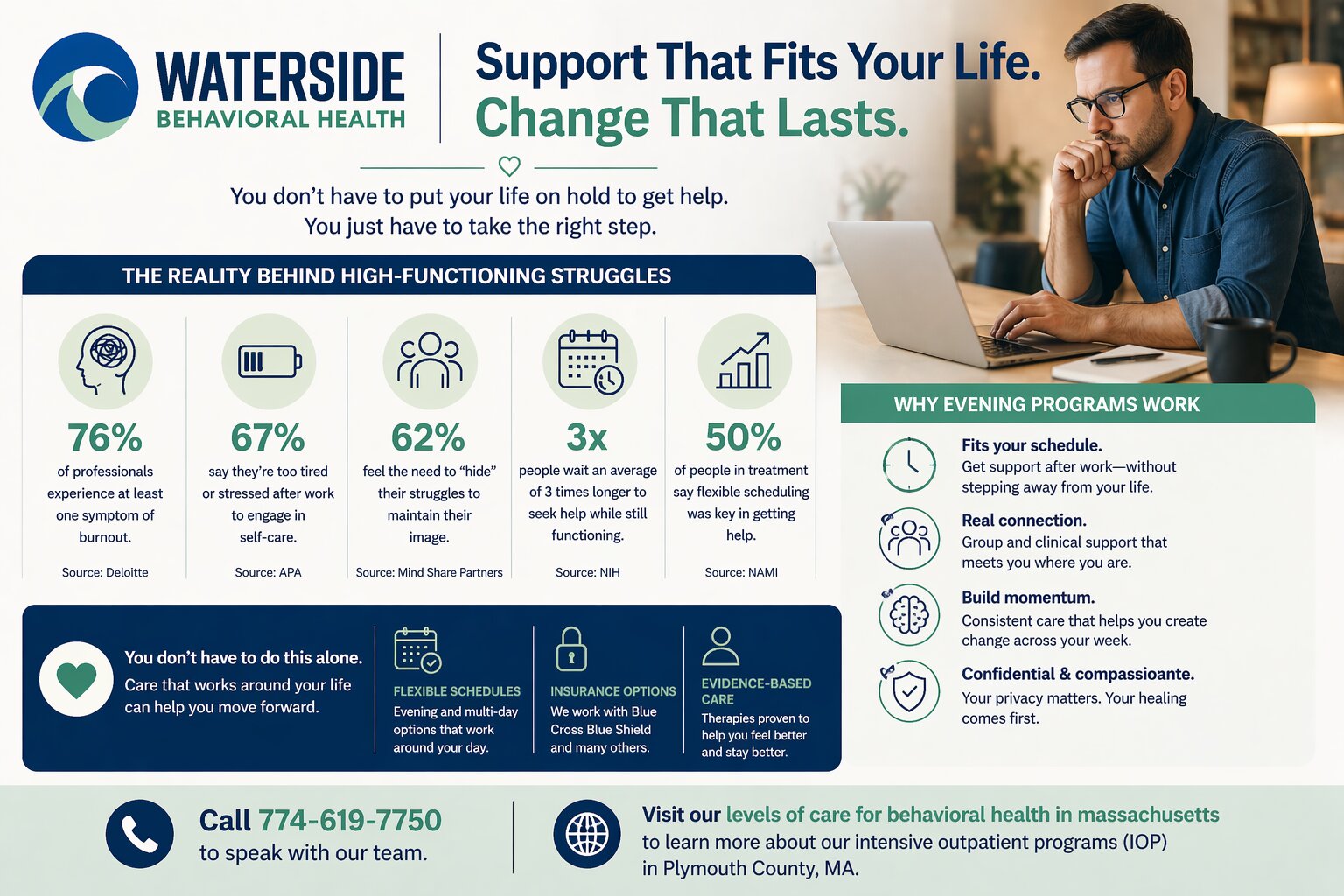
What Actually Makes an Evening Program Worth It
If you’re considering this level of care, here’s what separates something that works from something you quietly walk away from:
It Accounts for Your Exhaustion
You shouldn’t have to “power through” treatment after a full day.
The environment should meet you where you are—not expect you to show up fully energized.
It Doesn’t Let You Stay on the Surface
High-functioning people are good at staying just deep enough to look engaged.
A strong program gently—but firmly—pushes past that.
Not aggressively. But consistently.
It Builds Momentum Across Your Week
This isn’t just about talking through things and going home.
It’s about creating continuity:
- What you learn carries into your next day
- What you notice gets revisited
- What you avoid doesn’t get skipped forever
That’s where change actually happens.
It Balances Flexibility With Accountability
You need a schedule that fits your life.
But you also need structure that keeps you from slipping out when things get uncomfortable.
Too rigid, and you burn out.
Too loose, and nothing sticks.
The right balance keeps you in it.
Why People Like You Leave Early (And Don’t Talk About It)
Here’s the truth most people won’t say out loud:
High-functioning individuals often leave care quietly.
Not dramatically. Not in conflict.
Just… gradually.
Because:
- It feels like one more obligation
- You don’t feel immediate results
- You’re not used to being in spaces where you’re not in control
So you pull back.
And then you tell yourself:
“I tried. It didn’t really help.”
But most of the time, it’s not that it didn’t help.
It’s that it didn’t reach you in the right way.
There Is a Version of This That Fits Your Life
You don’t need to disappear from your responsibilities to get help.
But you also don’t need to keep forcing yourself to function at this level without support.
The right program fits into your life and challenges the patterns that are keeping you stuck.
If you’re looking for real care in Massachusetts, it exists in forms that respect both your responsibilities and your limits.
And if you’re exploring different treatment options in Massachusetts, taking your time to find the right fit isn’t hesitation—it’s awareness.
The Decision Isn’t “Whether”—It’s “How”
At this point, you probably already know something needs to change.
The real decision isn’t if you should get help.
It’s how you do it without losing everything else in the process.
That’s a different kind of question.
And it leads to better answers.
FAQ: What High-Functioning Professionals Usually Ask
Can I actually keep working while doing evening care?
Yes. That’s the point of evening structure. But it will require energy—and honesty about your limits.
Will my insurance like Blue Cross Blue Shield cover this?
In many cases, yes. Coverage varies, but many structured outpatient options are partially or fully covered. Verification is always the next step.
What if I’m too tired to engage after work?
That’s a real concern. The right program will account for that and adjust pacing so you can still participate meaningfully.
Do I have to tell my employer?
Not necessarily. Many people manage care privately, depending on their schedule and needs.
What if I start and can’t keep up?
That’s more common than you think. The goal isn’t perfection—it’s finding a structure you can realistically stay with.
How do I know if it’s the right fit?
You’ll feel it. Not instantly—but over time. You’ll notice whether you’re actually engaging, or just attending.
You don’t have to keep holding everything together by yourself.
There’s a version of support that fits your life—and actually helps.
Call 774-619-7750 or visit our levels of care for behavioral health in massachusetts to learn more about our levels of care for behavioral health in Massachusetts, intensive outpatient programs iop for behavioral health in Massachusetts services in Plymouth County, MA.