

Maybe you’ve always felt like your brain was turned up too loud.
Not broken. Not wrong. Just loud.
You sense everything. You think in images, or music, or feelings. You make things that don’t have words yet. You create because you have to—not because it’s fun, but because it’s how you survive.
And now someone’s telling you to start therapy. Maybe take medication. Maybe slow down.
And inside your head, a fear rises:
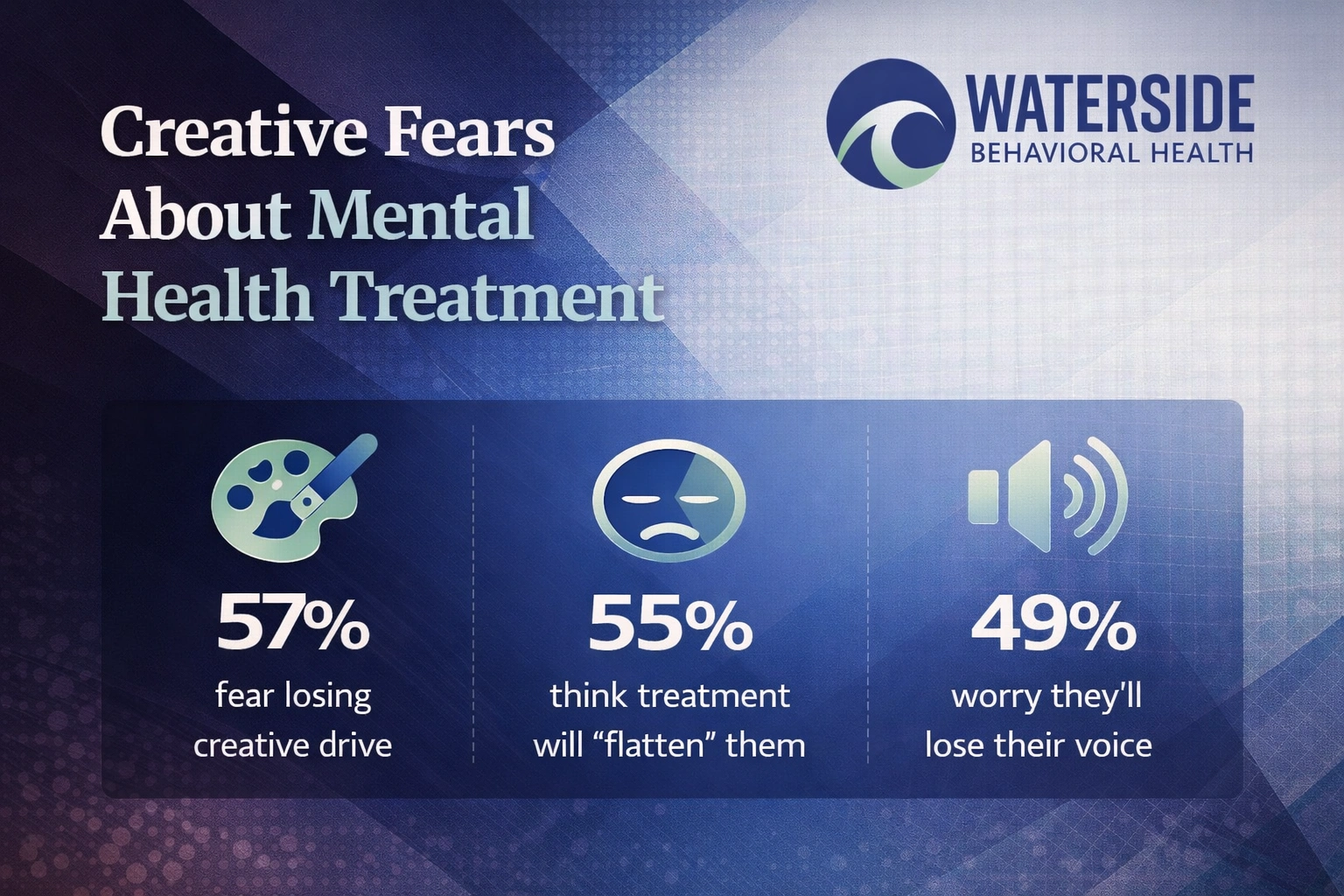
If I go into mental health treatment… will I lose the very thing that makes me who I am?
We want you to know this, first and clearly:
Mental health treatment isn’t here to silence your voice. It’s here to help you hear it without all the static.
And if that voice is tied to your creativity, your queerness, your neurodivergence, your cultural identity—it still belongs. It doesn’t get edited out of the process.
This blog is for the ones who fear that healing will make them boring. The ones who are deeply afraid they’ll disappear. The ones who’ve always felt like they’re too much and not enough—at the exact same time.
Let’s walk through what care can look like when you’re scared it’ll cost you your self.
The Fear: “If I’m Not Struggling, Will I Still Be Creative?”
This fear is so real.
If your art came alive in the middle of breakdowns, late nights, panic, or grief… then yeah, peace might feel like the death of something sacred.
It’s easy to confuse intensity with depth. And sometimes the crash of emotions does bring something urgent and raw. But you don’t have to live on the edge of a cliff to access your creativity.
The truth is: pain can fuel the work. But healing gives it direction.
In clinical spaces, we often see clients discover that the art they made from chaos was real—but the art they make from stability is sustainable.
You don’t have to bleed for every piece you create.
The Lie: “Treatment Will Flatten Me Out”
Let’s talk about this. Especially around medication.
You might imagine meds turning you into a blank version of yourself. No highs, no lows. No spark. Just beige.
That’s not the goal—and it’s not what happens when the process is done right.
The goal is to reduce the symptoms that get in your way:
- The thoughts that loop and loop and loop
- The body that won’t sleep
- The panic that comes out of nowhere
- The dark fog that makes joy feel like a rumor
The right treatment doesn’t turn you into someone else. It helps you feel like yourself again—without fighting every minute to hold it together.
And no, you don’t have to say yes to meds. You get to explore, ask questions, and say no. A real therapeutic partnership respects your agency.
The Truth: Your Voice Is Still Yours
We’ve worked with clients who said:
- “I’m scared therapy will make me too normal.”
- “If I stop spiraling, what if I stop making art?”
- “What if this pain is the most interesting thing about me?”
And we get it. Especially if you grew up feeling misunderstood or only noticed when something was wrong.
Here’s what we offer back:
You’re allowed to keep your voice. You’re allowed to be intense. You’re allowed to cry in metaphor or scream in poetry. You can bring your whole weird, beautiful, layered self to treatment—and it will be met with care.
Our job as clinicians is not to flatten. It’s to witness. To support. To clear away what hurts so you can stay fully present in what’s true.
Therapy Isn’t About Explaining Yourself in Bullet Points
You don’t have to have a “clear narrative.” You don’t have to say things the “right” way. You don’t have to decode your own mind just to be taken seriously.
If you speak in loops, we’ll track with you.
If you talk through colors, music, images—we’ll meet you there.
If your pain comes out sideways, we’ll help you turn toward it.
Good mental health treatment—especially with providers trained in working with creative, identity-focused clients—makes room for complexity. We won’t rush your process or pathologize your personality.
You can be poetic and be in pain. Both can be true. And both can be supported.
You’re Not a Project. You’re a Person.
You don’t need to be “fixed.” You need to feel safe enough to stop bracing.
And when that happens, something wild occurs: your mind starts making space for more than survival.
We’ve seen clients say things like:
“I thought the anxiety was part of my genius. Turns out it was just noise.”
“I’m still me. I just have more capacity now.”
“I can finish a piece now. Not just start and burn out.”
That’s the shift. Not a personality transplant. Just a return to your own rhythm—with less static, more breath, and more choice.
And in Plymouth County, Massachusetts, we’ve seen more and more people embracing that possibility—not as a loss of identity, but a deepening of it.
You Don’t Need to Explain Your Identity to Get Care
This one matters. Especially for queer, trans, BIPOC, neurodivergent, or culturally layered individuals.
So many people hesitate to seek mental health treatment because they’ve been forced to translate themselves. They’re tired of being misunderstood—or worse, minimized.
At Waterside Behavioral Health, we believe your identity is not a barrier to care—it’s part of what shapes your experience. We offer culturally responsive, affirming, and collaborative care.
Whether you’re exploring your gender, holding spiritual tension, processing generational trauma, or just trying to feel seen—we’ll honor the full picture.
If you’re seeking treatment options in Massachusetts that don’t erase your background or your brilliance, know that we’re here for it.
You Don’t Need to Feel Ready
Still feel unsure? Good. That’s actually a sign that you’re thinking deeply—and that matters.
You don’t have to feel “ready.” You just need to be curious. Even a little.
You can start small:
- A phone call
- A single session
- A journal page you read aloud
- A question about meds you’re not ready to take
Mental health treatment doesn’t require certainty. It welcomes honesty.
FAQs for Creatives in Mental Health Treatment
What if my creative process depends on my emotional intensity?
We help you explore which parts of your intensity are useful—and which are painful. You can keep your creative edge without constantly feeling on edge.
Can I say no to medication?
Yes. You’ll never be forced into meds. We offer information, options, and space for you to decide what feels right.
Will I have to change who I am?
No. You don’t need to change your identity, expression, or style to benefit from treatment. You’ll be supported as you are.
Is there support for LGBTQIA+ clients?
Yes. We provide affirming care for queer, trans, and nonbinary clients, with clinicians who understand the intersections of identity and mental health.
Can I bring up spiritual or cultural parts of my story?
Absolutely. These parts of your experience matter, and we honor them in treatment.
What if I live outside the city?
Our programs support clients in urban, suburban, and rural areas. For example, we’ve worked with many people in Bristol County, Massachusetts who’ve accessed both in-person and virtual services.
Distance should never be the thing that keeps you from care.
Let’s Clear the Noise—Not Mute the Music
If the voice in your head says, “This is who I am—don’t take it from me,” we get it.
We won’t.
We’re here to protect the part of you that feels deeply, thinks vividly, and creates wildly. And we’re also here to help you suffer less while doing it.
Call 774-619-7750 or visit our mental health treatment in Massachusetts to learn more. Let’s turn down the noise—so you can hear yourself clearly again.