

You’ve been managing.
Some days better than others. Some nights are sleepless. Some mornings you push through with a smile that feels just a little thinner than it used to.
Maybe your anxiety feels louder. Or you’ve noticed your energy is always drained—even after rest. Maybe you’re tired of snapping at people you care about, tired of pretending things are fine, or just tired of being tired.
But something’s different now. You’re not brushing it off. You’re not just googling symptoms.
You’re reading this because, deep down, you know: it’s time.
This guide was written for you—the person who knows they need support but isn’t quite sure what mental health treatment actually involves. Not the stereotypes. Not the TV version. The real, human version.
At Waterside Behavioral Health, we help people in Plymouth County and beyond take their very first steps into therapy—and we never forget how brave that first step really is.
What Is Mental Health Treatment?
Mental health treatment is the care and support provided to help people navigate emotional pain, mental health conditions, or just the feeling of “not being okay.”
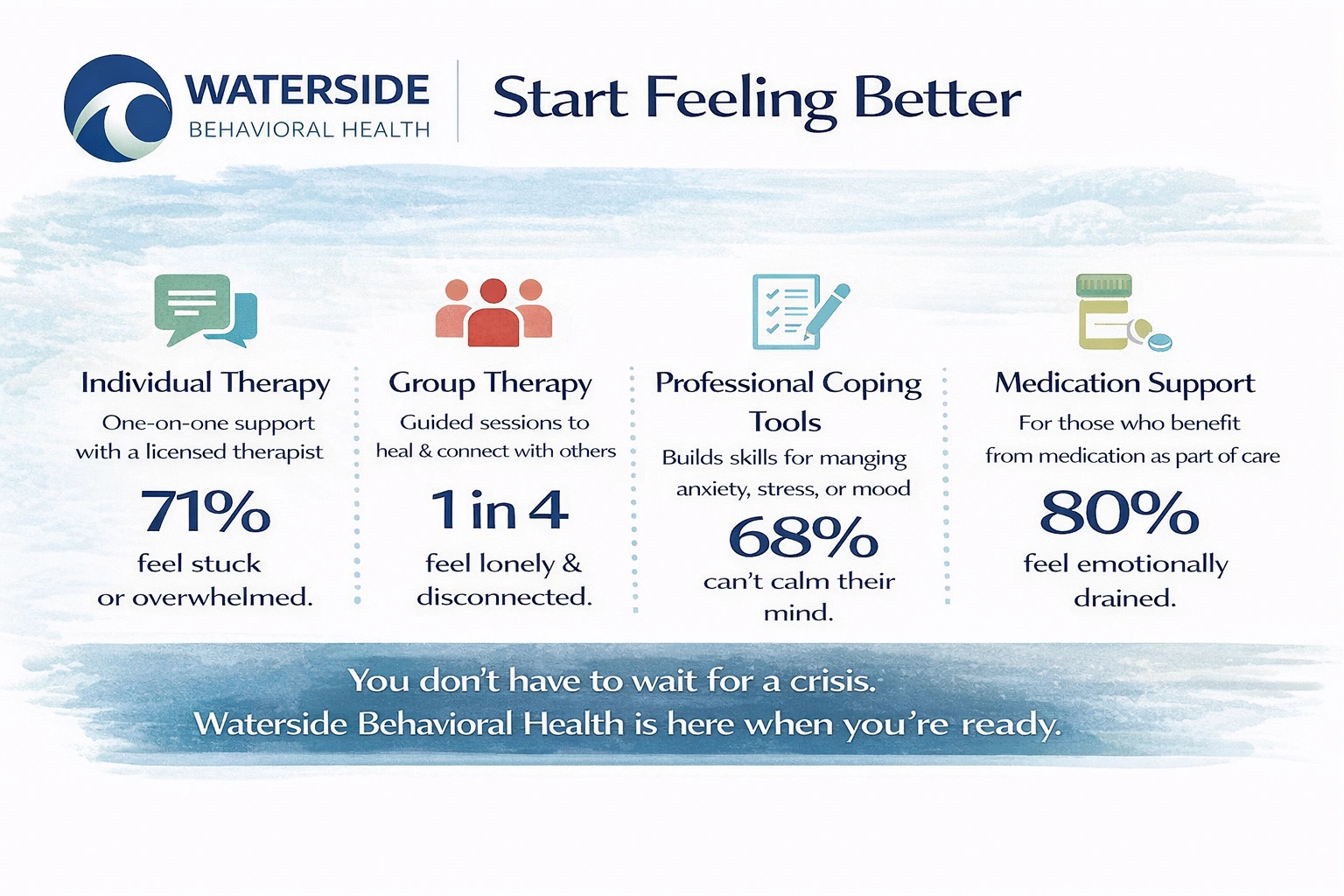
It’s not one-size-fits-all. At Waterside, treatment might include:
- Individual therapy: Private sessions with a licensed therapist
- Group therapy: Guided spaces where people learn from and support each other
- Medication support: When needed, prescribed and managed responsibly
- Coping tools: Practical strategies for managing thoughts, emotions, and behavior
- Family involvement: If helpful, we can include loved ones in parts of the journey
More than anything, mental health treatment is a relationship. A safe, nonjudgmental place to unpack what’s weighing you down—and learn how to carry it differently.
Who Is It For?
One of the biggest myths about therapy is that you have to be in crisis to start.
You don’t.
People begin treatment for all kinds of reasons:
- They’re feeling overwhelmed or emotionally stuck
- They’re struggling in their relationships
- They’re processing a big change—grief, divorce, career shifts
- They’re dealing with trauma, anxiety, depression, or addiction
- They simply want life to feel lighter than it does
If you’re feeling that low-grade sadness, numbness, panic, or burnout that just won’t go away—that’s reason enough. Therapy isn’t about proving how bad things are. It’s about finally giving yourself permission to feel better.
What Will Happen in the First Session?
We know this part feels intimidating. That first appointment often carries a weight all its own. You might worry you won’t know what to say. Or that you’ll say too much. Or that you’ll cry, or not cry, or freeze completely.
That’s all okay.
Here’s what you can expect:
- A warm welcome. No clipboard quizzes or cold stares. Just real people.
- A simple conversation. We’ll ask what brought you in and what you’re hoping to feel or experience through care.
- A few background questions. These help us understand where you’re coming from.
- A plan that fits. We’ll talk about what kind of support might help you—and what next steps feel doable.
There’s no pressure to commit on the spot. We move at your pace, not ours.
How Does Therapy Actually Work?
In the movies, therapy is usually just a quiet person nodding while someone talks on a couch.
In real life, it’s different. Better.
Therapy is a collaborative process. That means your therapist is actively working with you to:
- Understand your thoughts and emotional patterns
- Help you explore how the past may be affecting the present
- Teach strategies for managing overwhelm, panic, or low mood
- Support boundary setting, emotional regulation, and self-trust
- Create a space where you can say the unsayable without fear
Sometimes you’ll leave sessions feeling lighter. Other times, you might leave stirred up—that’s normal too. Growth can feel messy at first. But over time, therapy becomes a steady place you can count on. A place where your inner world doesn’t have to be a secret anymore.
What If I’ve Never Talked About This Stuff Before?
That’s more common than you think. For many of our first-time clients, the things they share in treatment are things they’ve never said out loud before.
You don’t need to be eloquent. You don’t need to have your thoughts organized.
You can cry. You can be quiet. You can say, “I don’t know where to start.”
Your therapist will help you figure it out. You don’t have to carry the conversation. You just have to show up.
And if you’re looking for mental health treatment in Plymouth County, MA, we’re here. From the very beginning.
What If I Start and Then Don’t Like It?
You’re allowed to not click with your first therapist. You’re allowed to change directions. You’re allowed to pause and regroup.
At Waterside, we believe good treatment is rooted in fit and trust. If something isn’t working, we’ll help you adjust—not shame you into staying.
That’s also why we offer guidance to first-timers from nearby areas like Bristol County, helping you explore all your options—not just the first one.
You don’t have to get it perfect. You just have to start.
What Healing Can Look Like (Even in Small Ways)
Healing doesn’t always look like big, dramatic changes. Often, it’s small, powerful shifts.
Clients have told us:
- “I didn’t panic in that meeting—and I usually do.”
- “I didn’t feel the need to explain myself for once.”
- “I actually said what I needed in that conversation.”
- “I felt like I could breathe again.”
That’s the power of mental health treatment. Not erasing your story—but giving you more peace inside it.
First-Time FAQs About Starting Treatment
How long will I need to be in therapy?
There’s no fixed answer. Some people come for a few months. Others stay longer. We’ll help you define your goals—and reassess as you grow.
Do I have to talk about trauma or painful memories?
Not unless you want to. Therapy is a safe space, not a forced one. Some people focus on present challenges and skills. Others explore the past over time.
What if I feel worse before I feel better?
That can happen—and it’s okay. Sometimes, opening up brings tough feelings to the surface. But you won’t face them alone. That’s what we’re here for.
Is this confidential?
Yes. What you share in therapy is private, with a few legal exceptions (which we’ll explain). Your privacy is deeply respected and protected.
Can I do this if I’m already on medication or seeing a doctor?
Absolutely. Therapy can be part of a well-rounded care plan. We’ll collaborate with your medical team if that’s helpful for you.
You Deserve Care That Feels Like a Starting Line—Not a Deadline
You don’t have to prove anything. You don’t have to be perfect, or ready, or even sure.
If you’re reading this, you’re already braver than you think.
At Waterside Behavioral Health, we offer mental health treatment in Plymouth County, MA designed for people taking their very first step toward feeling better. Whether you’re feeling overwhelmed, anxious, flat, or just done with carrying it alone—this is where your next chapter can begin.
Call 774-619-7750 to get started.
You don’t have to wait until it gets worse. You can start now.