

Even when a treatment sounds promising, it’s natural to wonder what it might change in you. For someone newly diagnosed, that fear can be sharp—especially if you already feel like your sense of self is fragile. Maybe you’re worried that healing will make you someone else entirely, or that therapy will “flatten” your feelings.
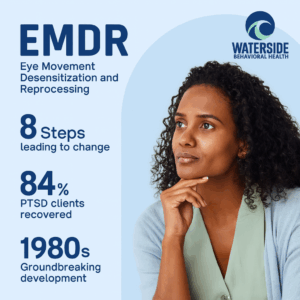
At Waterside Behavioral Health, we believe that understanding each step of EMDR therapy near me can help replace fear with informed choice. This guide walks through the eight phases of EMDR, weaving in what clients often tell us and how each phase supports—not erases—your identity.
1. History-Taking: Mapping Your Story
Before anything else, your therapist will want to know you. This is more than a checklist of symptoms. It’s a chance to share what shaped you—your experiences, your strengths, and the values you want to protect during therapy.
This is where trust begins. You set the pace. You decide what you’re ready to talk about and what needs to wait. Your therapist listens for both the patterns that cause pain and the parts of you that are already resilient.
“It was the first time someone asked me what I wanted to keep about myself—not just what I wanted to change.” – Outpatient Client, 2024
2. Preparation: Building Emotional Safety
Think of this phase as packing a survival kit before a challenging hike. You’re not expected to walk into difficult memories without tools to stay steady. In preparation, you’ll learn techniques to calm your nervous system—breathing exercises, grounding skills, and mental “safe places” you can return to at any time.
For many clients, this step is where confidence starts to grow. You may not be ready to process trauma yet, but you’re learning how to hold yourself steady when the ground feels shaky.
3. Assessment: Choosing the Target
With safety tools in place, you and your therapist will decide which memory, image, or belief to work on first. This “target” might be something from years ago or as recent as last month.
The assessment isn’t about forcing you to relive everything. Instead, it’s about identifying one moment that still feels emotionally charged and mapping out how it affects you—what images, emotions, and body sensations come up when you think about it.
4. Desensitization: Processing the Memory
This is often the phase people imagine when they think of EMDR: using bilateral stimulation—eye movements, tapping, or alternating sounds—while recalling the memory.
It’s important to know that you remain in control the entire time. If something feels too intense, you can pause. Over time, the emotional “spike” connected to the memory begins to fade. You’re not erasing the event; you’re teaching your brain it’s no longer a present threat.
Some clients describe it as “turning down the volume” on a memory that used to feel deafening.
5. Installation: Strengthening the Positive
Once the distress is reduced, your therapist will guide you to focus on a positive belief to replace the old one. For example, “I am powerless” might shift to “I can make choices for myself.”
This isn’t about forcing positivity. It’s about creating a belief that feels true and empowering. The brain learns to associate the once-distressing memory with this new perspective, giving you a healthier way to carry it forward.
6. Body Scan: Releasing What’s Left
Trauma doesn’t only live in thoughts—it lives in the body. Even after the mind feels calmer, there may still be tightness in your shoulders, a knot in your stomach, or a racing heartbeat.
In the body scan, you check for any leftover tension or discomfort. Your therapist helps you release it through grounding, breathwork, or additional EMDR processing. The goal is to leave the memory feeling resolved in both mind and body.
7. Closure: Ending the Session Safely
Even if a memory isn’t fully processed, you won’t be left feeling raw. Every session ends with grounding exercises, reflection, and a sense of emotional closure.
You might leave with a short list of self-care steps to help you feel steady—like journaling, listening to calming music, or spending time in nature. This ensures that therapy fits into your life without overwhelming it.
8. Reevaluation: Checking Your Progress
At the start of your next session, you and your therapist revisit the memory to see if any emotional charge has returned. Sometimes, additional processing is needed. Other times, the memory now feels distant, even neutral.
This phase also gives you a chance to notice other areas of life that feel different. Clients often share that they’re sleeping better, feeling less anxious, or approaching challenges with more calm—even if those weren’t the original focus of therapy.
If you’re looking for EMDR therapy near me in Plymouth County, MA, knowing that your therapist will check in every step of the way can help you feel less like a passenger and more like a partner in the process.
Why This Matters for the Newly Diagnosed
For someone scared that therapy—or medication—will take something away from them, EMDR offers a deeply collaborative process. Each phase centers your autonomy. You decide what to work on, when to pause, and how far to go.
It’s not about erasing who you are. It’s about helping you feel safe in your own mind again—so you can keep the parts of yourself you love, and free yourself from the parts that still hurt.
FAQ: EMDR Therapy Near Me
1. How long does EMDR take?
The number of sessions varies based on your history and goals. Some people notice shifts in just a few sessions, while others benefit from longer-term work.
2. Is EMDR safe?
Yes, when provided by a trained clinician. Your therapist will ensure you have emotional safety tools before processing any difficult memories.
3. Can EMDR work if I don’t remember everything about a trauma?
Yes. EMDR can target the feelings, sensations, or fragments you do recall. You don’t need a perfect memory of the event.
4. Will I lose parts of my identity?
No. EMDR is about integrating your experiences so they no longer control you—not changing your personality or creativity.
5. Is EMDR available in my area?
If you’re in Massachusetts, you can explore our EMDR therapy near me in Plymouth County or in nearby Bristol County.
Call 774-619-7750 or visit our EMDR therapy page to learn more about our emdr therapy near me services in Plymouth County, MA.